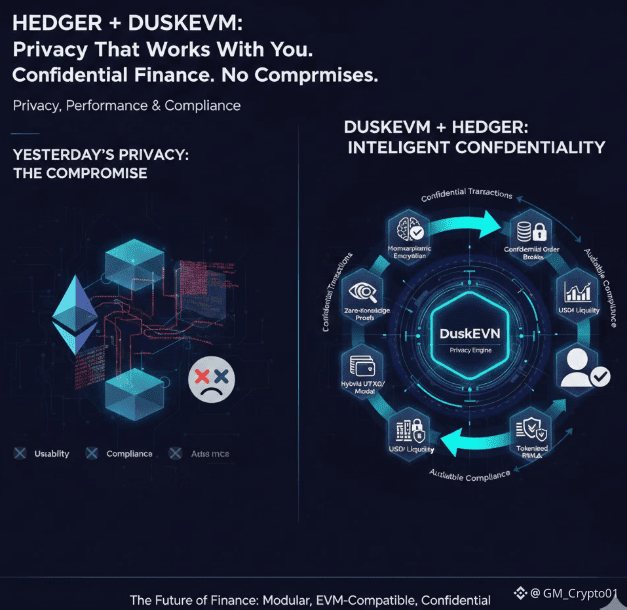
For years, privacy in crypto has been an afterthought. Early decentralized finance systems were built for transparency, and while openness created trust, it also created real risks. Every transaction, every balance, every transfer could be seen by anyone. Traders, institutions, and even everyday users were forced to reveal strategies, holdings, and positions. Early privacy solutions tried to fix this, but they often created bigger problems: they were difficult to integrate, slow, and incompatible with the tools developers already relied on. Hedger, the new privacy engine for DuskEVM, takes a completely different approach. It does not ask anyone to compromise. Privacy is built into the system from the ground up, while still being fast, usable, and compliant.
Privacy in finance is not just a nice-to-have feature. For regulated markets and enterprises, confidentiality is essential. It protects strategies, builds trust, and allows businesses to operate securely. Most blockchains today ignore this reality. Platforms like Ethereum expose nearly everything. For businesses and institutions, that level of transparency can be dangerous. Hedger changes this. It allows transactions to remain confidential while still being fully compatible with the tools and workflows developers already use.
Hedger is designed for the account-based model of the EVM, which is how most modern DeFi and smart contract systems work. That makes it different from older privacy engines built for UTXO-based systems. This isn’t just a technical choice; it’s a design philosophy. Account-based blockchains are where developers build today, and Hedger fits naturally into that world. Developers can deploy contracts, manage assets, and use privacy without having to learn completely new systems. Privacy is no longer an afterthought; it becomes part of the foundation.
At the heart of Hedger is a clever combination of cryptography. Sensitive data can be processed without ever revealing it. Computations are verified without exposing private inputs. And the system works across different blockchain layers. This combination ensures that privacy and compliance do not fight each other. In fact, they reinforce each other. Confidentiality can exist alongside auditability.
The real power of Hedger becomes clear when looking at real-world applications. Take institutional trading. Public order books reveal intentions and strategies, leaving large traders vulnerable to manipulation. Hedger enables confidential order books, allowing big trades to happen without exposing strategy. Ownership and balances remain encrypted end-to-end, but regulators can still audit when necessary. Privacy no longer conflicts with oversight; it supports it.
Hedger is also fast and usable. Generating proofs happens in the browser in under two seconds, which means users can transact quickly without waiting, developers can integrate privacy without headaches, and regulators can verify activity without friction. Speed and convenience no longer have to be sacrificed for confidentiality.
Beyond individual transactions, Hedger changes the way we think about on-chain finance. Institutions can now integrate tokenized real-world assets, digital securities, and other financial instruments into a single framework where privacy, compliance, and usability coexist. Liquidity flows efficiently and safely, with USDf providing access without forcing asset liquidation. Capital can be productive while staying confidential. Yield emerges naturally from design, not from constant trading.
This approach reflects a broader maturity in the crypto world. Many platforms are still chasing hype, short-term incentives, or flashy demos. Hedger and DuskEVM focus on real-world readiness: building systems that support regulated activity, enterprise workflows, and long-term strategic capital. This is not marketing; it is infrastructure that works for the people and institutions who actually use it.
Privacy is no longer optional. It is not just for enthusiasts or niche projects. With Hedger, privacy is the default. Developers can build applications that respect confidentiality. Users can transact with confidence. Enterprises can adopt blockchain safely. Hedger changes the conversation from “can we hide information on-chain?” to “privacy is how the system works.”
Ultimately, Hedger is more than a privacy engine. It is a vision for the future of blockchain finance. Confidentiality, compliance, and usability no longer compete—they form the foundation of next-generation financial systems. Liquidity flows without forced compromise. Yield emerges naturally from structure. Privacy is not a feature; it is a principle. DuskEVM, powered by Hedger, shows that on-chain capital can operate securely, intelligently, and productively, setting a new standard for how decentralized finance can work in the real world.