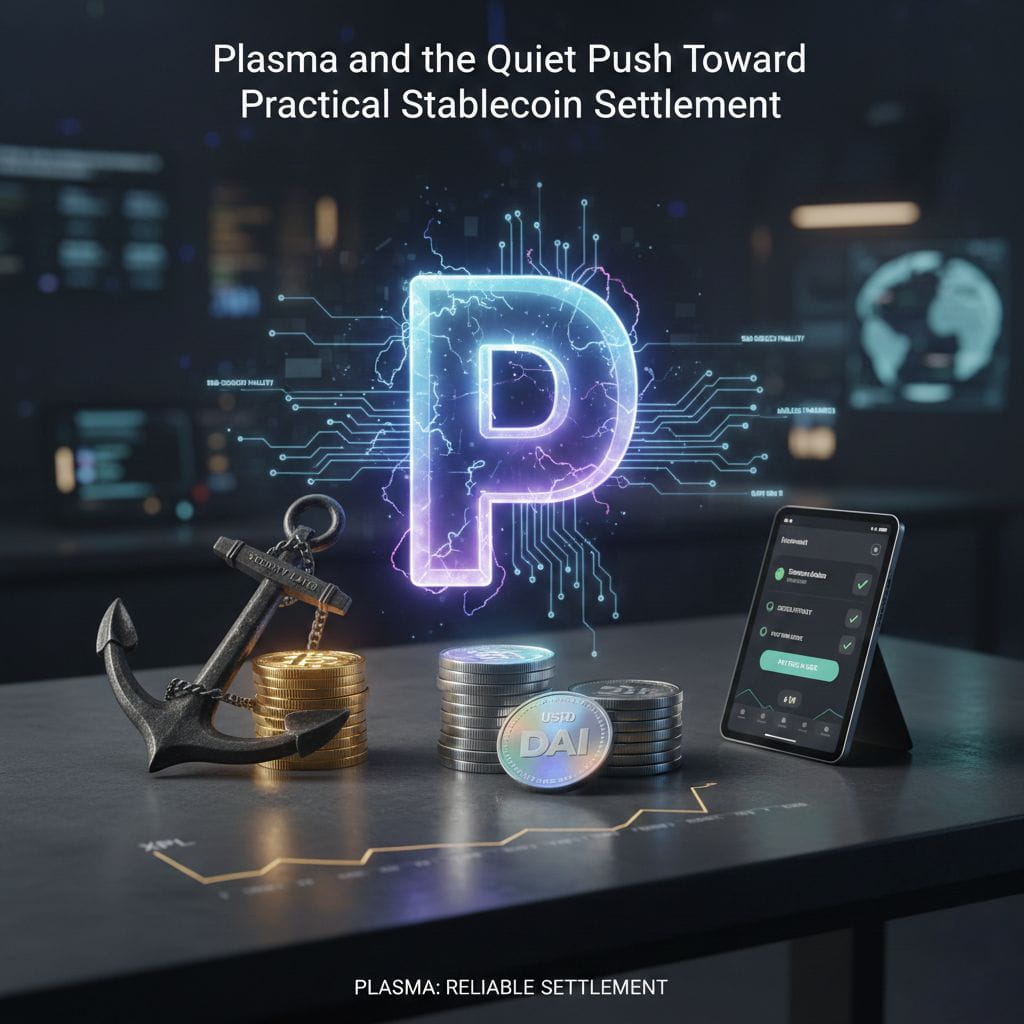
In crypto it is easy to get distracted by loud promises and bold slogans. Every new network claims to be faster cheaper and more revolutionary than the last. Over time most readers learn to filter that noise and focus on something simpler. Does this system solve a real problem and does it do so in a way that feels sustainable rather than flashy. Plasma enters the market with that exact question hanging in the air. It presents itself as a Layer 1 chain built mainly for stablecoin settlement and payments. Not as a general playground for every possible experiment but as a piece of financial plumbing that is meant to work quietly in the background.
The core idea behind Plasma is straightforward. Stablecoins already move billions in value each day. People use them for transfers remittances trading and treasury operations. Yet the networks that carry these coins were not designed only for that task. Fees can spike. Finality can take longer than users expect. And new users still struggle with the idea that they must hold a separate token just to pay for basic actions. Plasma tries to narrow its focus and build a chain where stablecoin use is not a side feature but the main design target.
Technically the network stays close to what developers already know. Plasma runs a full EVM environment powered by a modern Ethereum client written in Rust. That choice signals restraint rather than radical reinvention. Smart contracts and tools that work in Ethereum can be brought over with little friction. For builders this matters more than bold architecture charts. It reduces cost and lowers the risk that teams will face strange edge cases when deploying real products.
Where Plasma pushes further is in settlement speed and payment flow. Its consensus system aims for sub second finality. In plain terms that means transactions should become final almost as soon as they are confirmed. For payment use cases this is not a luxury feature. Merchants and service providers care about certainty far more than raw throughput numbers. Waiting many seconds for a transfer to settle may not sound serious in trading but it feels very different when someone is standing at a counter or moving payroll funds.
Another part of the design is the option for gasless stablecoin transfers. Plasma wants basic USDT movements to happen without forcing users to hold a native token. The protocol itself can sponsor these fees under specific rules. This sounds simple but it touches one of the longest standing usability problems in crypto. New users rarely understand why they need two assets just to move one. Removing that step could make stablecoin wallets feel closer to normal payment apps rather than blockchain tools.
Plasma also supports paying transaction fees in approved assets including stablecoins themselves. This stablecoin first gas model again points to a practical mindset. Instead of insisting that everyone hold a volatile token just to stay active the chain adapts to what users already prefer to keep in their accounts. It does not remove the native token from the system but it lowers the surface area where casual users must think about it.
Security is another area where Plasma takes a careful tone. Alongside its own validator set the network plans to anchor parts of its state to Bitcoin. This does not mean every transaction lives on Bitcoin but rather that checkpoints are recorded there to make large scale history changes harder. The message is subtle. Plasma is not claiming to replace the most battle tested network in crypto. It is trying to borrow some of that long term stability as an added layer of assurance. Whether this hybrid approach proves efficient at scale is something only time and usage will settle.
From an economic standpoint the network uses a native token called XPL for staking and governance. Validators lock it to secure the chain and earn rewards. Supply and distribution follow familiar patterns with allocations for the community development investors and long term incentives. Fees include a burn mechanism that may offset inflation over time. None of this is exotic and that may be intentional. In a sector that often chases novelty a predictable structure can be a virtue.
The project has already moved beyond theory. A mainnet beta launch and early distribution programs brought real users onto the network. The focus now is on growing activity rather than polishing roadmaps. Plasma highlights integrations with financial protocols and payment focused services to seed liquidity and real transaction flow. The ambition is clear. This is meant to be a settlement layer that institutions and retail users can rely on rather than a chain that only thrives during speculative cycles.
Still a sober view is necessary. Building a new Layer 1 in a crowded field is never easy. Even a focused chain must compete with established networks that already host massive stablecoin volumes. Liquidity tends to stick where it already lives. Regulators continue to shape how stablecoins are issued and used which can affect adoption in unpredictable ways. Plasma may have designed around known frictions but it cannot design around the entire market.
There is also the question of whether specialization becomes a strength or a ceiling. By centering so strongly on payments Plasma risks being seen as narrow if the market shifts again toward more complex financial products or new on chain behaviors. On the other hand that same focus could protect it from chasing trends that fade quickly. In infrastructure boring is often another word for durable.
What stands out most is the tone of the project itself. Plasma does not lean heavily on grand claims about reshaping the world. Its features read like responses to everyday complaints heard from users who actually move stablecoins for work. Fees should be predictable. Transfers should settle fast. Wallets should feel simple. Security should lean on systems that have already survived stress. These are not glamorous goals but they are the ones that decide whether a network gets used five years from now.
Seen through that lens Plasma looks less like a headline grabbing experiment and more like an attempt to refine a specific corner of crypto until it feels almost dull in its reliability. For a market that has matured past its early thrill seeking phase that may be exactly the point.