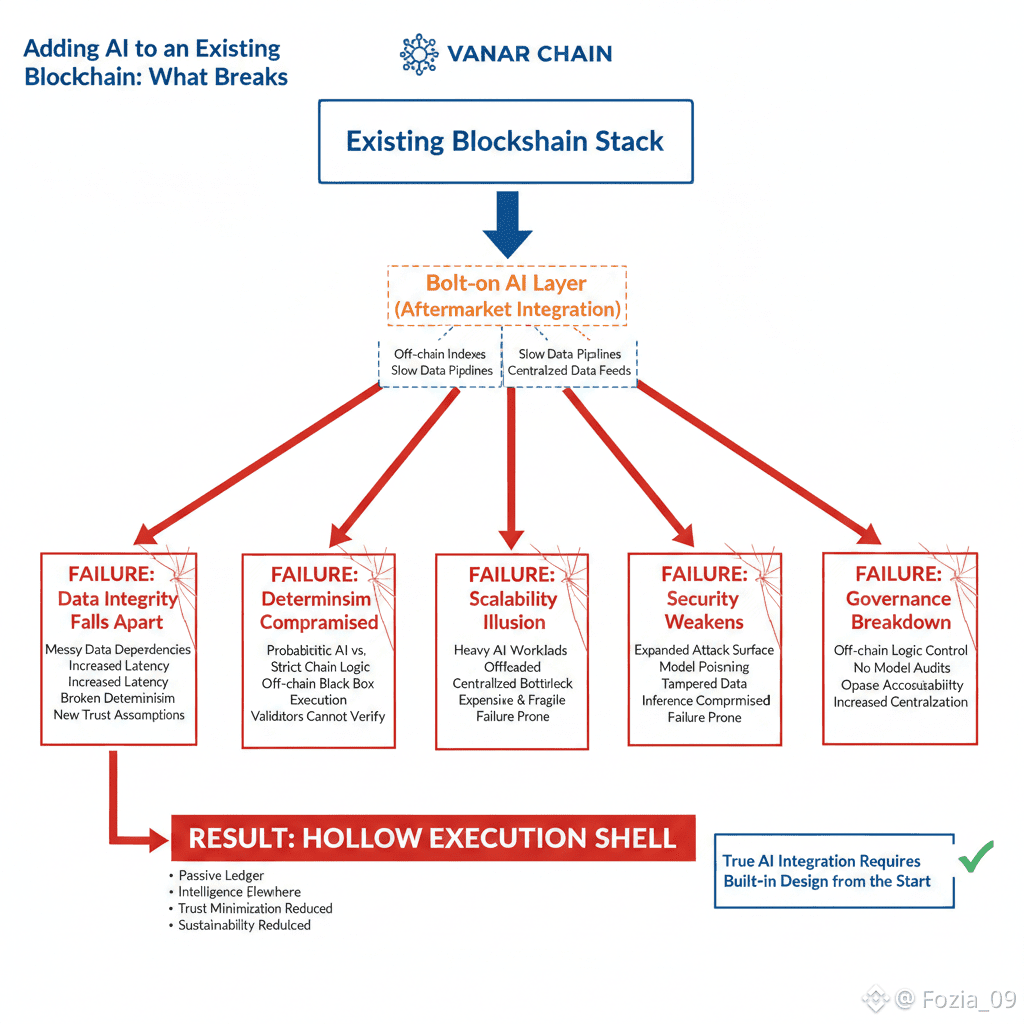
On paper,adding AI to a finished blockchain stack sounds exciting.Teams love to hype up “AI-powered”analytics,smarter routing,or automated governance as easy upgrades.In reality,this approach tends to break more than it fixes.
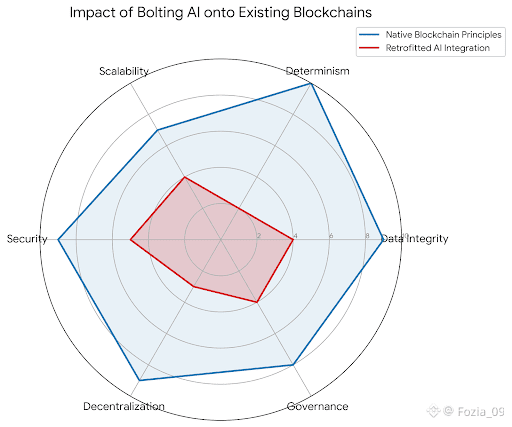
First,data integrity falls apart.Blockchains weren’t built to deliver the kind of clean, structured,real time data that AI systems need.When you layer AI on top,it has to depend on messy off chain indexes,slow data pipelines,or centralized data feeds.All of that means more latency,broken determinism,and ironically new trust assumptions sneaking back in.The very thing blockchains aim to eliminate.
Then there’s determinism.AI models work probabilistically.Blockchains demand strict determinism:same input,same output, everywhere.If you tack on AI logic from the outside,most of the decision making happens off chain and gets pushed back to the chain as“results.”Now you have execution paths that are basically black boxes.Validators can’t independently check them,and consensus guarantees start to fall apart.
Scalability?That’s mostly an illusion.AI workloads are heavy.In these retrofitted setups,you end up offloading AI computations to centralized servers,with the blockchain just recording whatever pops out. It looks efficient,but really,the intelligence layer turns into a bottleneck one that’s expensive,fragile,and a prime target for failure as usage grows.
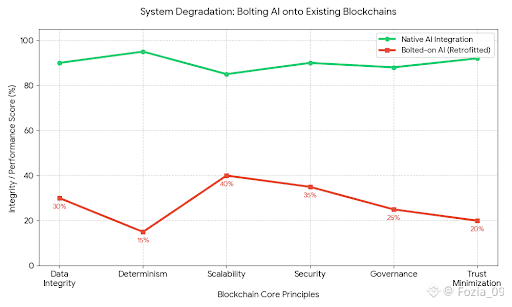
Security gets weaker,too,often without anyone noticing.AI models need constant updates,tuning,and new data.Move those processes off chain,and you multiply the attack surface.Model poisoning,tampered data,compromised inference all real threats. But most blockchain security models aren’t built for this kind of adversary.
And then governance starts to break down.If AI logic is run outside the chain,who controls updates?Who audits the models?Who’s responsible when something goes wrong in an opaque system?Suddenly,you’re making governance decisions the protocol was never meant to handle,and the result is usually more centralization just dressed up as“optimization.”
In the end,when you add AI after the fact,a blockchain turns into a hollow execution shell.The chain becomes just a passive ledger,while all the real intelligence happens elsewhere.Trust minimization,composability, sustainability they all take a hit.
If you want true AI integration,you can’t tack it on later.It has to be built in from the start. Otherwise,you end up with all the downsides of both worlds,and none of the strengths.