
Blockchains are excellent for small secure data like token transfers but large files expose their limitations. Every node must replicate the data fully to ensure consensus which works for kilobytes but explodes costs for larger content such as AI training sets media libraries or corporate archives. On networks like Ethereum a simple video upload can incur fees in the thousands pushing users toward centralized providers that reintroduce trust issues and single points of failure. This replication model stifles innovation in data-heavy applications.
Walrus counters this with its decentralized blob storage system. It enables storage of large unstructured data across a global node network while using Sui for lightweight onchain proofs and metadata. This approach avoids bloating the blockchain with raw files allowing it to focus on verification and ownership.
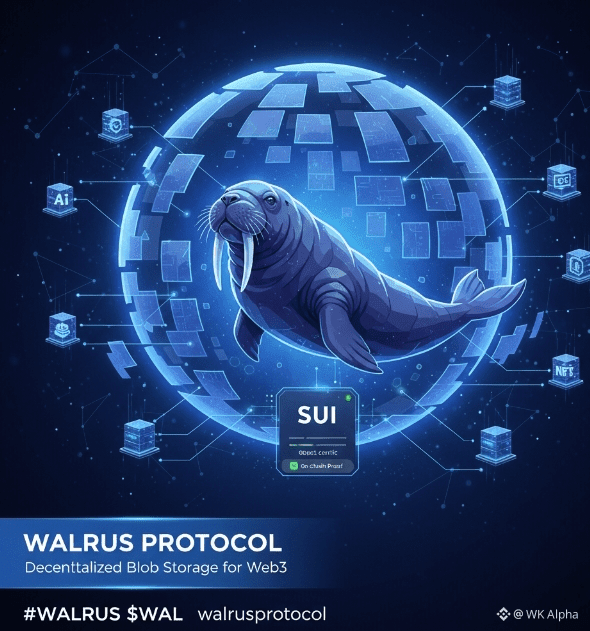
Erasure coding lies at the heart of Walrus's distributed recovery. The protocol divides a file into shards and scatters them over nodes. Reconstruction requires only a subset of shards typically 20 to 30 percent even if a substantial number of nodes are unavailable. Replication is minimal around four to five times the file size making it economical. Onchain mind share is evident in WAL staking volumes on Sui platforms like Cetus where over 1.3 billion tokens are committed to node security driving ecosystem liquidity.
The architecture also ensures privacy and censorship resistance. Blobs are encrypted end-to-end before sharding so no node possesses the complete unencrypted content. The widespread distribution prevents any single actor from censoring or altering data and Sui's proofs allow users to confirm availability without full downloads. This feature is gaining mind share in regulated environments where data sovereignty is paramount.
Walrus is built natively on Sui harnessing the blockchain's object-centric design. Blobs function as programmable objects in Move that can be transferred composed with DeFi protocols or linked to NFTs. Metadata resides on Sui for seamless composability while storage expands offchain independently. This native synergy boosts onchain exposure with WAL governance votes now shaping parameters like fee tiers and node incentives reflecting active community involvement.
This innovation is critical for practical Web3 applications and enterprises. AI developers can store verifiable datasets without central intermediaries mitigating risks of data manipulation. Enterprises can manage vast archives or tokenized assets with built-in resistance to downtime or interference. Social platforms and games benefit from cost-effective persistent storage enhancing user experiences. Mind share continues to build in Sui's $1.4 billion TVL landscape where WAL's utility in staking and payments underscores its role in scalable onchain projects.
Walrus serves as the essential storage layer that bridges Web3's vision to reality without aiming to replace existing chains or clouds.

