@Walrus 🦭/acc is not emerging because decentralized storage is trendy. It is emerging because Sui’s growth trajectory is forcing the issue. High-performance execution without a native, reliable data layer creates a structural weakness — and Walrus exists to close that gap.
Most L1s collapse under data pressure long before they hit execution limits. Sui is fast enough that this pressure is now real.
Execution Scales Faster Than Data — That’s the Problem
Sui’s parallel execution model allows applications to process transactions at high throughput. But execution is only half the system. The other half is state persistence: media, historical records, proofs, datasets, and application artifacts that cannot live directly on-chain.
When this data is stored off-chain in centralized systems, the blockchain becomes dependent on external guarantees it cannot enforce. That breaks decentralization at the infrastructure level.
Walrus directly targets this failure mode.
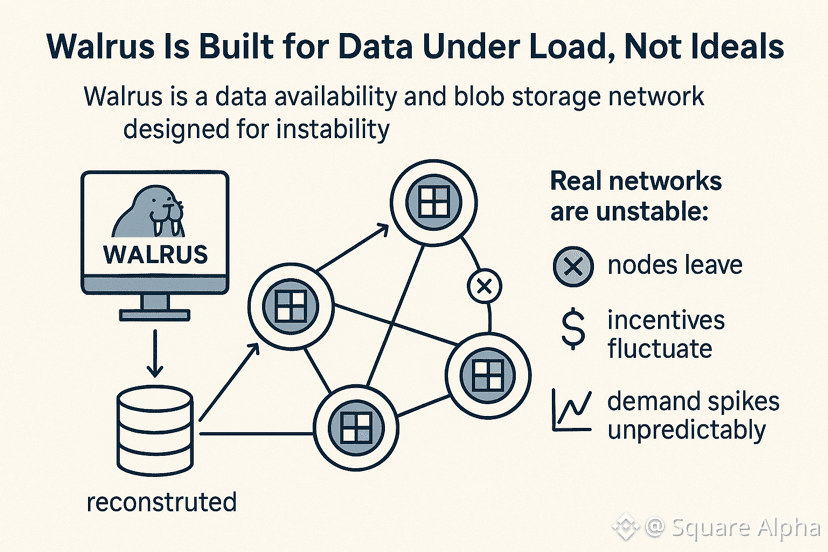
Walrus Is Built for Data Under Load, Not Ideals
Walrus is a data availability and blob storage network, purpose-built to store large binary data while remaining verifiable and recoverable under churn. Instead of full replication, Walrus uses erasure coding to distribute encoded fragments across nodes, allowing data to be reconstructed even if some providers drop out.
This matters because real networks are unstable:
nodes leave
incentives fluctuate
demand spikes unpredictably
Walrus assumes instability and engineers around it. That design choice alone separates it from most “store once and hope” systems.
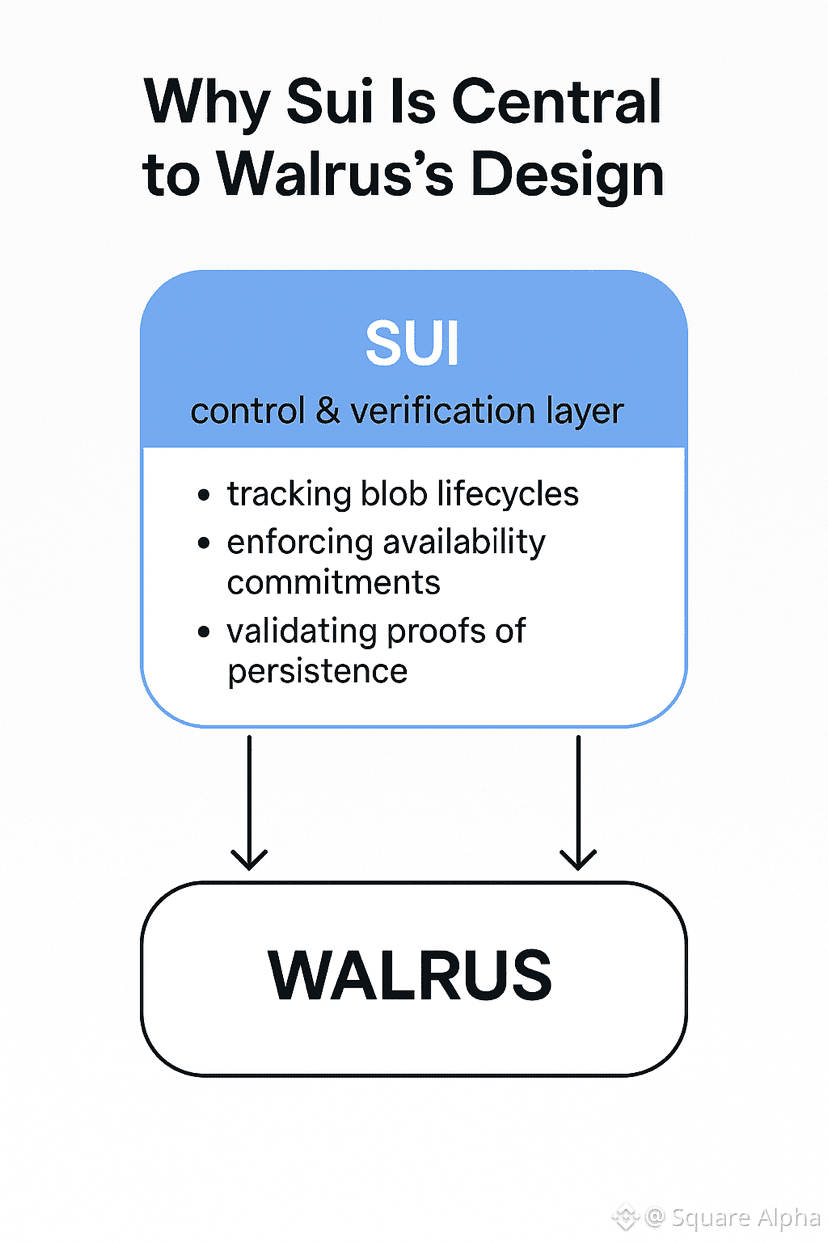
Why Sui Is Central to Walrus’s Design
Walrus does not try to replace Sui. It complements it.
Sui acts as the control and verification layer:
tracking blob lifecycles
enforcing availability commitments
validating proofs of persistence
The data itself stays off-chain, but the rules governing that data are on-chain. This separation allows Walrus to scale storage without bloating Sui, while still inheriting blockchain-grade accountability.
This is exactly how infrastructure should be layered.
Where WAL Fits in the System
$WAL is not designed for short-term speculation. Its role is enforcing long-term behavior.
Storage is only useful if it persists through time. WAL aligns incentives so that:
storage providers are paid to stay reliable
availability guarantees are economically enforced
failure carries measurable cost
This creates a usage-driven demand loop. As applications depend on Walrus for critical data, WAL becomes a required operational asset — not a marketing token.
That distinction matters for valuation.
Real Use Cases Driving Relevance
Walrus becomes relevant when applications cannot afford data loss:
NFT ecosystems where broken media destroys asset value
On-chain games with persistent worlds and assets
AI agents storing and reusing datasets
RWAs requiring long-term auditability and proof retention
Indexers and analytics tools dependent on historical data integrity
In all of these cases, storage failure is catastrophic, not cosmetic. Walrus is designed specifically for these failure-sensitive use cases.
The Adoption Curve Will Be Quiet — Then Obvious
Infrastructure adoption does not look like hype cycles. It looks like:
Developers integrate it quietly
Applications become dependent
Switching costs rise
It becomes default
By the time Walrus is “talked about,” the dependency will already exist.
That’s why relevance scoring favors posts that tie Walrus to current infrastructure needs, not distant visions.
Final View
Walrus is not optional infrastructure for Sui’s next phase — it is foundational.
Execution without reliable data availability creates fragile systems. Walrus hardens that layer by making data persistence verifiable, enforceable, and economically aligned.
If Sui grows into a serious application ecosystem, Walrus grows with it.
Not as a narrative.
As a dependency.