

Upgrading a node in a live blockchain network is one of those things that separates casual participants from real operators. On Dusk, this process is taken seriously because network upgrades are not just “new features” — they are improvements that directly affect performance, stability, security, and long-term scalability. If you are running a Dusk node, keeping it updated is not optional. It’s part of your responsibility to the network, and it’s also the best way to protect your own uptime and consistency as an operator.
The most important thing to understand is why upgrades happen in the first place. A blockchain network is never truly “finished.” As the ecosystem grows, optimizations become necessary. New versions may include better consensus handling, bug fixes, performance tuning, security patches, and compatibility updates. And because nodes power the network, every operator needs a smooth upgrade path that doesn’t break the machine or destroy existing configuration. That’s why Dusk focuses heavily on making upgrades as frictionless as possible.
The upgrade process is centered around a dedicated installer script that can be updated from time to time. This script is designed to run in a non-destructive way, which is a huge deal for node runners. In practical terms, it means the upgrade won’t randomly wipe your system or force a full reinstall. Instead, it only changes what is required for the update. This approach respects the reality of production infrastructure: node runners need predictable behavior, not surprises. Another key point is that the upgrade flow gracefully stops the node software when needed, which prevents corruption, partial updates, or state issues that could happen if services are modified while still running.
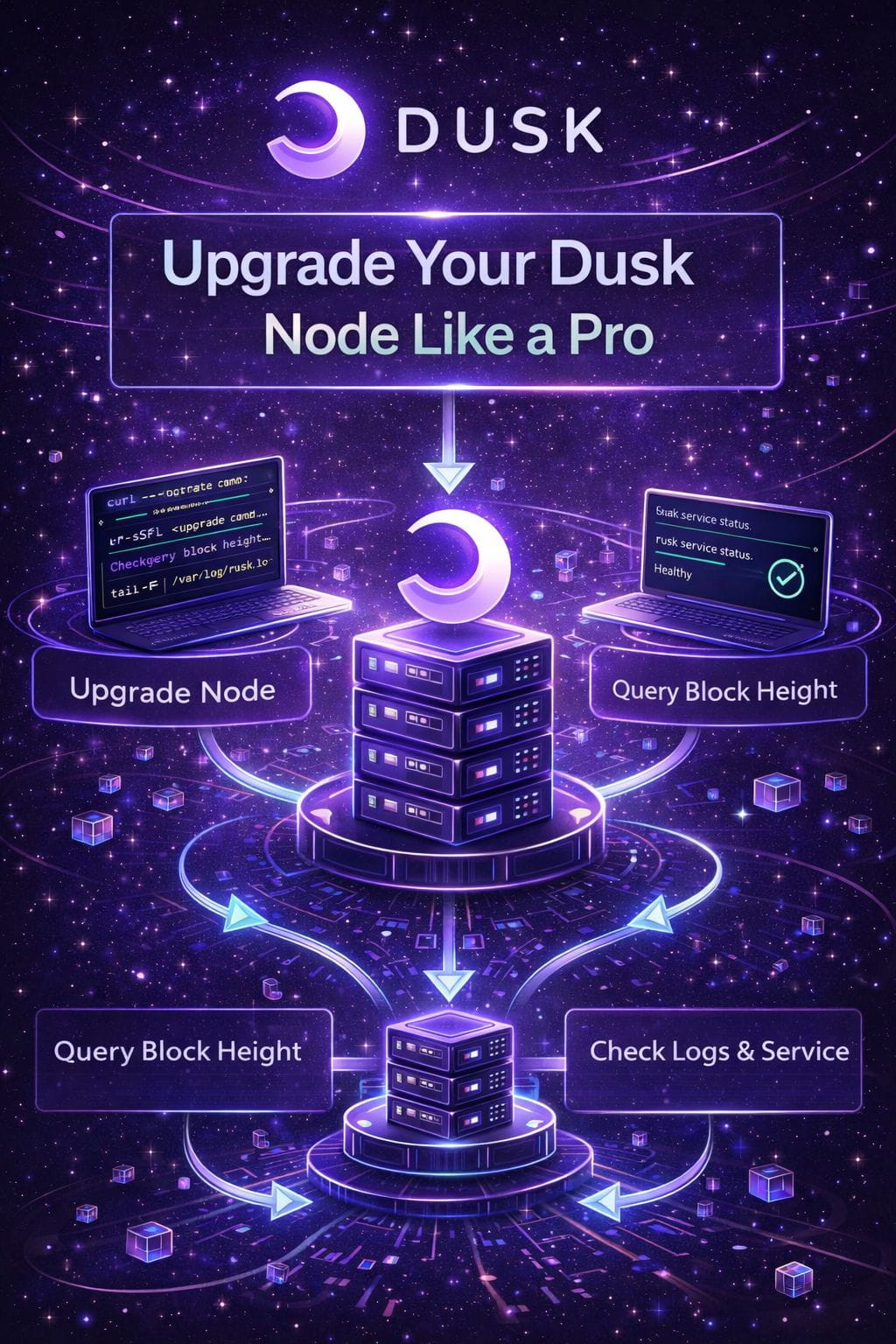
When it’s time to upgrade, the workflow is straightforward but professional. First, you run the main upgrade command to pull and apply the newest mainnet version. This is the core step, and the quality of this step is simple: it should complete without errors. Once the upgrade is applied cleanly, the node service is started again. This restart is not just a technical formality; it’s the moment your node transitions from “updated software” back into “active network participant.” For Dusk, this matters because reliability is the whole point — an upgrade only counts if your node returns to active operation smoothly.
But Dusk doesn’t stop the process there. A strong upgrade process must include verification. And verification is where real node operators stand out, because they don’t rely on “it looks fine.” After restart, the node needs to prove it is functioning correctly and syncing normally. One of the simplest checks is querying the block height multiple times to confirm it is progressing. This is a powerful test because it confirms several things at once: the node is connected, it is receiving data, it is processing new blocks, and it is continuing to follow the chain head.
For deeper confidence, monitoring the logs is the next step. Logs are basically the heartbeat of any node service. Watching the live log stream allows you to confirm that blocks are being created or accepted properly. It also helps you catch subtle problems early, such as peer connection issues, misconfigurations, or service warnings that aren’t fatal but could impact performance later. This is why experienced operators always check logs after major actions. If everything looks normal and block acceptance continues, your node is officially back in business.
You can also check the service status directly, which gives a fast “health snapshot” of your node process. This matters because sometimes a service can start and then silently fail due to missing dependencies, config mismatch, or resource constraints. A quick status check confirms whether the system sees the service as healthy and running, and it adds another layer of confidence to your upgrade routine.
What makes this entire process special is that it reflects the maturity of Dusk as an infrastructure network. Many projects ignore operator experience, leaving upgrades messy, unclear, or risky. Dusk does the opposite. It treats node runners like serious participants and provides a repeatable system that upgrades cleanly, restarts properly, and can be verified using practical, real-world checks. This is exactly the kind of upgrade culture that strong decentralized networks require — because decentralization doesn’t survive on hype, it survives on operators who keep the chain healthy.
If you’re running a Dusk node, the upgrade routine should become part of your standard maintenance mindset. A network that evolves needs operators who evolve with it. And when upgrades are handled properly—clean update, clean restart, verification through block height, logs, and service status—you’re not just maintaining your node. You’re supporting the reliability of the entire Dusk ecosystem.
That’s the operator standard Dusk is pushing for. And honestly, that’s what makes it worth running.
