

Dusk Network isn’t trying to be “just another chain” competing for attention. It’s building something far more structured: a blockchain ecosystem designed for privacy-preserving finance, compliant digital assets, and real-world institutional usage. And one of the most underrated parts of this design is how Dusk splits the ecosystem into multiple network environments, each built for a specific stage of development and testing. When you truly understand how Mainnet, Testnet, and Devnet work together inside Dusk, you start seeing why the project feels more like professional infrastructure than a typical crypto experiment.
The idea behind providing multiple networks is simple: real innovation needs safe environments. On many chains, teams push updates directly into public systems, which creates risk for users and unnecessary chaos for developers. Dusk approaches this like real engineering. It offers separate networks so that every feature, upgrade, and performance optimization is proven before it touches real assets. This is how strong networks build trust over time—by making sure the ecosystem is stable at every layer.
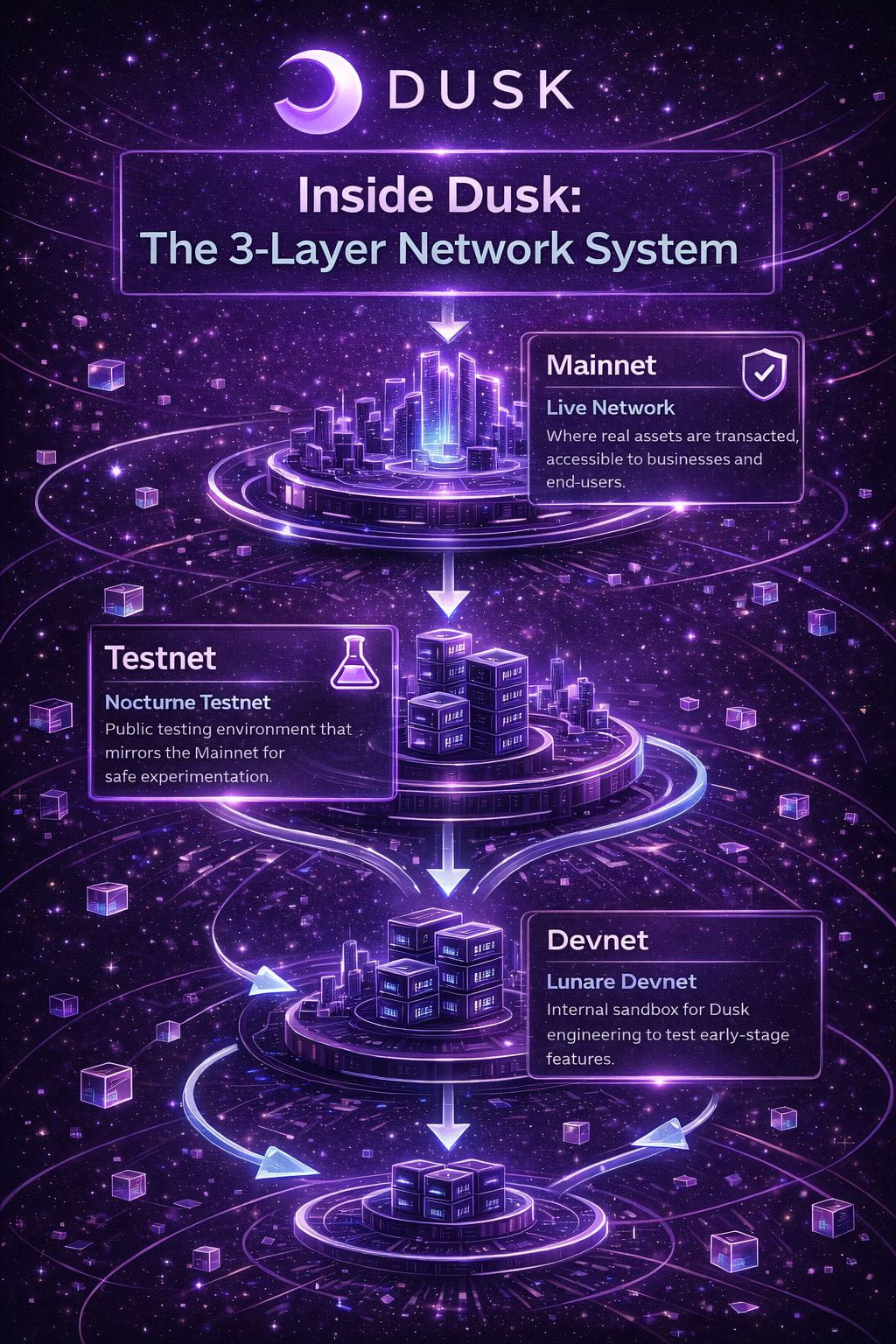
At the top of this structure sits the Mainnet. Mainnet is the live, production-ready environment where the Dusk economy and real transactions take place. This is the network where everything is designed to be secure, compliant, and privacy-preserving, supported by Dusk’s zero-knowledge foundations. Mainnet is also where Dusk’s larger vision becomes visible: decentralized market infrastructure that can support regulated asset settlement, native issuance of digital securities, and post-trade processes that fit real institutional workflows. That means Dusk isn’t only thinking about trading tokens. It’s building a framework where equity-like instruments, debt-style products, and structured financial assets can exist on-chain while still respecting privacy, identity controls, and compliance requirements. In other words, Dusk is trying to solve the hardest version of blockchain adoption—bringing regulated finance on-chain without sacrificing confidentiality.
But no serious network pushes experimental features straight into Mainnet. That’s why Dusk’s test environment becomes so important. The primary public testing environment is the Nocturne Testnet. Nocturne exists as a realistic, risk-free playground where developers and community members can experiment with Dusk’s functionality without exposing real assets to risk. This is where upgrades are deployed first, where security measures are validated, and where the network is stress-tested under different conditions. It’s not a “fake chain.” It’s a full environment designed to behave like Mainnet so that the testing is meaningful. Developers can deploy and test smart contracts, build applications, explore node operations, and validate their logic before going live.
Nocturne is also where community participation becomes valuable. In testnets, performance insights are gold. Network stress tests and node activity show how the system behaves when conditions are unpredictable. That kind of feedback loop is a key reason why Dusk can upgrade confidently. When Nocturne proves stability, the project can move forward knowing improvements have already survived real usage patterns.
Of course, a testnet only works if users can interact with it freely. That’s why Dusk provides a simple mechanism for getting test tokens. Instead of complex faucets or confusing forms, Dusk allows test tokens to be distributed through a Discord-based faucet system. This makes onboarding easy for real users and devs who just want to start building quickly. The flow is straightforward: join the Dusk Discord, locate the faucet bot, send a command, and provide your test wallet address. After that, tokens are queued and delivered once processed. There is also a daily limit per wallet, which is an important detail because it keeps the faucet fair and prevents abuse. This small design choice shows the maturity of Dusk’s testing culture—open access, but with guardrails.
Beyond public testing, Dusk also runs an internal development environment known as Lunare Devnet. This environment is reserved for the engineering team and exists for early-stage experimentation. It’s where unstable features can be tested, benchmarked, and debugged before they are polished enough for the public testnet. This is the stage where raw ideas become real implementations. It’s also where edge cases are explored and improvements are measured under controlled conditions. By keeping this environment internal, Dusk protects the public ecosystem from half-ready deployments while still allowing rapid iteration behind the scenes.
This three-layer approach—Mainnet for real value, Nocturne for public testing, Lunare for internal experimentation—creates a clean pipeline for innovation. It ensures the network can evolve without breaking trust. It creates room for developers to build confidently. And it supports the long-term mission of Dusk: becoming a serious on-chain foundation for privacy-first financial markets.
What makes this even more important is that Dusk’s use cases are not casual. When a chain aims to support compliant digital securities, identity controls, governance features, and institutional-grade post-trade infrastructure, there is no room for careless updates. Every feature must be proven, every upgrade must be controlled, and every deployment must be measured. That’s why having multiple networks isn’t a “nice addition” for Dusk—it’s a core requirement.
The biggest takeaway here is that Dusk is designing its ecosystem the way real systems are designed: with separation of risk, clear environments, and responsible deployment flows. Builders get a safe testnet with real network behavior. Engineers get a devnet for fast iteration. Users get a mainnet built for stability and real-world usage. This is how Dusk turns blockchain from speculation into infrastructure.
And if you’re watching the future of Dusk, this network structure is one of the strongest signs that the project is focused on long-term value. Because strong chains don’t win by being loud. They win by being reliable, scalable, and ready for the real world.
