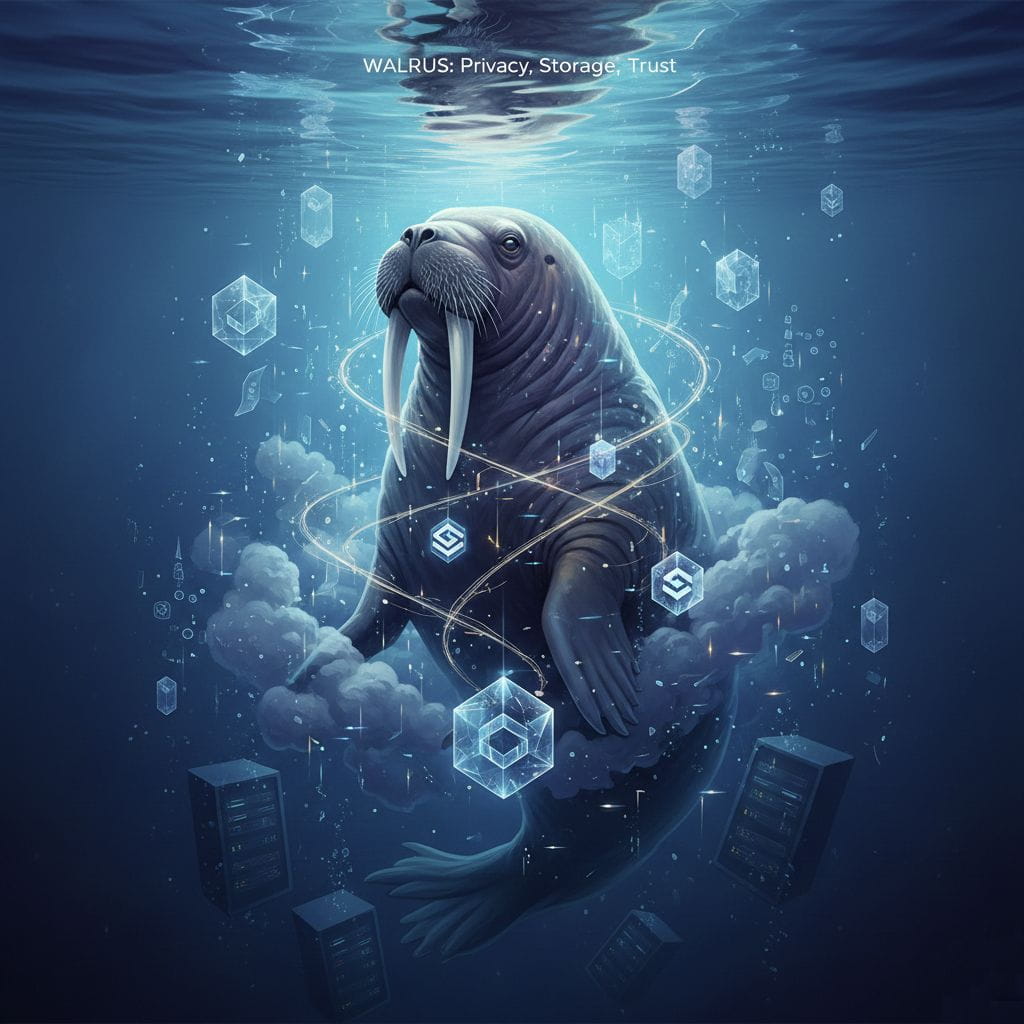
In the deep waters of the decentralized world, not every powerful force announces itself with noise. Some move slowly, deliberately, reshaping entire ecosystems while the surface appears calm. Walrus is one of those forces. It doesn’t chase hype or rely on spectacle; instead, it builds something foundational, something that quietly questions how modern digital life is structured and who truly controls it. At its core, Walrus is less about a token and more about restoring balance between users, data, and trust in a world that has grown dangerously comfortable with centralization.
For years, people have accepted a fragile bargain: convenience in exchange for control. Files, conversations, creative works, and sensitive records are handed over to centralized systems that promise reliability but demand surrender. Walrus challenges this unspoken agreement. It imagines a digital environment where privacy is not requested but assumed, where storage is not permissioned by corporations, and where the infrastructure itself respects the autonomy of its users. This is not a philosophical afterthought; it is embedded directly into how the protocol functions.
Built on the Sui blockchain, Walrus takes advantage of a modern, high-performance foundation while focusing its energy on a problem that has long been underestimated in decentralized systems: large-scale, efficient, and private data storage. Most blockchains are excellent at recording transactions but struggle when confronted with real-world data needs. Walrus addresses this gap with a design that feels almost elegant in its restraint. Through erasure coding and decentralized blob storage, data is broken apart, distributed, and protected against loss or censorship. No single entity holds the whole, and yet the whole remains recoverable. It’s a system that mirrors nature more than traditional infrastructure, resilient because it is dispersed.
There is something deeply human about this approach. People don’t just store data; they store memories, identities, livelihoods, and futures. A protocol that treats data as something worth protecting rather than exploiting speaks to a growing unease with how digital power has been concentrated. Walrus doesn’t ask users to trust a brand or a boardroom. It asks them to trust mathematics, incentives, and a network of participants whose interests are aligned through transparent rules.
The WAL token exists within this ecosystem not as a gimmick, but as an economic heartbeat. It enables governance, staking, and participation in the network’s long-term health. Those who hold and use WAL are not passive observers; they become part of a living system that rewards stewardship and accountability. Governance here is not abstract. Decisions affect how data is stored, how resources are allocated, and how the protocol evolves. This gives WAL a gravity that many tokens lack, anchoring value in utility and responsibility rather than speculation alone.
What makes Walrus particularly compelling is its refusal to separate privacy from usability. Too often, privacy-focused systems demand sacrifices in performance or accessibility. Walrus aims to remove that tradeoff. By focusing on cost efficiency and scalability, it positions itself as a practical alternative, not just an ideological one. Developers can build applications that handle large datasets without reverting to centralized solutions. Organizations can explore decentralized storage without exposing themselves to fragility or inefficiency. Individuals can store data knowing that it is not one policy change away from being locked, scanned, or erased.
There is also a quiet emotional current running through the project. In an era defined by surveillance, data breaches, and algorithmic profiling, privacy has become a form of dignity. Walrus doesn’t dramatize this, but it understands it. By making privacy-preserving storage the default, it acknowledges a simple truth: people should not need to justify their desire for digital solitude. The system assumes that confidentiality matters, and builds outward from that assumption.
Walrus feels like a response to maturity in the blockchain space. Early decentralization was obsessed with proving what was possible. Now the question is what is sustainable, humane, and worth maintaining for decades. Storage is not glamorous, but it is essential. Without reliable, censorship-resistant storage, decentralization remains incomplete. Walrus steps into this role with patience, focusing on infrastructure that others can build upon rather than chasing fleeting attention.
The future Walrus points toward is not one where centralized systems vanish overnight. It is more subtle and more realistic. It is a future where alternatives exist, where power is distributed enough that no single failure or authority can dictate outcomes. In that world, data becomes portable, durable, and owned by those who create it. Trust is no longer something you grant blindly; it is something you verify through design.
Walrus may never shout the loudest, but its presence is felt in the way it reframes what decentralized technology can offer. It reminds us that real innovation often happens beneath the surface, in systems that prioritize resilience over spectacle and principle over popularity. As the decentralized landscape continues to evolve, Walrus stands as a quiet testament to the idea that privacy, efficiency, and decentralization do not have to compete. They can coexist, reinforcing one another, shaping a digital world that feels less extractive and more honest.