
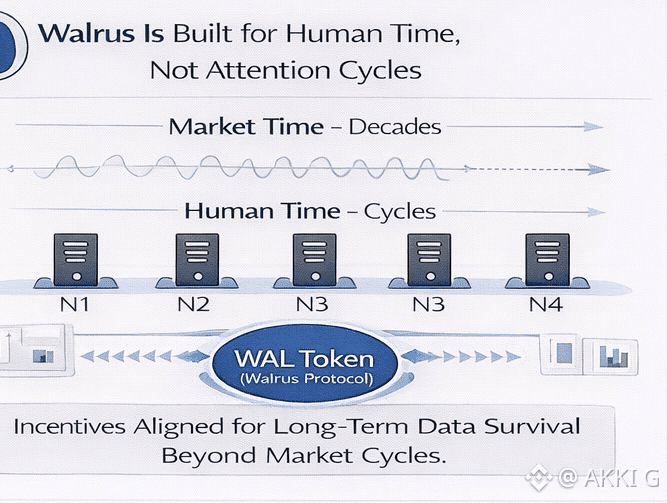
Most systems in crypto are built around market time. They are designed to perform well during periods of attention, growth, and activity. When conditions change, priorities shift. Data may still exist, but responsibility for it weakens. Walrus is built around a different clock. It is designed for human time, where data is expected to remain meaningful long after market cycles have passed.
Human time is slow. Records matter years later. Decisions are revisited. History becomes evidence. Walrus treats this reality seriously. Instead of optimizing for rapid turnover or short-lived relevance, the protocol assumes that data will need to survive long stretches of inactivity, uncertainty, and change. This assumption shapes everything from storage architecture to incentive design.
In Walrus, blob storage is not just a technical choice. It is a commitment to longevity. Large datasets are split into fragments and distributed across Walrus nodes so that the loss of individual participants does not erase history. The system does not rely on stable actors or constant growth. It relies on structure. As long as enough fragments remain, the past remains accessible.
WAL plays a crucial role in aligning the network with this long horizon. The token does not push participants to maximize short-term throughput. It encourages continuity. Nodes are economically motivated to remain available even when activity is low and attention has moved elsewhere. This is critical for data that must survive quiet periods, not just peak demand.
What distinguishes Walrus here is that it does not confuse durability with popularity. Data does not need to be frequently accessed to deserve protection. On the contrary, some of the most important data is accessed rarely but critically. Walrus is designed to protect that kind of information without requiring constant engagement.
My take is that infrastructure built for human time tends to outlast infrastructure built for market time. Walrus is positioning itself in that category. By prioritizing endurance over momentum, it creates space for data that matters beyond the present moment. In systems where history has weight, that design choice becomes essential.

