
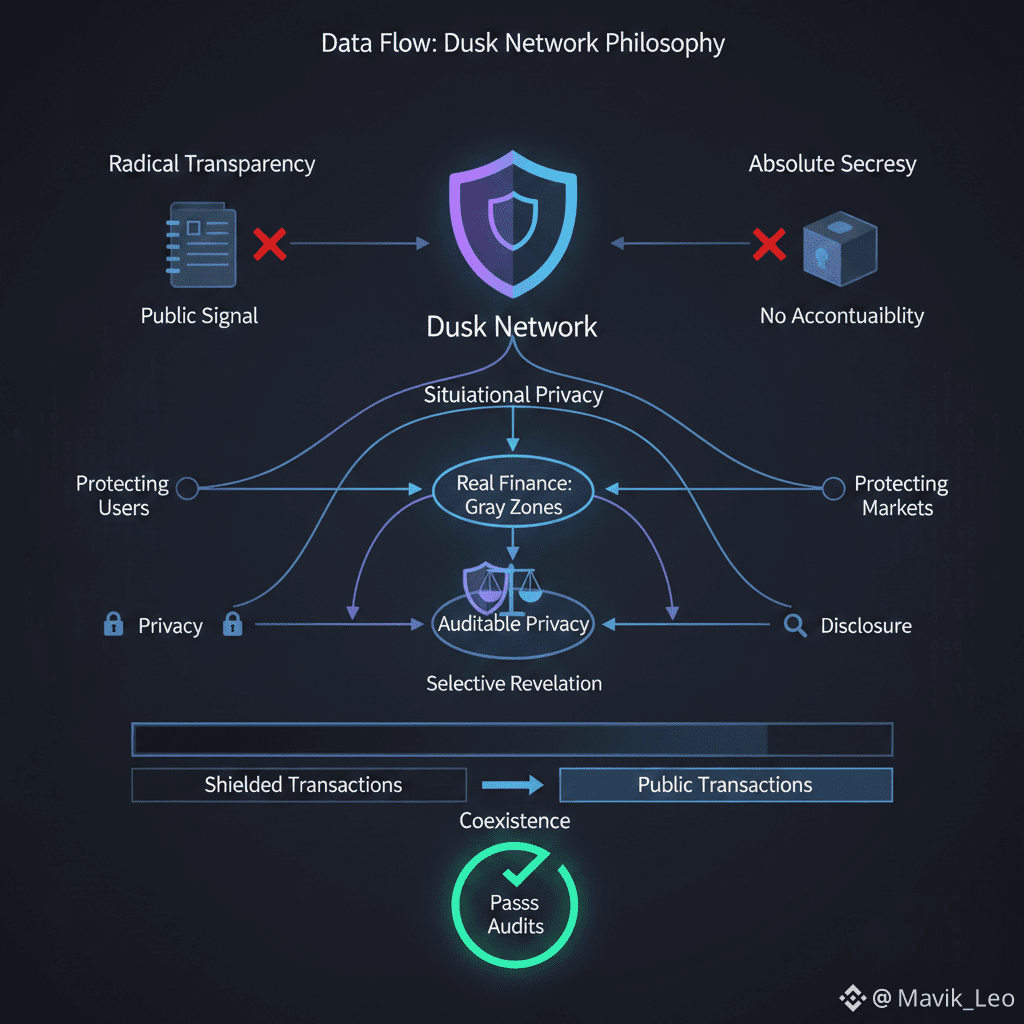
I’ve started to think about Dusk Network less as a competitor in the Layer-1 race and more as a quiet answer to a problem that only shows up once money becomes serious: people want discretion, but institutions demand explanations. Most blockchains resolve that tension by choosing a side. Either everything is radically transparent so transparent it turns normal financial behavior into a public signal or everything is hidden, and the moment an auditor or regulator asks a reasonable question, the system has no graceful way to respond. Dusk feels like it was designed by people who have actually sat inside those conversations, where compliance, privacy, and accountability all pull in different directions at once.
What stands out is that Dusk doesn’t treat privacy as an absolute virtue. It treats it as situational. Sometimes privacy protects users. Sometimes disclosure protects markets. And often, what’s required is something in between: the ability to reveal just enough, to the right party, at the right time, without turning the entire ledger inside out. The coexistence of shielded and public transactions isn’t a branding choice it’s a design admission that real finance lives in gray zones. That difference is subtle on the surface, but it’s the gap between a protocol that looks elegant in theory and one that can pass through an audit without betraying its participants.
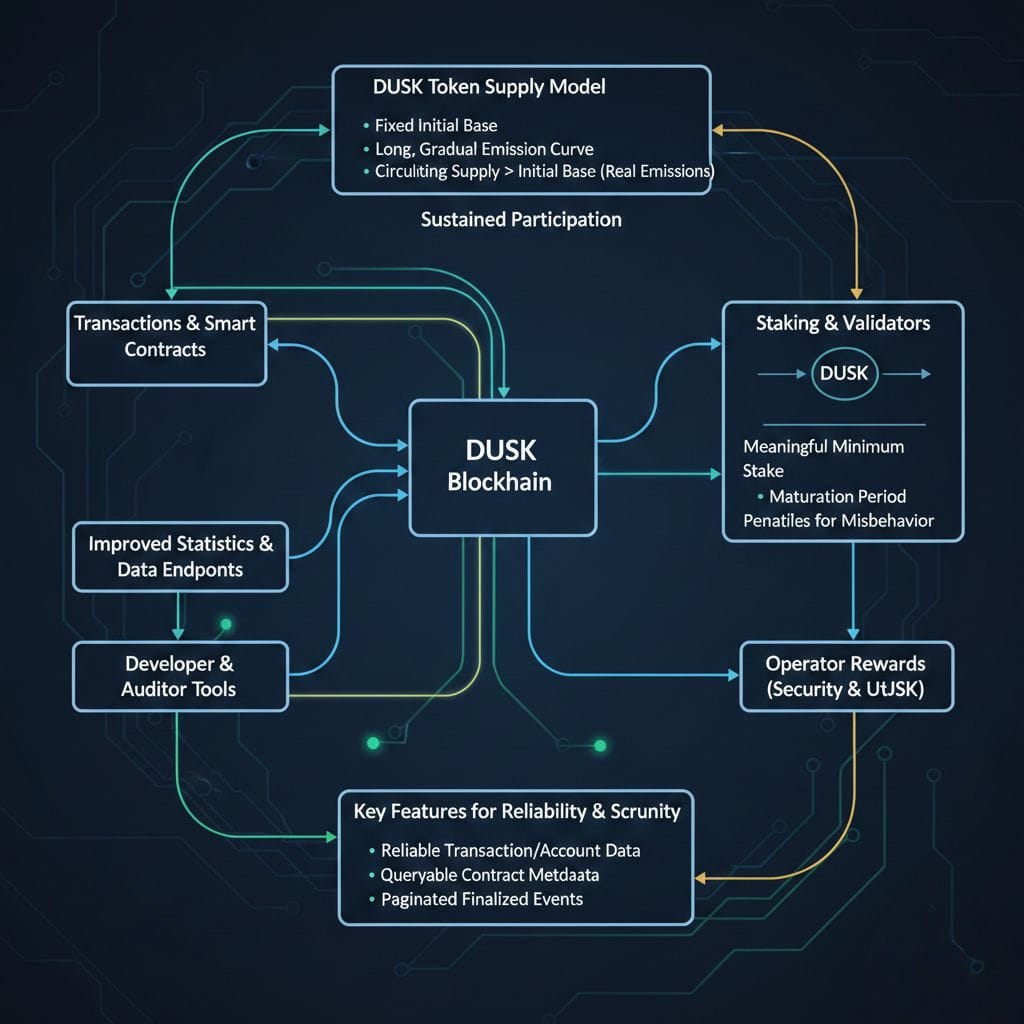
The last year of technical progress reinforces that impression. If you look past announcements and into node releases, the work is unglamorous but revealing. Improved statistics endpoints. More reliable transaction and account data. Queryable contract metadata. Proper pagination for finalized events so historical inspection doesn’t require custom scripts or guesswork. These are not features people celebrate on social media. They’re features that matter when something goes wrong or when someone with authority asks, calmly, “Walk me through exactly what happened.” A team that invests in this layer of detail is signaling that it expects scrutiny, not just experimentation.
Even the token mechanics feel grounded. DUSK isn’t framed as a mythical asset that solves every problem. It pays for execution, secures the network through staking, and rewards the operators who keep the system functioning. The supply model is straightforward: a fixed initial base and a long, gradual emission curve aimed at sustaining participation over time. The fact that circulating supply has already moved beyond the initial base tells its own story. Emissions aren’t hypothetical they’re being earned, distributed, and absorbed by real validators doing real work.
Staking, in particular, reflects an unusually honest posture. There’s a meaningful minimum, a maturation period, and penalties for misbehavior. Dusk doesn’t pretend that running infrastructure should be casual or risk-free. It quietly nudges the network toward operators who treat reliability as responsibility. That may not satisfy maximalist decentralization narratives, but it aligns far more closely with how financial infrastructure actually survives in the long run.
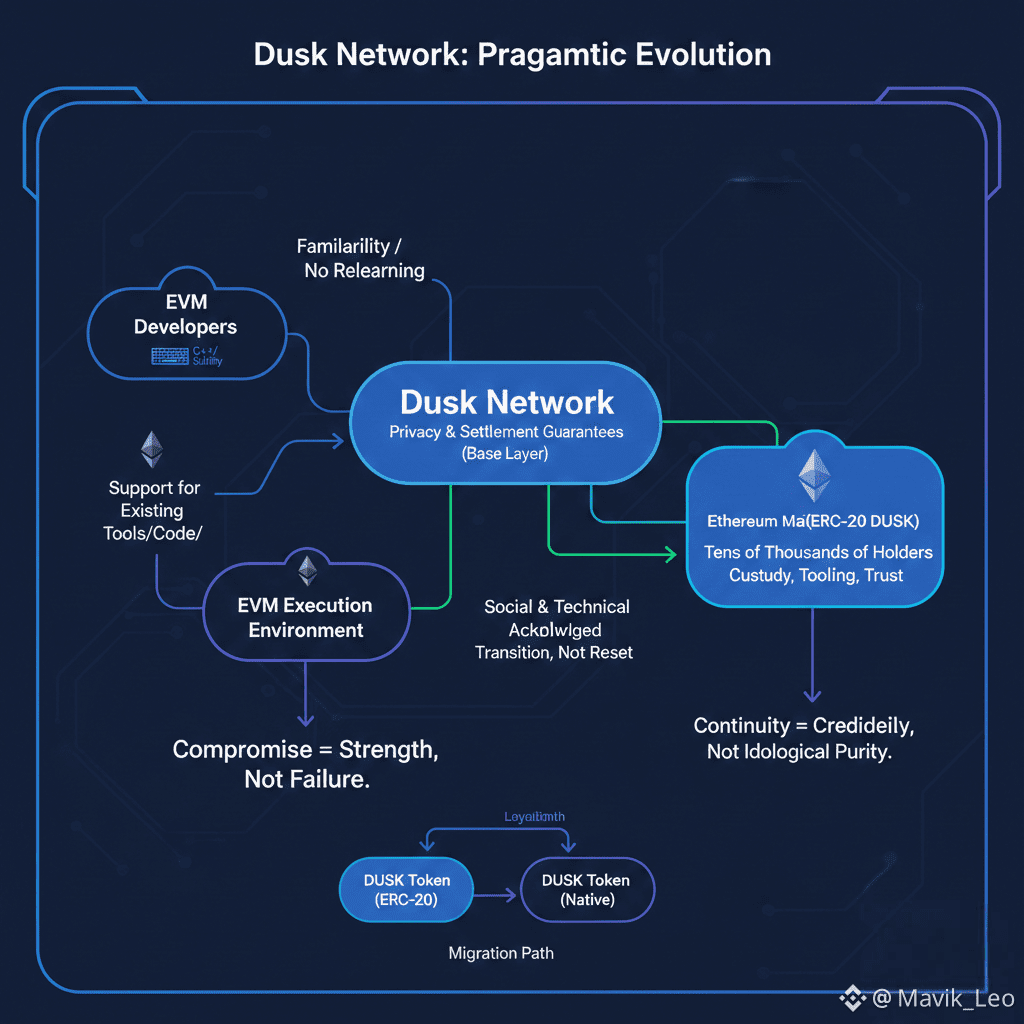
The EVM support follows the same pragmatic logic. Developers don’t want to relearn everything from zero, and Dusk doesn’t force them to. By supporting familiar execution environments while keeping privacy and settlement guarantees at the base layer, the network accepts compromise as a strength rather than a failure. Ideological purity is easy; adoption is not.
Even the continued existence of DUSK on Ethereum feels intentional rather than sloppy. Tens of thousands of holders still interact with the ERC-20 version, which means migration is not just a technical event but a social one. Custody, tooling, and trust don’t flip overnight. By acknowledging this transition instead of pretending it doesn’t matter, Dusk signals that it understands continuity—not resets—is how credibility is built.
Stepping back, what makes Dusk compelling isn’t any single feature. It’s the attitude embedded in the system. It feels designed by people who expect questions. Who assume logs will be requested, proofs will be demanded, and explanations will be necessary. And who want the protocol to survive those moments without collapsing into total exposure or total silence. In a space that often confuses ideology with engineering, Dusk’s quiet pragmatism may be its most genuinely radical quality.
