
Many systems assume that relevance comes from constant activity. When usage drops, incentives weaken, participants leave, and infrastructure quietly degrades. Walrus is designed with the opposite assumption. It expects long quiet periods and treats them as a normal operating condition rather than a failure state.
In real systems, data often matters most when it is accessed infrequently. Historical records, proofs, archives, and long-term datasets are not queried every day, but when they are needed, they must be available without warning. Walrus builds for this reality by separating data survival from continuous demand. Storage does not depend on popularity. It depends on structure.
Blob storage plays a critical role here. By fragmenting data and distributing responsibility across Walrus nodes, the system avoids dependence on any single operator remaining active. Even if participation declines temporarily, enough fragments can persist to allow reconstruction. Availability does not collapse simply because attention moves elsewhere.
WAL reinforces this design by aligning incentives around persistence rather than traffic. Nodes are rewarded for staying responsive over time, not for reacting to bursts of demand. This reduces the incentive to abandon the network during slow periods and prevents the gradual decay that affects many decentralized systems when excitement fades.
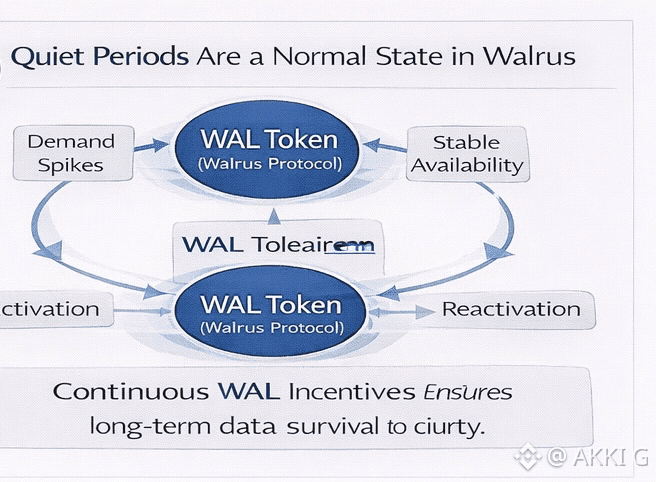
What makes this approach powerful is that Walrus does not need to predict usage patterns. It does not need to know when data will be important again. The system assumes uncertainty and designs for continuity regardless. Quiet periods are absorbed naturally rather than treated as emergencies.
My take is that infrastructure that survives inactivity tends to survive everything else. By designing explicitly for quiet time, Walrus protects data when it is most vulnerable. In the long run, this matters more than optimizing for constant engagement.

