
As systems scale, coordination becomes fragile. People leave, incentives change, and agreements decay. Many protocols rely heavily on ongoing coordination to keep data available. Walrus is designed to reduce that dependency as much as possible.
In Walrus, data survival does not require constant human oversight. Once data is stored, its availability is governed by protocol rules rather than continuous coordination. Fragmentation, distribution, and reconstructability ensure that access does not depend on specific individuals or groups remaining aligned. The system continues even as coordination weakens.
This is where WAL’s role becomes subtle but important. WAL does not coordinate through discussion or voting in day-to-day operation. It coordinates behavior automatically by making certain actions economically rational and others irrational. Nodes do not need to agree with each other. They only need to respond to incentives.
By pushing coordination into infrastructure, Walrus reduces the surface area for failure. There are fewer moments where collective action is required to prevent data loss. The protocol does not rely on timely intervention or emergency decisions. It simply continues to operate according to its design.
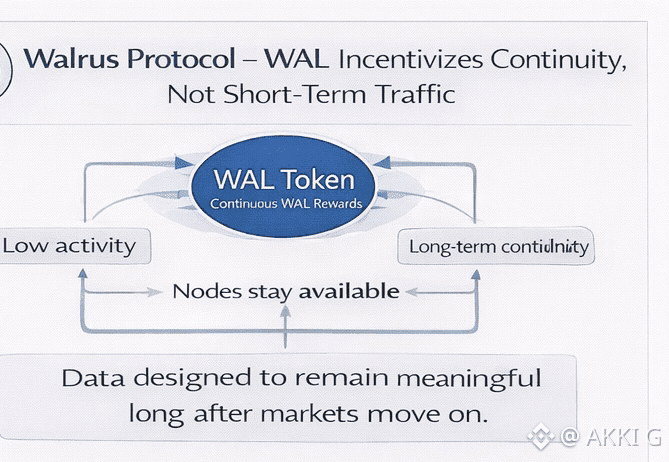
The result is a system where data survival is decoupled from social dynamics. Even if participants disagree, leave, or lose interest, the data remains accessible. This is particularly important for information that must outlive the communities that created it.
My take is that systems which rely less on human coordination tend to be more durable over time. Walrus embraces this principle by embedding coordination into architecture rather than process. That choice makes data survival less fragile and more predictable.

