Decentralization promises a future where control over digital assets and personal data shifts from corporations to individuals. Yet, as Web3 matures, one problem remains persistent: data. Blockchains are excellent at establishing consensus and trust, but they struggle when it comes to efficiently storing, retrieving, and manipulating large datasets. This limitation has created a tension in Web3: how can applications remain decentralized without compromising speed, usability, or affordability?
Walrus offers a solution that challenges assumptions about what decentralized storage can be. Despite a name that suggests something slow and cumbersome, the technology behind Walrus is nimble, efficient, and scalable. Its design philosophy treats data as a primary consideration rather than a secondary feature. The result is a platform that allows developers to build applications as smooth and responsive as those on Web2, but fully trustless and decentralized.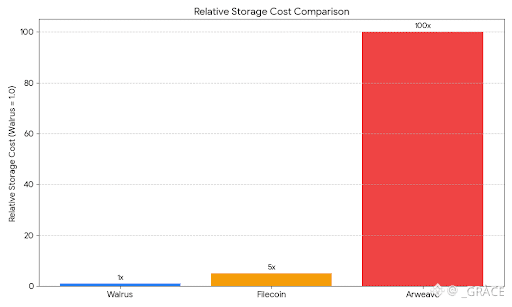
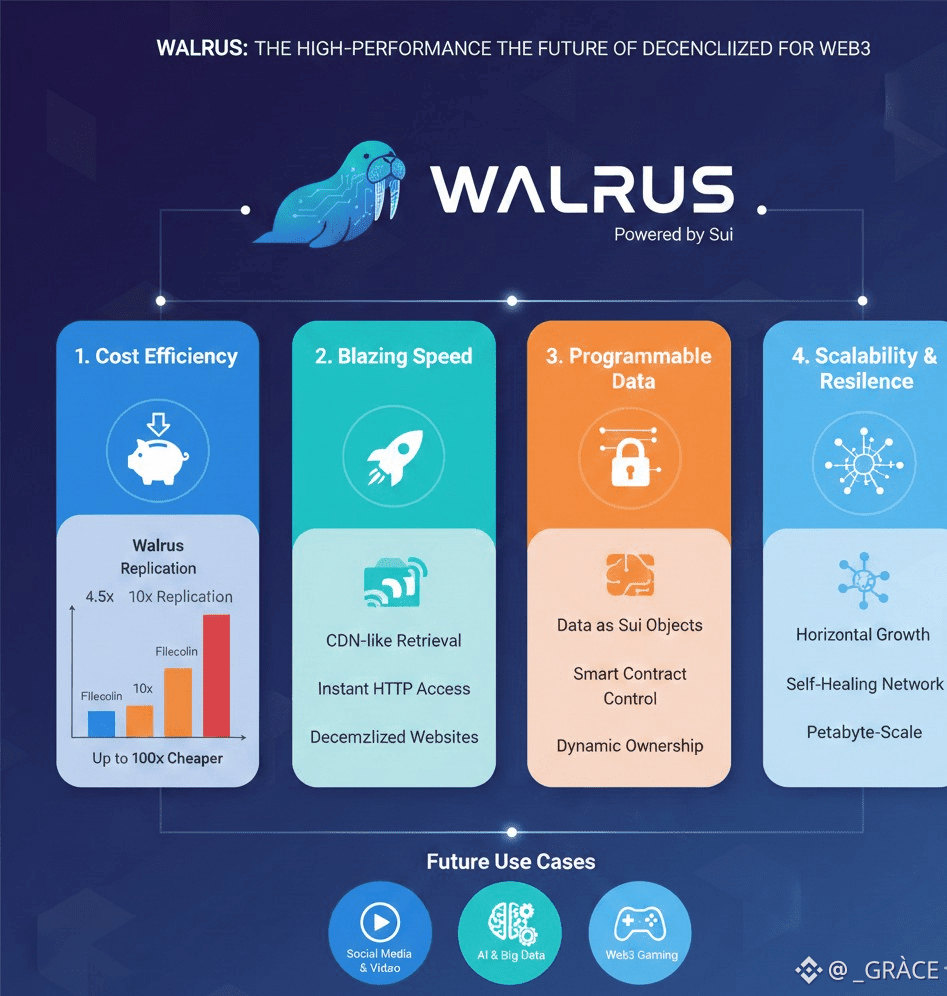
A fundamental challenge in Web3 infrastructure has always been reconciling resilience with efficiency. Traditional blockchain storage relies on full replication across nodes, which guarantees data safety but creates massive overhead and high costs. Walrus takes a different approach. By splitting data into small fragments and distributing them strategically across a global network of nodes, the system ensures that even if a significant portion of nodes fail, the data remains fully recoverable. This approach provides resilience on par with replication, but far more efficiently.
Beyond resilience, Walrus introduces a new dimension to programmability in decentralized storage. Every stored item, or "blob," is treated as a programmable asset on the Sui blockchain. Smart contracts can interact with, transfer, or regulate access to data directly. In practice, this means that data is no longer static, it can be actively controlled, monetized, or gated. Developers can design applications that leverage this dynamic, creating entirely new forms of interaction between users and data.
Cost efficiency is another area where Walrus stands out. Legacy blockchain storage solutions are often prohibitively expensive due to heavy replication. Walrus leverages advanced erasure coding, reducing the amount of storage overhead needed while maintaining high fault tolerance. By optimizing how data is stored and recovered, it dramatically lowers costs. The implication is significant: smaller teams and emerging projects can now afford decentralized storage, leveling the playing field and making Web3 innovation more accessible.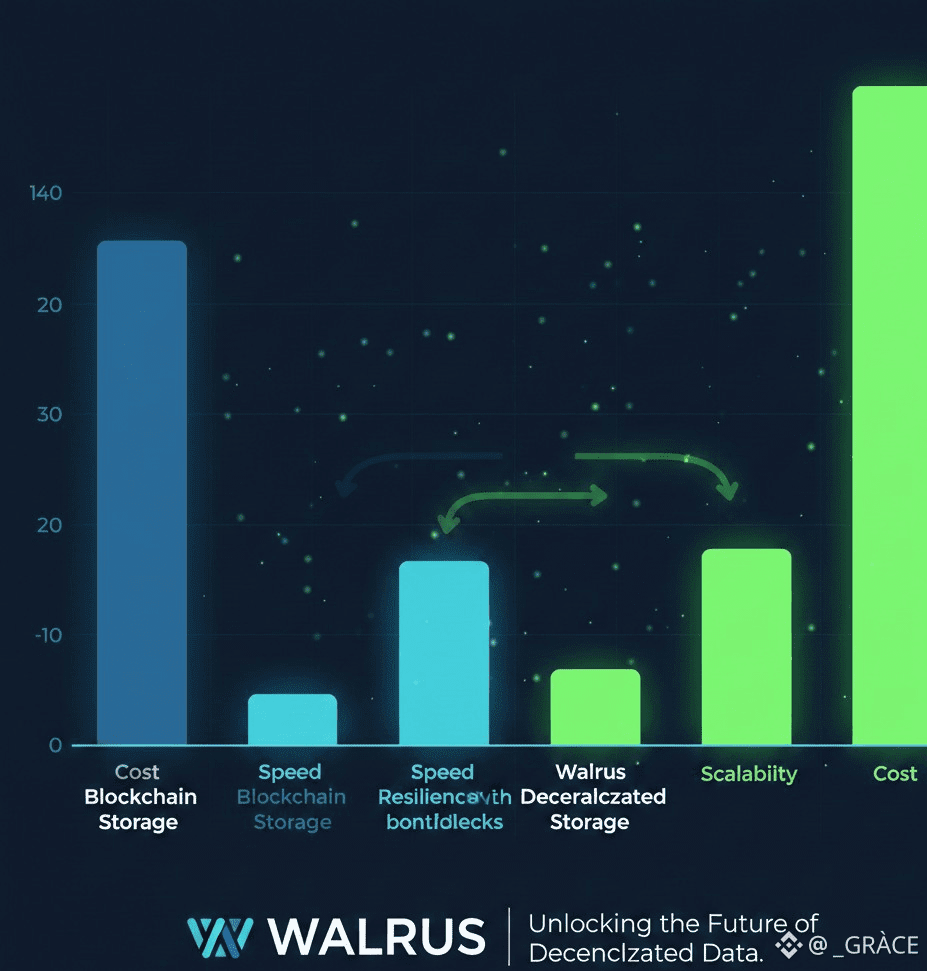
Scalability is a challenge for most decentralized networks. As more nodes join, coordination and capacity management can become bottlenecks. Walrus addresses this with horizontal scaling. As the network grows, total storage capacity expands, and the cost per node decreases. Its self-healing capabilities allow data reconstruction without a centralized coordinator, enabling organic growth that doesn’t compromise reliability. This makes the network robust, flexible, and future-proof.
The impact of Walrus extends beyond technical innovation it also addresses inclusivity. Performance and cost in Web3 are moral issues as much as technical ones. Systems that are slow or expensive naturally exclude participants, concentrating power in the hands of those who can afford it. By optimizing both speed and cost, Walrus helps democratize access, allowing more developers and users to participate. This is a subtle but critical way infrastructure shapes the equity of digital ecosystems.
Walrus also reflects the realities of a multi-chain Web3. Today, decentralization doesn’t exist in a single network it exists as an interconnected ecosystem. Interoperability is essential. Walrus enables seamless movement of data across chains, ensuring that applications are not locked into one ecosystem. Data can flow where innovation happens, making storage not just a utility but an enabler of experimentation and cross-chain collaboration.
The technical principle behind Walrus, splitting data into fragments or "slivers," is particularly noteworthy. Traditional replication duplicates entire datasets, consuming vast amounts of storage. Walrus instead fragments data, scattering it across multiple nodes. Even if a large percentage of nodes fail, the dataset can be fully reconstructed. This method balances redundancy with efficiency, combining reliability with lower costs. The result is infrastructure that is mathematically resilient and operationally practical.
User experience benefits significantly from this approach. Decentralized applications built on Walrus can offer interactions as seamless as Web2 alternatives. Uploading, sharing, and accessing data can be immediate, without the slowdowns often associated with decentralized storage. Developers can focus on design, functionality, and innovation rather than worrying about the limitations of underlying infrastructure. Users experience decentralized systems that are reliable, intuitive, and responsive.
Ownership and control are central to the Walrus philosophy. Decentralization is meaningful only when users maintain sovereignty over their data. By combining programmability with redundancy, Walrus ensures that users can control access, movement, and usage of their digital assets without sacrificing performance or convenience. This balance between security and usability is essential for mainstream adoption, signaling that Web3 infrastructure can meet real-world demands.
The innovation enabled by Walrus is broader than just storage efficiency. By resolving the bottleneck of data, it empowers developers to build applications that were previously impractical. Social platforms, financial applications, and media systems can now operate trustlessly without compromise. The system encourages experimentation, turning storage from a limiting factor into a foundation for creative growth.
Sustainability is another consideration. Erasure coding and efficient data management reduce wasted computation and energy compared to replication-heavy approaches. In an era where digital infrastructure faces scrutiny for energy consumption, Walrus demonstrates how decentralized systems can be both performant and environmentally conscious. Responsible design in Web3 infrastructure is no longer optional, it’s a competitive advantage.
Walrus challenges a common misconception: that decentralization inherently comes at the cost of speed or usability. Its architecture demonstrates that trust, efficiency, and accessibility can coexist. This philosophy reshapes expectations for what decentralized systems can deliver, raising the bar for infrastructure across the ecosystem. Decentralized systems are no longer expected to be clunky they can be elegant, robust, and scalable.
The implications for developers are substantial. With infrastructure that handles storage efficiently and reliably, they can focus on user experience, application features, and innovation. Projects no longer need to compromise between trustlessness and performance. For users, the benefits are equally tangible: their data is secure, accessible, and portable, without requiring technical expertise or specialized hardware.
Walrus also sets a precedent for infrastructure as an enabler rather than a limitation. The ability to programmatically interact with data, combined with global scalability, creates an environment where digital assets can flow freely, applications can scale organically, and innovation can thrive without centralized constraints. Infrastructure is no longer a passive component it becomes an active driver of growth, equity, and inclusion.
The system’s emphasis on interoperability highlights a crucial shift in Web3 thinking. Data is no longer tied to one chain or ecosystem; it can move and adapt wherever it is needed. This fluidity is essential for a multi-chain future, where projects are increasingly interconnected. By facilitating composable and portable storage, Walrus ensures that the infrastructure grows in tandem with innovation rather than limiting it.
One of the most important aspects of Walrus is that it bridges the gap between experimental decentralized technology and practical adoption. Many Web3 systems remain niche because they fail to meet the usability and performance expectations of mainstream users. Walrus addresses this directly. By combining speed, reliability, affordability, and programmability, it provides the missing link that allows decentralized applications to operate on a global scale without sacrificing user experience.
Mathematical resilience is at the heart of Walrus. The system’s ability to recover data even when substantial portions of the network are offline ensures reliability without imposing unnecessary redundancy. This efficiency is more than just technical it has social implications. By lowering the cost and complexity of participation, Walrus opens opportunities for developers and communities that would otherwise be excluded from building on decentralized infrastructure.
The approach taken by Walrus also reinforces a broader vision for Web3: that infrastructure can empower users and creators without introducing friction. By focusing on performance, cost efficiency, and programmability, it proves that decentralized systems can meet real-world needs without compromise. This sets a new standard for how we evaluate the value of infrastructure not only by security or decentralization but also by its ability to enable innovation and inclusion.
In a practical sense, Walrus represents a blueprint for the future of Web3. It demonstrates that decentralized storage can be high-performance, reliable, and user-friendly, creating a foundation for applications that are as responsive and functional as any centralized platform. For developers, this is an invitation to innovate freely. For users, it is a promise of sovereignty and accessibility. For the Web3 ecosystem, it is evidence that infrastructure can scale without imposing barriers or limitations.
Ultimately, Walrus proves that decentralization, efficiency, and usability are not mutually exclusive. Its architecture shows that the constraints traditionally associated with trustless systems can be overcome, creating infrastructure that is flexible, resilient, and inclusive. This is not merely an incremental improvement, it is a rethinking of what decentralized infrastructure can achieve when designed with both human and technical considerations in mind.
The broader lesson from Walrus extends beyond storage. It signals a maturity in Web3 thinking. Infrastructure is no longer a passive layer that developers hope will perform adequately; it is an active enabler that determines who can participate, innovate, and create. By solving the core bottleneck of data, Walrus sets the stage for a wave of applications that are fast, affordable, reliable, and inclusive. The future of decentralized innovation depends on solutions like this.
As Web3 continues to evolve, Walrus offers a vision of what infrastructure can be: efficient, scalable, and human-centric. It shows that digital ownership and sovereignty can coexist with high performance and ease of use. It demonstrates that decentralization can be elegant, not clunky, and that trustlessness need not come at the expense of experience. By addressing the foundational challenge of data, Walrus opens a pathway for the next generation of decentralized applications applications that can scale, innovate, and remain inclusive.
In conclusion, Walrus is more than a decentralized storage solution. It represents a shift in how infrastructure is conceived and executed in Web3. It combines programmability, resilience, efficiency, and interoperability in a way that empowers developers and users alike. By doing so, it proves that infrastructure can drive innovation, expand accessibility, and enable the next wave of digital sovereignty. For a Web3 ecosystem striving to grow responsibly and inclusively, Walrus is a model of what’s possible when foundational problems are solved elegantly and thoughtfully.