
In every technological cycle, there are loud innovations that grab headlines and quieter ones that end up doing the real work. Walrus belongs firmly to the second category. While much of crypto remains obsessed with speed wars, meme cycles, and speculative narratives, Walrus is focused on something far less glamorous but infinitely more important: how data actually lives, moves, and survives in a decentralized world.
At its core, Walrus is not trying to reinvent finance or replace blockchains. It is trying to solve one of Web3’s most persistent bottlenecks — scalable, reliable, and programmable storage for large amounts of real data. NFTs, identity credentials, AI models, media files, enterprise records — these are not small JSON objects that fit neatly on-chain. They are massive, unstructured blobs, and until recently, Web3 had no truly native way to store them without falling back to centralized infrastructure.
Walrus changes that equation.Built on the Sui blockchain, Walrus operates as a decentralized blob storage network where the blockchain coordinates truth, proofs, and incentives, while the heavy data itself lives across a distributed network of storage nodes. This separation is subtle but powerful. Sui does not try to store the data; instead, it certifies its existence, availability, and integrity. Walrus handles the rest. The result is a system that feels less like a crypto experiment and more like foundational internet infrastructure the kind you don’t notice until it’s gone.
What makes Walrus technically compelling is not just decentralization for its own sake, but efficiency. Rather than relying on brute-force replication — copying the same file again and again across nodes — Walrus uses erasure coding. Files are split into fragments, encoded, and distributed in such a way that only a subset is required to reconstruct the original data. This dramatically lowers storage costs while increasing resilience. Even if multiple nodes go offline, data remains recoverable. In practice, this means storage that is cheaper than naive decentralized alternatives and far more robust than centralized servers that rely on single points of failure.
The blockchain layer adds another dimension. Every stored blob is represented on Sui through metadata objects and availability proofs. This allows smart contracts to reason about data itself — not just tokens. A contract can check whether a file exists, whether storage fees are paid, whether retention conditions are met, or whether a dataset should expire or renew automatically. Storage becomes programmable, not passive. That shift alone unlocks entire categories of applications that were previously impossible to build without trusted intermediaries.
Walrus’ native token, WAL, is what keeps this machine running. It is not designed as a speculative ornament but as an economic coordination tool. WAL is used to pay for storage, to stake and secure the network, to reward node operators for uptime and reliability, and to participate in governance decisions that shape protocol parameters over time. As usage grows, a portion of fees is burned, creating a usage-linked deflationary dynamic that ties the token’s long-term value to real demand rather than hype.
This alignment becomes especially important when looking at real-world adoption. Walrus is not just storing test files or demo NFTs. Identity infrastructure like Humanity Protocol has already migrated millions of credentials onto Walrus, treating it as a backbone for verifiable, long-lived data. These are not speculative assets meant to be flipped; they are records that must remain accessible, tamper-resistant, and durable at scale. As identity systems expand toward tens or hundreds of millions of users, the importance of decentralized storage that actually works becomes impossible to ignore.
The same logic applies to AI. Models, training datasets, and inference artifacts are large, expensive, and increasingly sensitive. Centralized storage creates concentration risk and censorship pressure. Walrus offers a neutral substrate where AI-related data can be stored, verified, and accessed without relying on a single corporate gatekeeper. While still early, community-led integrations already point toward this direction, suggesting that Walrus may quietly become part of the decentralized AI stack rather than a headline-grabbing AI token.
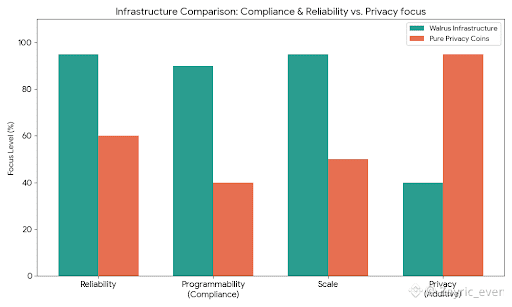
Privacy is often mentioned in discussions around Walrus, but it’s important to understand the nuance. Walrus itself is primarily a storage protocol, not a privacy coin. Any privacy-enhanced behavior largely comes from how applications use it and from Sui’s broader roadmap around confidentiality and advanced cryptography. This distinction matters, because it keeps expectations grounded. Walrus is not selling anonymity as a narrative; it is selling reliability, programmability, and scale. Privacy, where it exists, is additive rather than performative.
From a developer perspective, Walrus feels refreshingly practical. Data can be uploaded through command-line tools or APIs, encoded into blobs, certified on-chain, and retrieved as long as payments are maintained. There is no mysticism here — just a clear flow that mirrors how real systems are built. The difference is that ownership, availability, and incentives are enforced cryptographically instead of contractually.
What ultimately sets Walrus apart is that it does not ask the world to change its behavior. Applications already need storage. Enterprises already manage massive datasets. Identity systems already depend on durable records. Walrus simply offers a way to do all of that without central points of failure, without opaque trust assumptions, and without abandoning the composability that makes blockchains powerful in the first place.
This is not a project designed to dominate social media cycles. It is designed to disappear into the background and quietly hold the weight of the next generation of Web3 applications. That may not make for viral slogans, but it is often how the most important infrastructure is built.
Walrus is, fundamentally, a bet that Web3 will mature — that it will move beyond experiments and into systems people actually rely on. If that future arrives, storage will not be optional, and the protocols that handle it well will matter far more than most people realize today.

