

EVM chains made smart contracts popular because everything is inspectable. That same “glass box” design is also why serious finance keeps EVM at arm’s length. A public mempool, visible balances, and transparent position changes turn trading into a leak. In real markets, counterparties don’t publish their inventory and intent to the world—privacy is the default setting, not a special feature you have to justify.
Dusk’s approach to that problem starts with a split: keep a settlement-oriented base layer, then add an EVM execution layer that developers already understand. DuskEVM is described as an EVM-equivalent environment inside Dusk’s modular stack, meant to run standard EVM tooling while inheriting security/settlement guarantees from DuskDS. That sets the stage for the harder question: how do you keep EVM usability, but stop EVM’s habit of oversharing?
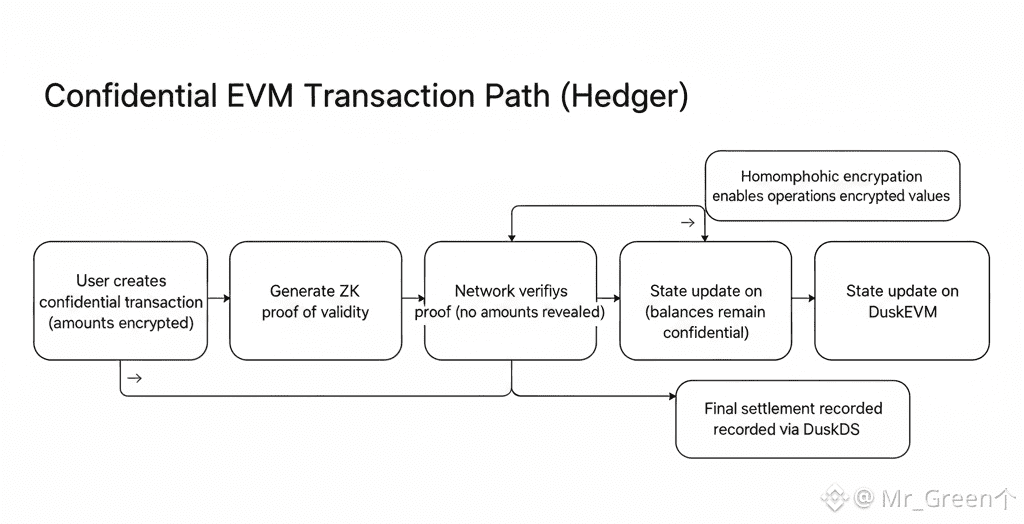
This is where Hedger comes in. Dusk describes Hedger as a new privacy engine “purpose-built for the EVM execution layer,” bringing confidential transactions to DuskEVM through a combination of homomorphic encryption and zero-knowledge proofs. The choice of that pairing is the real signal. It suggests Dusk is trying to avoid a common privacy trap: either you hide data so well that nobody can verify anything, or you keep everything verifiable by making it public.
Homomorphic encryption is the “keep it locked while still usable” tool. In the simplest framing, values stay encrypted, yet certain operations can still be performed correctly. Zero-knowledge proofs become the “receipt.” They let the system prove that the encrypted computation was done properly—without revealing the private inputs. Dusk positions this mix as “compliance-ready privacy,” meaning confidentiality doesn’t have to eliminate auditability; it can be structured so verification exists, and disclosure can be limited to authorized contexts.
That design matters because regulated finance doesn’t actually want radical transparency or radical secrecy. It wants something more boring: trades should be private to the public, but defensible to auditors and regulators when required. Dusk’s multilayer architecture write-up even points at the kinds of workflows this targets—auditable confidential transactions and even obfuscated order books—which are closer to how real venues operate than “everything is public forever.”
The technical tension is cost. Confidentiality is not free. Proof generation takes work, verification costs gas, and encryption schemes have their own overhead. The promise only holds if developers can actually afford to use privacy modes without turning every transaction into an expensive ceremony. This is why Hedger being “purpose-built for the EVM layer” is an important claim: it implies the team is trying to make the privacy path feel native to how EVM apps are built, rather than a separate privacy system that forces teams to abandon their tooling.
There’s also a product-level constraint: privacy features only become real when they’re programmable. It’s one thing to have private transfers; it’s another to support private balances inside contracts, private accounting inside pools, or private settlement outcomes for trading systems. Dusk’s framing of DuskEVM as the application venue—and Hedger as the privacy engine inside that venue—suggests the target is not “privacy as a wallet trick,” but privacy as an application capability.
From a security perspective, the bar is high. A confidential system must prevent value creation through malformed proofs, protect against leakage through metadata patterns, and keep the verification path simple enough that implementations don’t become brittle. In practice, the strongest “auditable privacy” designs aren’t the ones that hide the most—they’re the ones that define exactly what must be proven, and prove only that, every time. That’s where ZK proofs are a good fit: they turn rule enforcement into something the network can check mechanically.
So the honest way to read Hedger is not as a buzzword bundle, but as a deliberate attempt to make EVM behave more like finance: private by default, verifiable by design, and compatible with oversight. If Dusk can keep the developer experience familiar through DuskEVM while making confidentiality practical through Hedger, it’s a meaningful step toward on-chain markets that don’t broadcast their entire internal life to strangers.
