
I've been thinking about what changed when Walrus went from testnet to mainnet and the lessons are different from what most people assume. WAL trades at $0.1259, down 2.10% but with volume climbing to 7.41 million tokens. RSI at 33.99 shows some recovery. But the more interesting data point is what happened between October 2024 testnet and March 2025 mainnet launch—what broke, what didn't, and what that reveals about the protocol.
Most projects treat testnet as theater. Launch something barely functional, call it testing, then scramble to fix everything before mainnet. Walrus did something different and it shows in how the network operates now.
Testnet processed 12 terabytes of actual data over five months. Not synthetic test files. Real applications uploading real content to see if the coordination mechanisms actually worked. That's small scale compared to mainnet ambitions but large enough to stress-test the architecture with real developer usage patterns.
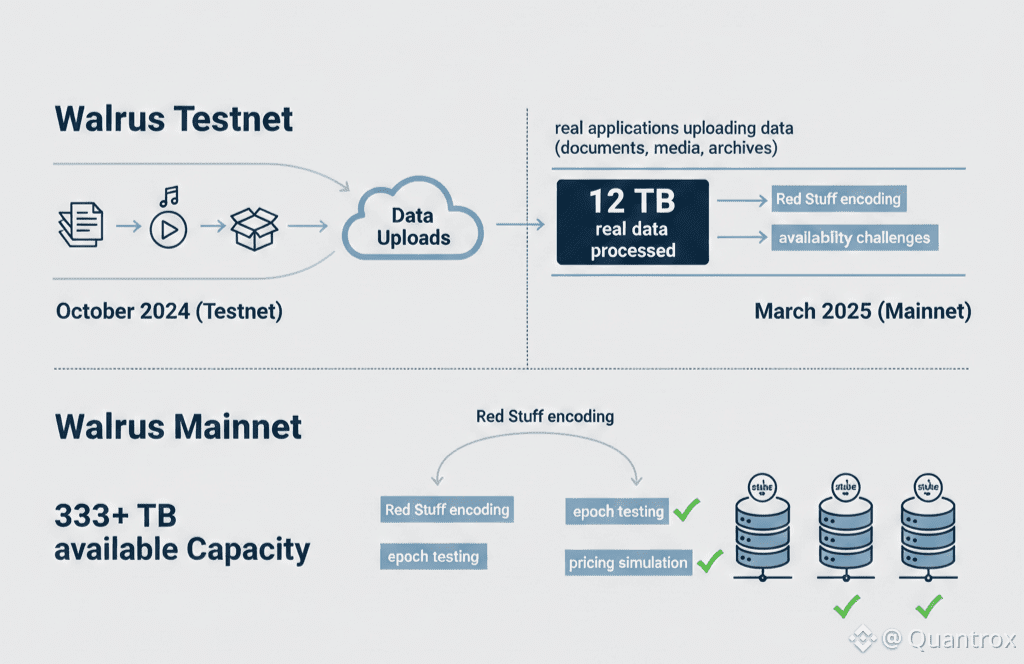
Here's what caught my attention. The transition to mainnet didn't involve massive protocol changes. Most of what launched in March 2025 was already running during testnet. The core Red Stuff encoding, the availability challenges, the epoch structure, the pricing mechanism—all tested for months before real value was at stake.
That means mainnet launch wasn't a leap of faith. It was turning on economic incentives for infrastructure that was already proven functional. Different risk profile than most crypto launches where mainnet is the first time pieces actually work together under real conditions.
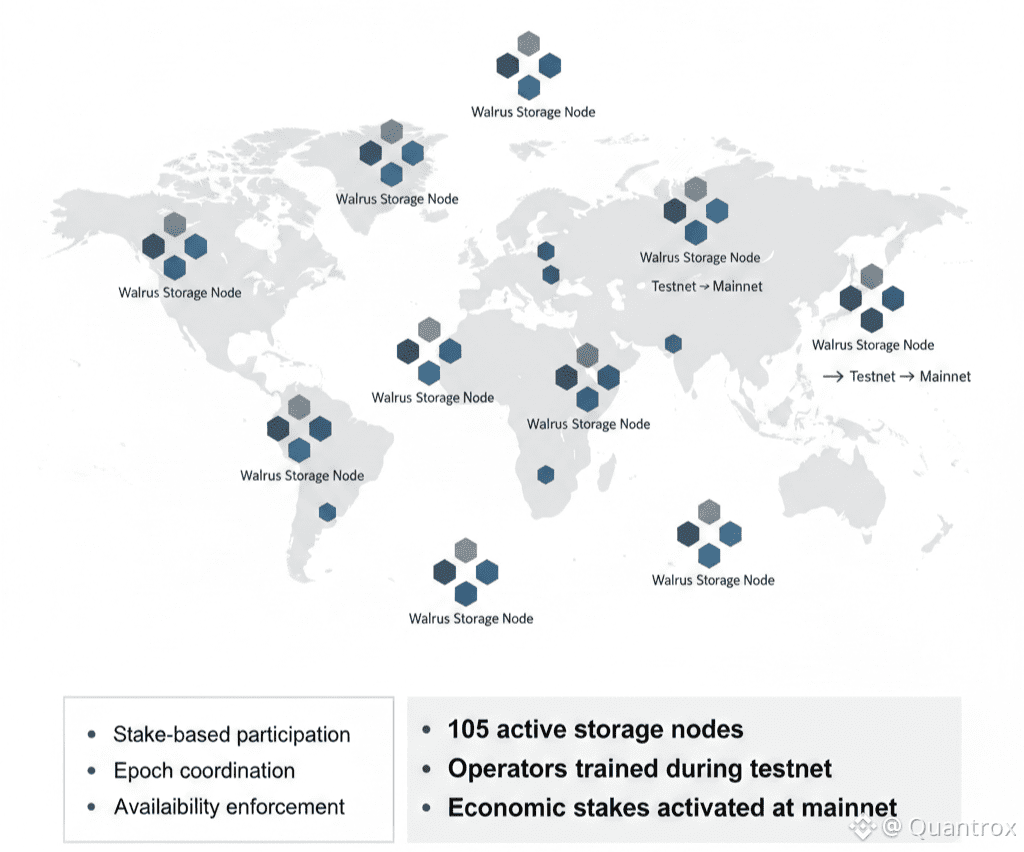
The 105 storage nodes running Walrus today aren't random new operators. Many participated in testnet. They learned the operational requirements, debugged their infrastructure, understood the economics before WAL tokens had real value. That continuity matters. These aren't hobby operators hoping for quick returns. They're committed participants who made it through testing.
What broke during testnet is harder to track publicly. But what didn't break is visible—the network coordination mechanisms worked well enough that hundreds of applications built on Walrus during testing and continued using it after mainnet. If fundamental architecture was broken, those developers would have abandoned the project.
Storage nodes have to stake WAL to participate. During testnet, stakes didn't have real value. Mainnet made those stakes economically meaningful. That's when you find out if operators are serious. Someone willing to lock up worthless test tokens might not lock up tokens worth real money. The fact that node count stayed stable through mainnet transition suggests operators were already committed.
Volume of 7.41 million WAL today includes activity from applications that started on testnet and migrated to mainnet. That migration path matters. If moving from testnet to mainnet was painful, developers would have quit. The relatively smooth transition is evidence the protocol design was solid before economic stakes were added.
The epoch-based model got tested during the five-month testnet period. Did two-week epochs work operationally? Could pricing consensus happen smoothly? Did node selection based on stake work without centralization? All questions that needed real-world testing before mainnet launch made failure expensive.
Walrus burned through multiple testnet iterations before the final version that led to mainnet. Most people don't see that work. They just see March 2025 launch and assume it appeared fully formed. Reality is months of testing, failing, fixing, retesting. The public testnet from October to March was the final validation phase, not the first time pieces came together.
My gut says the testnet-to-mainnet approach reveals Walrus priorities. Technical robustness before growth metrics. Infrastructure stability before token speculation. Boring long-term thinking instead of exciting fast launches. That's either smart risk management or excessive caution depending on whether you value shipping fast or shipping right.
The RSI at 33.99 shows markets don't particularly care about testnet history. Traders focus on current price action. But applications evaluating storage solutions should care deeply. A protocol that worked for five months under real usage before mainnet is fundamentally different risk than one that launched mainnet as first real test.
The 17 countries where Walrus nodes operate represent geographic diversity that was deliberately built during testnet. Not added later as scaling happened. Starting with distributed infrastructure is harder but creates better failure resistance. You can't easily retrofit decentralization after launching with concentrated infrastructure.
Operators running Walrus storage learned during testnet that availability challenges are serious. The protocol actually enforces requirements. Nodes that couldn't meet technical standards during testnet didn't make it to mainnet or quit early after realizing the operational demands. That filtering happened when stakes were low, which is the right time for it.
The pricing mechanism at 66.67th percentile got tested when operators didn't have financial incentive to game it. Testnet revealed whether the consensus approach worked mechanically. Mainnet added economic pressure but the coordination had already been proven feasible. That matters because pricing is often where decentralized systems break under real economic incentives.
Walrus processed 12 terabytes during testnet then jumped to 333+ terabytes capacity on mainnet. That scale increase happened because testnet proved the architecture could handle growth. Operators knew expanding infrastructure made sense because coordination had been validated. Without testnet proof, mainnet capacity would have started much smaller.
What you'd want to know about any protocol is whether testnet was real testing or marketing theater. Real testing means breaking things, finding limits, fixing problems before they're expensive. Theater means running minimal tests just to claim due diligence. Walrus leaned toward real testing, which is why mainnet has been relatively stable.
The circulating supply of 1.58 billion WAL out of 5 billion max includes tokens that were distributed partially based on testnet participation. Early operators and developers who tested the network got allocation priority. That creates alignment—the people running infrastructure now are the same ones who helped debug it when stakes were low.
Volume of $961,578 in USDT terms today doesn't reflect the value created during testnet phase when price was zero. Hundreds of developers built applications, storage nodes figured out operations, protocol parameters got tuned. All that work happened before trading existed. Markets capture some value but miss the foundational work that makes current operations possible.
Epochs lasting two weeks were set during testnet based on operational experience. Not theoretical ideal—actual testing of what time period made sense for pricing consensus, stake coordination, and challenge verification. Could have been one week or one month. Testing revealed two weeks balanced predictability with flexibility.
The Mysten Labs team building Walrus had shipped Sui before launching Walrus testnet. That matters. They weren't first-time protocol builders learning on the job. They applied lessons from shipping one major blockchain to designing storage infrastructure. Testnet was still necessary but started from experienced baseline.
Whether Walrus testnet-to-mainnet approach becomes standard practice or remains unusual depends on whether other projects value risk reduction over speed. Most crypto launches optimize for excitement and fast token trading. Walrus optimized for infrastructure stability and operator confidence. Different strategies for different goals.
Time will tell if the careful testnet phase gave Walrus meaningful advantage or just delayed inevitable mainnet problems. For now the network operates stably, operators understand requirements, applications built during testnet continue using mainnet. That continuity suggests the transition worked better than random chance would predict.

