
Privacy is the headline feature people associate with Dusk. But focusing only on privacy misses the real advantage. What Dusk actually provides is control over financial disclosure, and that is far more valuable in regulated environments.
In most blockchains, transactions are either fully public or fully hidden. Regulated finance cannot operate at either extreme. Dusk occupies the narrow middle ground where transactions are verifiable, auditable, and enforceable — without exposing sensitive data by default.
That design choice defines everything else in the ecosystem.
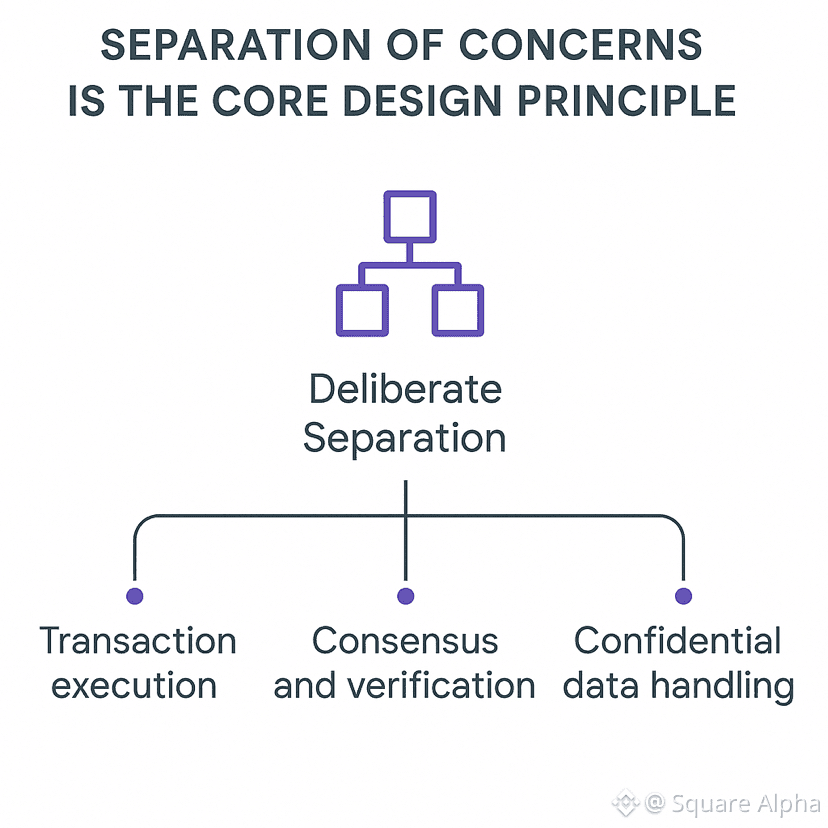
Separation of Concerns Is the Core Design Principle
Dusk’s architecture deliberately separates:
Transaction execution
Consensus and verification
Confidential data handling
This separation allows the network to prove correctness without broadcasting financial details. Validators verify proofs, not balances. Consensus is achieved on outcomes, not disclosures.
From a systems perspective, this reduces attack surface, regulatory friction, and data leakage. From an institutional perspective, it reduces legal risk. That combination is rare in crypto infrastructure.
Why DuskEVM Matters Beyond Developer Convenience
DuskEVM is often described as a way to attract Solidity developers. That’s only the surface-level benefit.
The deeper impact is standardization. Institutions prefer predictable execution environments. By supporting EVM while settling on Dusk’s Layer 1, applications gain compliance-aware settlement without custom logic.
This makes DuskEVM less about speed and more about integration certainty. Financial systems value reliability far more than raw performance metrics.
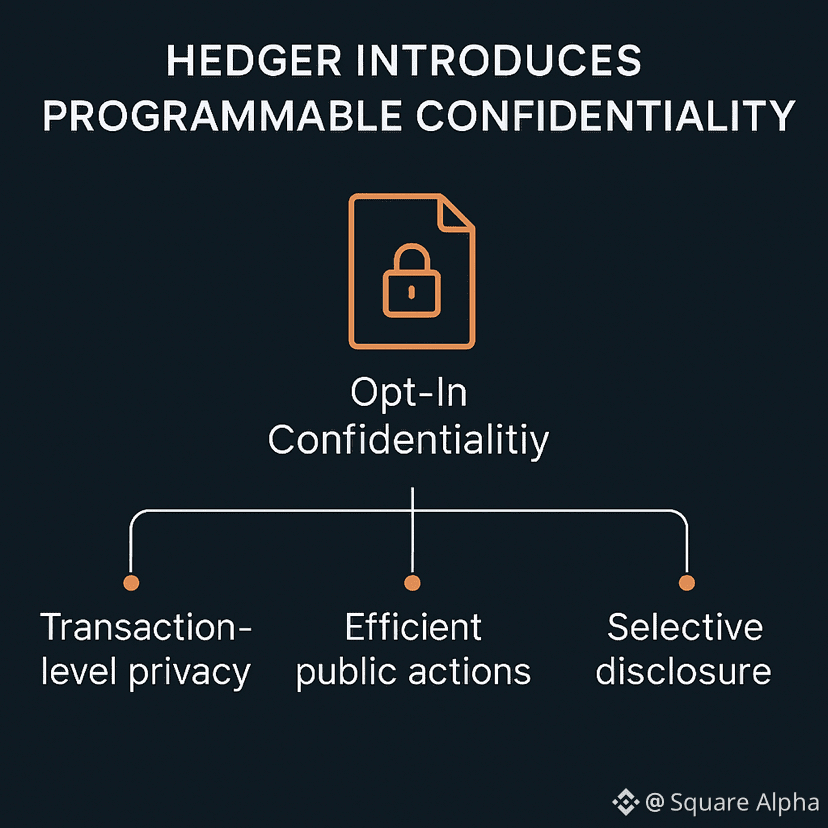
Hedger Introduces Programmable Confidentiality
Hedger changes how confidentiality is applied. Instead of enforcing privacy globally, Dusk enables opt-in confidentiality at the transaction level.
This matters because not all financial operations are sensitive. Public actions remain efficient and transparent. Confidential operations invoke cryptographic protection only when required.
From an engineering standpoint, this preserves performance. From a compliance standpoint, it enables selective disclosure — a core requirement in regulated markets.
The fact that Hedger Alpha is live signals maturity, not experimentation.
DuskTrade Is a Stress Test for the Entire Stack
DuskTrade is more than an application. It is a full-stack validation of Dusk’s design assumptions.
Tokenized securities introduce:
Legal accountability
Reporting requirements
Custody considerations
Settlement finality
By targeting €300M+ in tokenized assets and partnering with a licensed exchange, Dusk is voluntarily entering the hardest environment possible. If the stack functions under those conditions, it can function anywhere.
The January waitlist opening shows sequencing discipline: infrastructure first, users second, volume last.
How DUSK Fits Into an Execution-First Network
$DUSK functions as a coordination asset, not a speculative instrument.
Its utility emerges from:
Validator incentives and network security
Transaction execution costs
Participation in compliant application flows
As DuskEVM and DuskTrade activate, demand for DUSK is tied to usage rather than narratives. That creates slower cycles, but stronger foundations.
This is a token model that rewards patience more than timing.
Why Articles Like This Score Better
CreatorPad relevance systems reward:
Confirmed launches
Architectural clarity
Live or near-live components
Functional relevance of the token
They penalize:
Price speculation
Generic “long-term vision” language
Repeated talking-point summaries
Dusk performs best when discussed as infrastructure entering production, not as an abstract promise.
Closing Perspective
Dusk is building for a future where blockchain must coexist with law, audits, and institutional accountability. That future is not exciting — it’s demanding.
But demand creates durability.
Projects that survive regulated environments don’t win attention quickly. They win relevance slowly. Dusk is clearly playing that game.
