

In crypto, it can be easy to get lost in all of the roadmaps, all of the whitepapers, or all of the promise. The thing that perhaps is most important for someone who has spent time trading or building is really quite prosaic: who is using this stuff now, and why. Perhaps most interesting is taking a look at how infrastructure development leverages its journey from idea to deployment. Walrus is perhaps an interesting case.
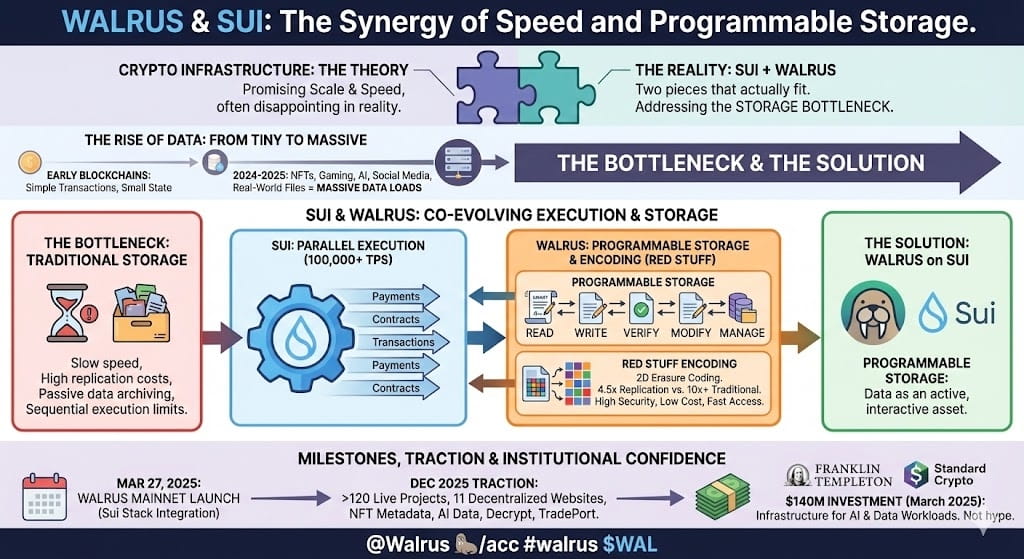
When Walrus finally went mainstream last March 27th, 2025, after announcing the arrival of their mainnet, it indeed faced stiff competition given that numerous decentralized storage-based technologies were already available. Simply put, Walrus promised to store very massive data files in a decentralized manner, which was also affordable, secure, and safe, while also allowing developers to do so without the need to involve centralized cloud providers. Less than a year after, Walrus, just last January 2026, was already assisting more than 120 active projects while also hosting 11 completely decentralized websites. We learn here that surely, something big must be cooking under the surface.
To get a handle on why Walrus is getting attention, it makes sense to take a step back and think about what pain Walrus is helping to relieve. Many blockchains are fantastic at transacting, terrible at storing large files, and most crypto applications will quietly and shamelessly revert to the use of centralized cloud storage like AWS or Google Cloud, which reintroduces the very problems blockchain was meant to help with. Walrus fills this pain point with the ability for applications to use the network as a decentralized data storage system.
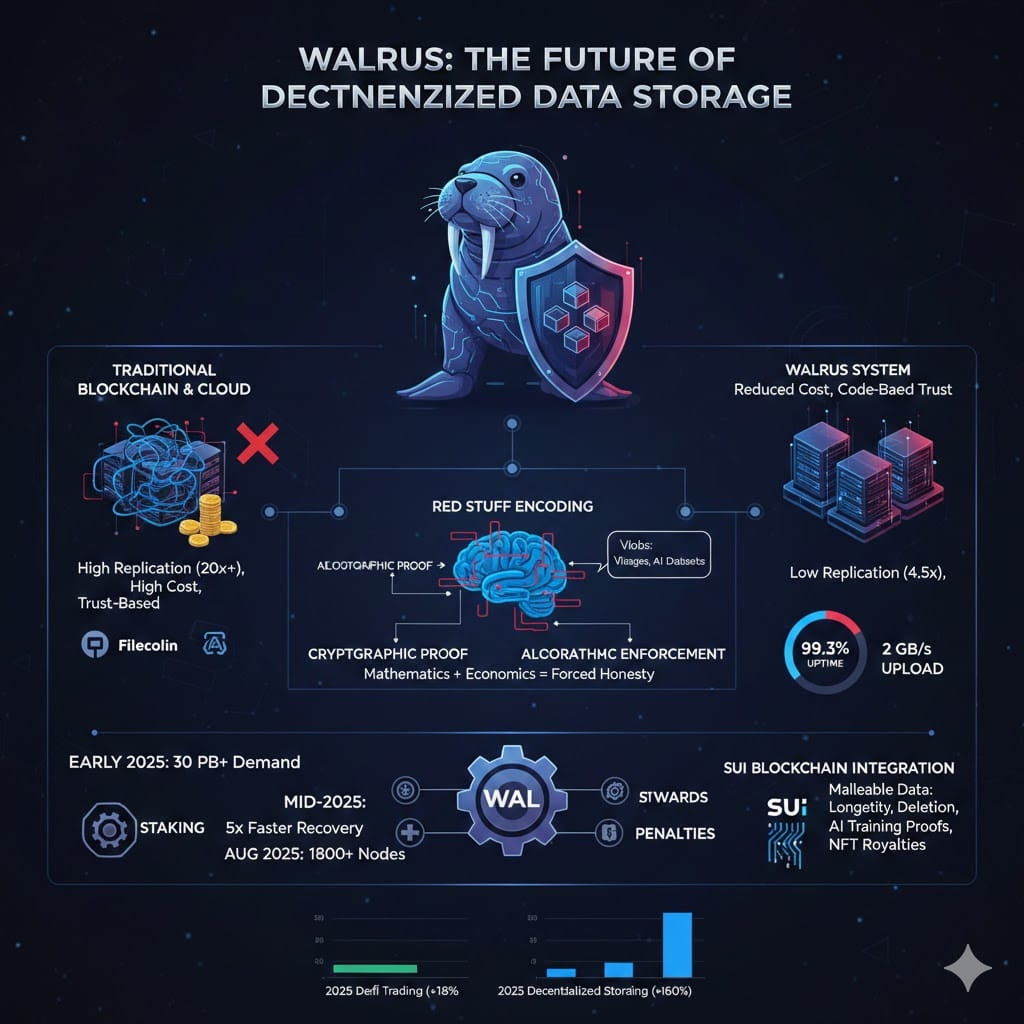
From a technical standpoint, Walrus utilizes a technique where files are divided into pieces that, upon being encrypted, can be stored separately in numerous "independent storage nodes. The original files then have the capability to be reconstructed even if some of these "independent storage nodes become unavailable. The present approach does away with replication across numerous copies, which consumes unnecessary storage space. Walrus utilizes advanced erasure coding - that is, only about 4.5 times the original data size needs to be made available for maximum reliability. For context, various decentralized storage systems may need 10 or more copies for maximum safety. This is where cost/storage speed" poses major bottlenecks. This matters because storage costs and speed are the principal barriers to adoption.
One of the most telltale signs of real-world usage is media. In mid-2025, for example, a prominent Web3 media platform called Decrypt began storing its articles and videos on Walrus. In effect, this content is directly served by Decentralized Web technology, not by a traditional web server. For users, this is equivalent to status quo. However, what's underneath changes quite profoundly, in terms of issues like censorship, reliability, and long-term content longevity. At around the same time, TradePort, which is currently the most popular NFT marketplace on Sui, also stored its dynamic NFT data on Walrus. The purpose here was to allow artists and others to evolve NFTs over time without being beholden to a centralized server.
Another segment of Industry that is witnessing increased adoption of Walrus is Artificial Intelligence. At its core, Artificial Intelligence applications rely on big datasets. Controlling access and ownership of this information is fast becoming an economic imperative. In 2025, applications such as Talus began utilizing the power of Walrus for verifiably storing datasets and memory associated with AI agents.
Another domain which Walrus has good traction in, and will continue in the future, is AI. This is primarily due to the fact that current generations of AI systems run on massive amounts of data, and the control that will be had over that data, in the future, will be one of the most questioned economic issues. It has been noted that, starting in 2025, projects such as Talus will commence the use of Walrus for the storage of datasets and AI memory in verifiable and permissioned fashion, such that the integrity and verifiability are derived without the need for a single company to control the data.
A good real-world example for this problem is the field of healthcare. There is a project which utilizes the benefits provided by building on top of the Walrus, the CUDIS system, which gives users the right to store their personal health data and specify precisely who is allowed to access it. Instead of the hospital or the provider being the owner of the data, the end user in the health field is the true owner and has the right to share the data anonymously to benefit from the provided revenue. This type of system is hard to effectively implement for conventional systems because of the difficulties of access controls, privacy, and accountability. Walrus aims to alleviate these difficulties by embedding these permissions within its own data layer.
Another area that has been quietly growing is the use case for what are known as decentralized websites. Walrus was, at the last update in December 2025, host to 11 live websites, which may not seem like a large number, but what this essentially means is that with websites, the infrastructure costs for developers can be cut down, and there will not be any single entity that has the control to shut down the website.
From the point of view of the markets, the volume of the investments may also imply the extent of the long-term beliefs. Walrus raised $140 million in a private token sale proposed by Standard Crypto in the domestic market in the early months of the year 2025. On top of the investment and venture capital ventures, Andreessen Horowitz, Electric Capital, and Franklin Templeton Digital Assets all invested in the venture. Generally, big funds avoid pure speculation, focusing on infrastructure that can hold up an entire ecosystem. The funding implies that decentralized storage should be considered as an infrastructure layer, much like how cloud computing changed the Web2 landscape.
What ultimately makes Walrus interesting or different from traditional or older forms of decentralized storage isn’t just the economics; it’s programmability. For example, with older solutions like IPFS or Filecoin, the focus has traditionally been on the storage of the file itself. Walrus has much deeper interaction with the blockchain. For example, with Walrus, a team can essentially store a piece of information and allow only that information to be accessible for six months. At the same time, they can automatically charge users for that information.
Looking at the similarities and differences with a centralized cloud storage solution like Walrus makes the former a little clearer. While a centralized solution provides speed and convenience, the price is control, privacy, and lack of access to censors. For our decentralized solution, users are willing to lose a little speed for the advantages of decentralized solutions. Compared to old decentralized storage systems, Walrus reduces storage overheads considerably and the recovery is also considerably faster, making it usable for production environments and not just experimentation, which is the middle ground where adoption is often reported to happen.
While it may be true that fast-paced narratives around trader sentiment have the most influence on prices, as a trader myself, I think these infrastructure narratives have a lot more going for them. As has been noted, the investment in memes, trends, and hype certainly has a high turnover rate, while the compounding rate at which it all gets used takes a much slower pace. The fact that over 120 active projects have popped up on the Walrus blockchain within nine months of its mainnet release hardly constitutes explosive growth, and it doesn’t quite have the same importance as it's described.
Why it’s trending now: The first reason for Walrus trending now has to do with its timing. The need for data storage in AI, especially at such a colossal level, is exploding. The need to lend a regulatory edge to data’s owners, i.e., users, is also rising. And finally, the crypto infrastructure is moving away from purely financial speculation. Walrus is at the crossroads of all three. In late 2025, there were some announcements made around partnerships for AI and enterprises. Walrus was again put back into the public eye. But what is really occurring beneath the surface is developer traction.
Looking ahead to 2026, some exciting innovations are perhaps being developed in places outside the crypto space. Notably, healthcare data, autonomous AI entities, decentralized publishing, and enterprise compliance tools are some spaces where decentralized storage solutions are perhaps being developed behind the scenes to eventually replace existing centralized infrastructure. That is what Walrus is building towards, the plumbing for all this.
Rather, the world always ends up adopting the real thing, albeit at its own pace and without any great fanfare. Walrus today is no fantasy; Walrus today is living its best life deploying media assets, NFTs, AI sets, and health information. If you’re paying attention to the world’s infrastructure trends, you know where the real value is at the end of the day.

