

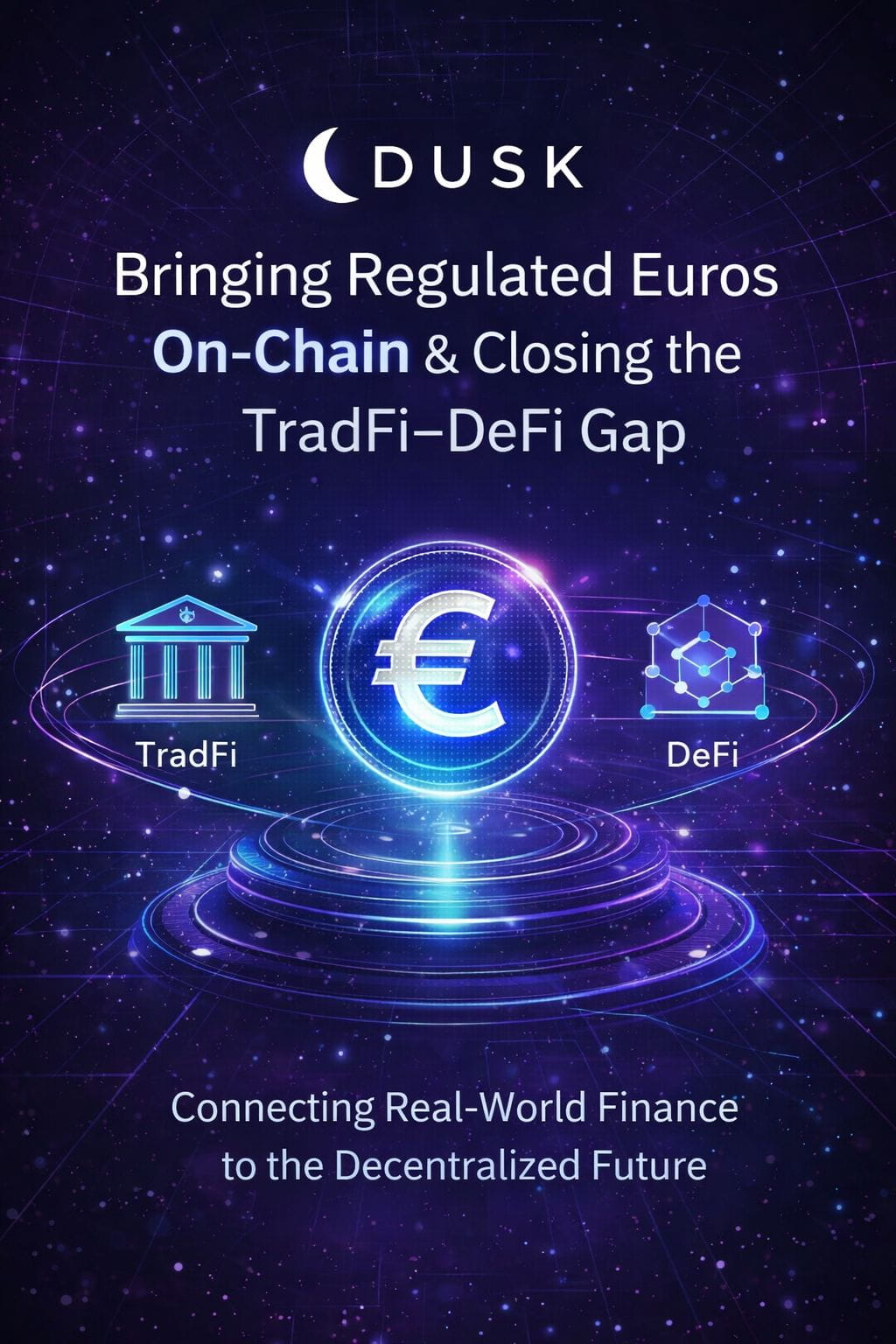
For years, crypto has promised a financial revolution, but most of that revolution stayed trapped inside the “crypto sandbox.” We built markets, created new assets, and experimented with DeFi—yet the biggest part of the global economy still remained outside. The reason is simple: real money doesn’t move at scale without regulation, compliance, and trusted infrastructure. And this is exactly where Dusk Network is building a serious edge. Dusk isn’t trying to compete as a general-purpose hype chain. It is positioning itself as a purpose-built network for regulated on-chain finance, where stable digital money, tokenized assets, and compliant financial tools can finally exist together.
The most exciting part is that Dusk isn’t talking about this future in theory—it is actively building it through real partnerships and practical financial integrations. When regulated digital euros like EUROQ enter the Dusk ecosystem, it signals something bigger than “another stablecoin launch.” It signals a major evolution in what blockchain can become: a place where real currency instruments can flow through on-chain rails, connect to regulated markets, and support financial activity that looks closer to the real economy than speculative trading.
This matters because the next wave of adoption will not come from louder marketing. It will come from infrastructure that is so useful, so compliant, and so practical that it becomes unavoidable. Dusk is making itself unavoidable by aligning with regulated finance instead of fighting against it.
At the center of this shift is a simple truth: stable value is the key to mass adoption. No matter how fast a blockchain is, it cannot serve as a real financial layer if users can’t reliably store and transfer value. In TradFi, that role is played by currencies like the euro. In blockchain, that role is played by stable assets—but not all stable assets are equal. Most stablecoins were built primarily for crypto trading and liquidity cycles. They work inside crypto, but they often struggle with regulatory clarity and suitability for regulated use cases. Dusk’s direction is different. The ecosystem is intentionally moving toward regulated stable value, built to operate in a financial world shaped by frameworks like MiCA and other compliance standards.
When a regulated euro instrument becomes available within Dusk’s ecosystem, it unlocks something powerful: the ability for real on-chain platforms to function with a stable unit of account that aligns with real economic systems. That means Dusk can support more than DeFi experiments. It can support compliant payment layers, settlement, and even on-chain market activity that needs legally compatible digital currency. This is where Dusk’s strategy becomes crystal clear: bring regulated money on-chain first, and you open the door for regulated markets next.
And regulated markets are exactly the bigger picture here. Dusk has long been working toward infrastructure that supports tokenization and real-world assets. But tokenization alone isn’t enough—you also need the right type of money to power those markets. A regulated digital euro becomes a critical building block for the next stage of Dusk’s ecosystem, because it can act as a stable settlement asset for on-chain financial products. That takes Dusk one step closer to something crypto has talked about for years: a truly functional bridge between TradFi and DeFi.
This bridge is not just a slogan. It is an operational transformation. When Dusk supports regulated currency rails, it becomes easier to onboard non-crypto participants—institutions, regulated platforms, and real investors who demand structure. It also makes it possible for Dusk to expand beyond the narrow categories of crypto usage. The network can enable real payment flows, retail-level transactions, compliant financial settlement, and the kind of large-scale volume that doesn’t depend on speculative hype.
The most impressive part is how Dusk is approaching this with ecosystem thinking. It’s not only about bringing in regulated digital money, but also about creating avenues where that money actually gets used. That means enabling on-chain trading, regulated market structures, and payment systems that can serve both crypto-native and real-world financial participants. When you combine regulated digital money with tokenization, market access expands dramatically. Suddenly the network is not just processing trades between tokens. It’s processing value connected to real economies.
This is also why Dusk Network’s role in regulated finance has a deeper meaning. Many blockchains attempt to attract institutions later, after they already build a user base. Dusk is doing the opposite: it is designing the foundation from the beginning with compliance and real finance in mind. That is important because compliance can’t be patched into infrastructure after the fact. It has to be architected into the system. Dusk understands that if blockchain wants to play in global markets, it must speak the language of regulation while still maintaining decentralization and open innovation.
And this is exactly what makes Dusk’s path feel different from most projects in the space. It’s not chasing narrative cycles. It’s building a long-term financial layer where blockchain becomes the engine underneath regulated value flows—without requiring users to even feel like they’re “using blockchain.” That’s the highest level of adoption: when the system becomes invisible while delivering real utility.
In the end, this isn’t just about a partnership or a single integration. It is about Dusk Network stepping into the role it was built for: becoming a network where regulated finance can operate natively on-chain. That means more real transactions, more stable liquidity, more institutional readiness, and more use cases that go far beyond speculation. Dusk is closing the gap between TradFi and DeFi not through promises, but through real financial infrastructure—where regulated digital euros, on-chain markets, and payment rails are all part of one connected system.
Dusk is not building for the crypto economy alone. It is building for the entire economy. And that is what makes Dusk Network one of the most serious projects to watch in the evolution of regulated Web3 finance.
