
The first time you ship a dApp that real users actually care about, you stop obsessing over transactions and start worrying about something far more fragile: data. Tokens are easy. Data is not. People don’t return to apps because a wallet signed something they return because their content loads instantly, their history is intact, their assets don’t disappear, and their identity feels persistent. When any of that breaks, users don’t rage on Twitter. They just leave. That quiet exit is the real killer in Web3, and it’s why storage has re-emerged as a serious, investment-grade problem.
Walrus exists precisely at that fault line. It’s a decentralized blob storage protocol designed for large, non-transactional data: images, video, audio, AI datasets, game assets, archives everything modern applications rely on but blockchains were never meant to hold. Built by Mysten Labs as a second major protocol alongside Sui, Walrus uses Sui as a coordination and verification layer rather than trying to reinvent execution from scratch. The result is a system optimized not for moving value, but for remembering things reliably. Walrus went live on public mainnet on March 27, 2025, and that date matters because it marks when decentralized storage moved from theory into production-scale reality for Sui-native apps.
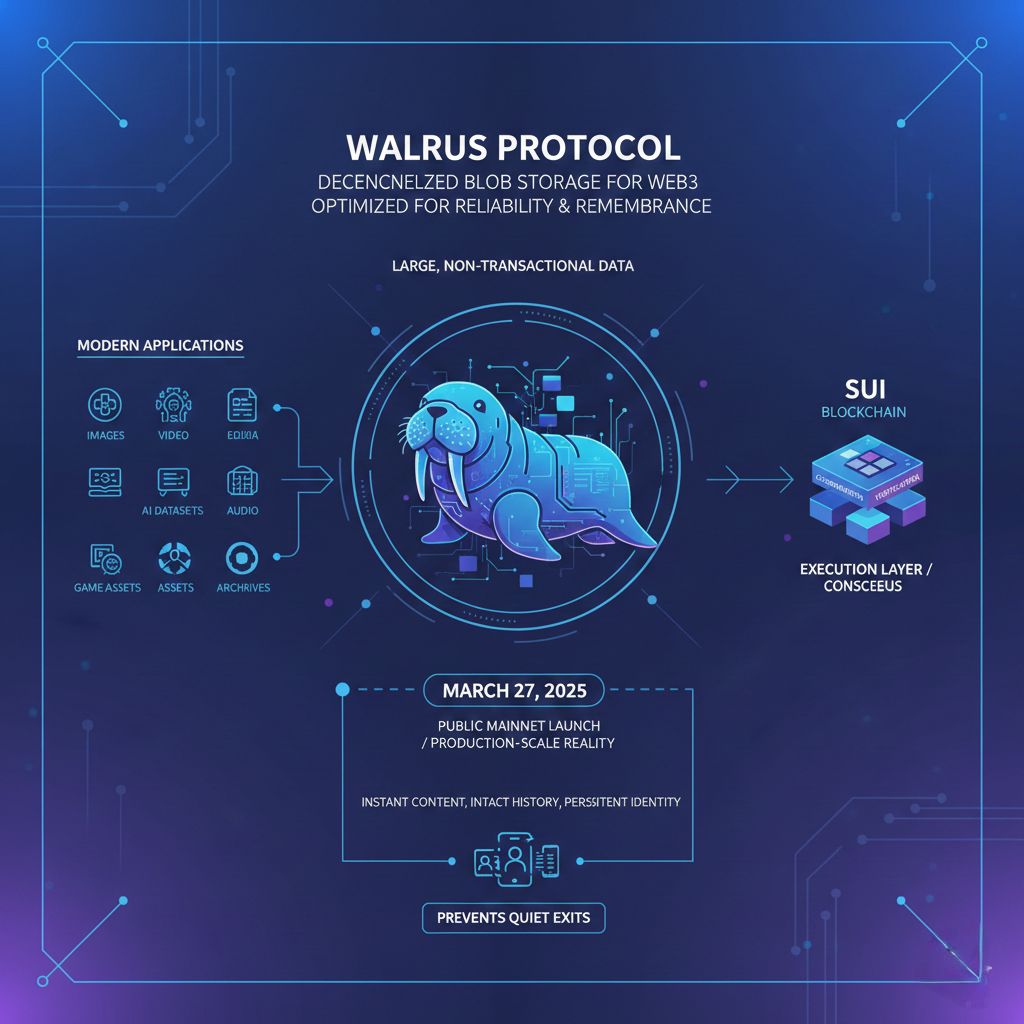
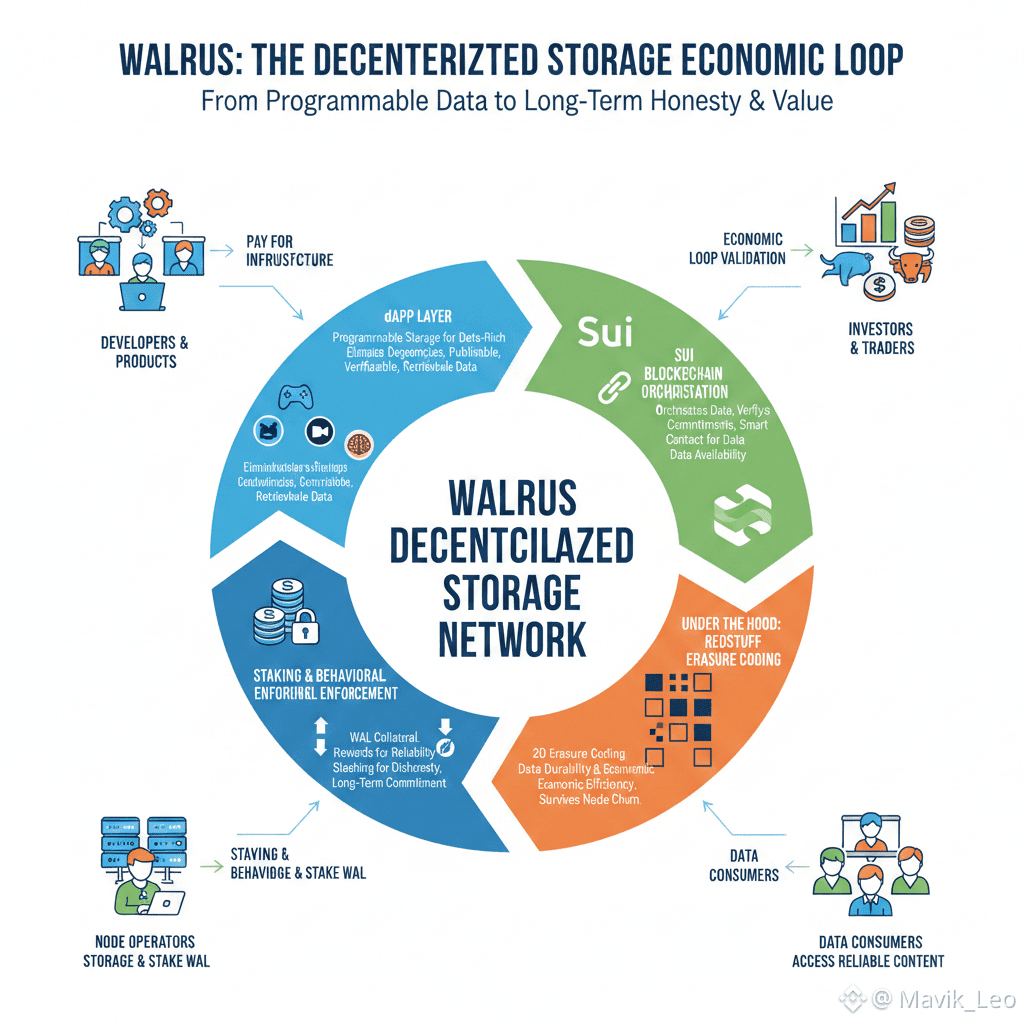
For investors and traders, the real question isn’t whether decentralized storage is philosophically appealing. It’s whether Walrus can become infrastructure that developers keep paying for because leaving it would break their product. That’s where its support for dApps, governance, and staking stops being abstract and starts looking like a real economic loop.
At the dApp layer, Walrus turns storage into something programmable rather than passive. Most Web3 apps today quietly cheat: they store real content on centralized servers and keep only pointers onchain. It works until it doesn’t. Links rot. APIs change. Hosting bills spike. Content gets censored or throttled. Walrus is designed to eliminate that silent dependency by making blobs publishable, verifiable, retrievable, and lifecycle-managed through onchain coordination. Sui’s role is critical here: it orchestrates who stores what, verifies commitments, and allows smart contracts to reason about data availability without bloating the chain itself.
This matters most for apps where data is the product. Games need fast, reliable asset delivery. Social platforms need permanent media and history. Creator tools need resilient video hosting. AI agents need access to large datasets. Even NFTs supposedly “simple” regularly fail because metadata disappears. Walrus positions itself as the middleware that lets these applications feel smooth and responsive without quietly re-centralizing the most important part of their stack.
Under the hood, Walrus uses a research-backed approach to solve the hardest storage problem: long-term honesty. Instead of naive replication, it relies on erasure coding specifically a two-dimensional scheme known as RedStuff to split data into recoverable pieces. The goal is to survive node churn and failures without wasting capital on excessive duplication. In plain terms, Walrus tries to make data durable and economically efficient, which is the only combination that survives at scale.
That technical choice feeds directly into staking. Storage networks fail when nodes are incentivized to behave well only temporarily. Walrus tackles this head-on with a staking model that enforces long-term commitments. Node operators stake WAL as collateral, earn rewards for reliable storage, and face penalties for underperformance or dishonesty. This isn’t just yield farming it’s behavioral enforcement. The protocol’s own documentation is explicit: staking, rewards, and slashing exist to keep data available over time, not just during hype cycles.
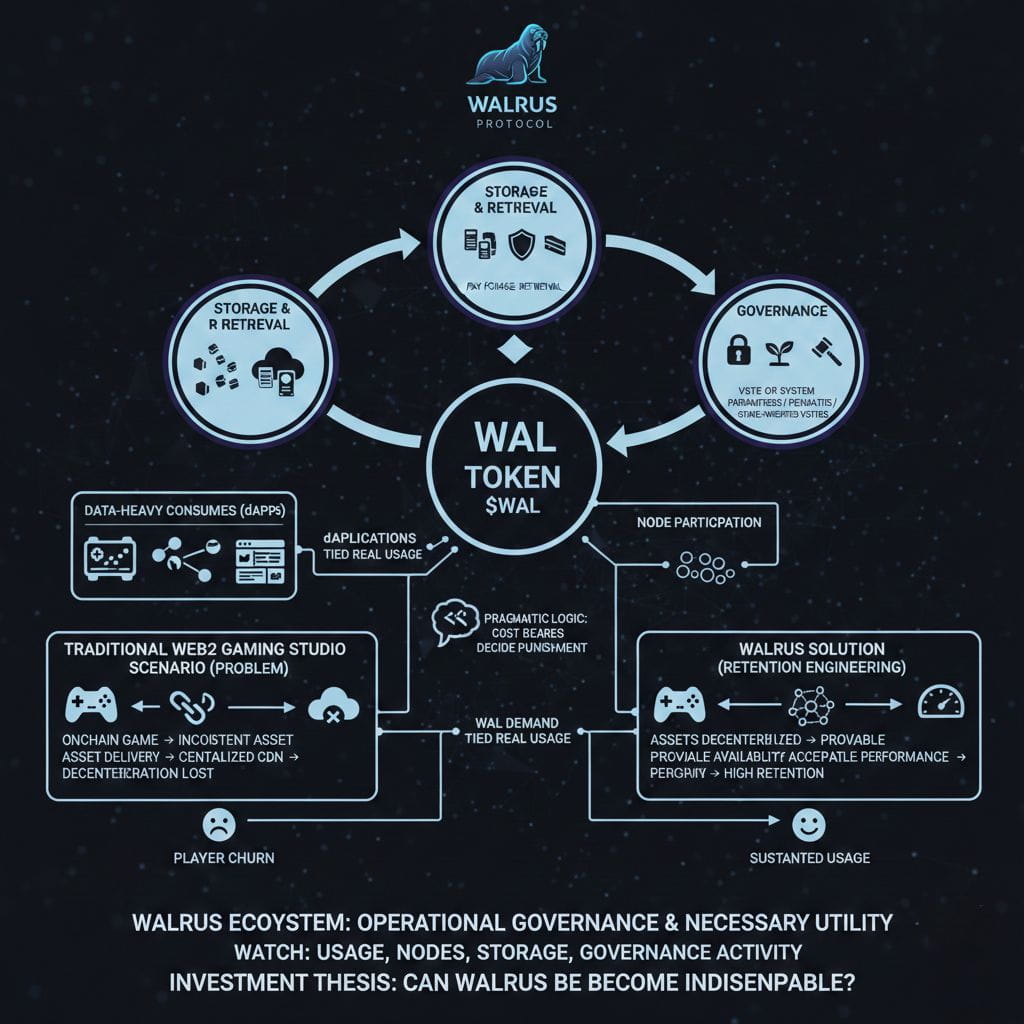
Governance then becomes operational rather than ideological. Walrus governance, conducted through the WAL token, focuses on tuning system parameters especially penalties. Nodes vote with stake on how strict the system should be. The logic is refreshingly pragmatic: the people who bear the cost of failures should help decide how harshly failures are punished. That’s the kind of governance infrastructure investors prefer, because it prioritizes system health over narratives.
WAL sits at the center of all of this. It’s used to pay for storage and retrieval, to stake for security and rewards, and to vote in governance. If Walrus gains adoption as a default storage layer, WAL demand becomes tied to real usage rather than abstract utility claims. Staking reduces liquid supply, rewards long-term participation, and strengthens the network at the same time. That doesn’t guarantee price appreciation but it does create a coherent supply demand structure, which is rarer in crypto than most people admit.
Consider a simple scenario. A gaming studio launches an onchain title. Early traction is strong, but asset delivery becomes inconsistent as usage grows. Players don’t complain; they just stop logging in. The studio “fixes” the problem by moving assets to a centralized CDN, quietly undermining the entire decentralization story. Walrus is designed to remove that tradeoff. Assets stay decentralized, availability is provable, and performance remains acceptable. That’s not ideological purity it’s retention engineering.
Retention is the real hidden alpha. Attention is cheap. Reliability is not. Protocols that survive aren’t the loudest; they’re the ones apps can’t afford to abandon. Walrus is betting that the next wave of Web3 won’t be DeFi-only, but data-heavy consumer products. If that bet is right, storage stops being background infrastructure and becomes a critical dependency.
If you’re trading WAL, watch more than charts. Track usage, node participation, storage demand, and governance activity. If you’re investing, the question is simpler and harder at the same time: can Walrus become so embedded in dApps that leaving it feels painful? That’s when tokens stop being traded narratives and start becoming necessary tools.
Blockspace gives applications motion. Storage gives them memory. Walrus isn’t trying to shout its way into relevance it’s trying to make itself unavoidable.

