

In the early days of Web3, most conversations revolved around money. Tokens, incentives, yield, speculation. Infrastructure was there, but it stayed in the background, quietly doing just enough to keep experiments alive. As the ecosystem matured, something became clear: value alone cannot carry a decentralized world forward. Information does. And the way that information is stored, accessed, and controlled determines whether Web3 evolves into a usable digital society or remains a niche experiment.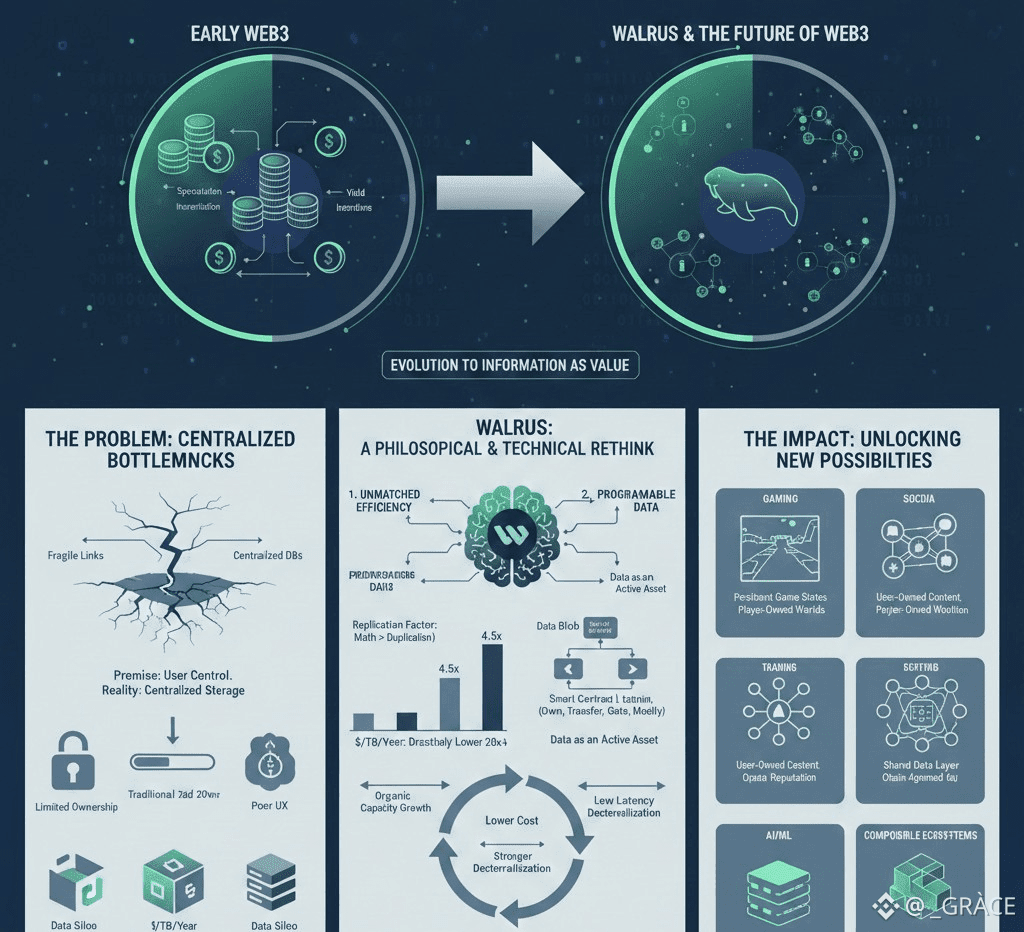
Data is the quiet backbone of every meaningful application. Social platforms depend on it. Games rely on it. AI systems are built on it. Yet for years, decentralized systems treated data as an inconvenience rather than a core concern. Blockchains excelled at agreement but struggled with anything large, dynamic, or persistent. Developers learned to work around limitations instead of solving them, stitching together centralized databases with decentralized logic and hoping users wouldn’t notice the cracks.
That tension created a contradiction at the heart of Web3. The promise was user ownership and trust minimization, but the reality often involved centralized storage providers, fragile links, and performance tradeoffs that pushed mainstream users away. The result was an ecosystem that spoke the language of decentralization while leaning heavily on centralized foundations.
Walrus enters this landscape not as a patch or a workaround, but as a rethink. It treats data as something that deserves the same rigor and intentional design as consensus or execution. Instead of asking how decentralized systems can tolerate weak storage, it asks how storage itself can become decentralized without losing speed, reliability, or accessibility.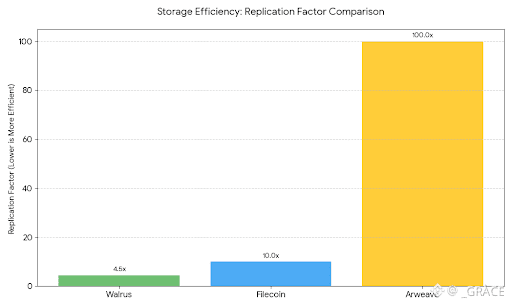
What makes this shift important is not a single technical breakthrough, but a philosophical one. Walrus is built on the idea that decentralization should feel invisible to the user. People do not wake up wanting to interact with distributed systems. They want experiences that respond instantly, behave predictably, and respect their autonomy. Infrastructure that demands patience or technical literacy becomes exclusionary by default.
At the center of Walrus is a data model that does not rely on blunt duplication. Traditional decentralized storage systems often default to replication, copying the same data across many nodes to ensure availability. While effective, this approach becomes expensive and inefficient at scale. Costs rise, redundancy balloons, and participation becomes limited to well-funded operators.
Walrus takes a more nuanced approach. Data is broken into fragments and distributed across the network in a way that preserves recoverability without unnecessary excess. The system does not depend on any single node or group of nodes. Instead, resilience emerges from mathematics rather than trust. Even when parts of the network fail or disappear, the data remains intact and reconstructible.
This design choice changes the economics of decentralized storage. Lower overhead means lower costs. Lower costs invite more participants. More participants strengthen decentralization. It is a feedback loop that aligns incentives instead of fighting them.
But efficiency alone does not create innovation. What makes Walrus particularly interesting is how it connects storage to programmability. Data is not treated as inert files sitting on a network. It becomes an active component of on-chain logic. Stored objects can be referenced, transferred, restricted, or unlocked based on conditions defined in smart contracts.
This transforms storage from a passive service into a composable layer. Developers can design applications where access to information is as programmable as access to funds. A dataset can be owned collectively, licensed temporarily, or revealed incrementally. Content can be gated without relying on centralized servers. Digital artifacts can persist independently of any single application or platform.
In practice, this opens doors across multiple sectors. In gaming, assets are no longer limited to static tokens or metadata pointers. Entire game states, environments, or user-generated content can live in a decentralized yet performant storage layer. Players are not just owners of items; they are custodians of experiences.
In decentralized social platforms, the implications are even more profound. Today’s social networks extract value by controlling data. Posts, connections, and identities are locked inside proprietary systems. Walrus supports a different model, where users retain control over their content while applications compete on experience rather than ownership. A post can outlive the platform that displayed it. A reputation can travel across ecosystems without being trapped.
AI adds another dimension to this conversation. Machine learning systems depend on vast amounts of data, and centralized control over datasets creates power imbalances. By enabling decentralized, resilient storage for large datasets, Walrus makes it possible to imagine AI models trained, shared, and governed in more open ways. Researchers can collaborate without surrendering control. Communities can decide how their data is used instead of donating it to opaque systems.
Scalability is often discussed in terms of transactions per second, but for many applications, data throughput matters just as much. An application that settles instantly but takes seconds to load content feels broken to users. Walrus is designed with this reality in mind. Its architecture supports high-performance access patterns that align with real-world usage rather than idealized benchmarks.
Equally important is how the system grows. As more nodes join the network, capacity increases organically. There is no fixed ceiling or centralized bottleneck. Recovery processes happen automatically, without manual intervention or privileged actors. This self-maintaining behavior reduces operational complexity and lowers the barrier to participation.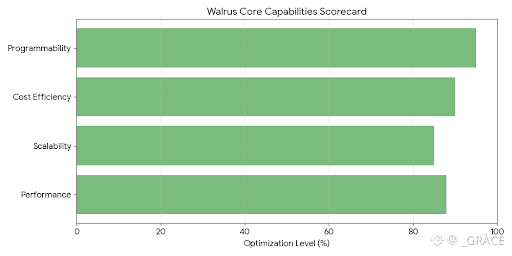
Decentralization is not only a technical property; it is a social one. Systems that are difficult to operate tend to concentrate power among specialists. By simplifying participation and reducing resource requirements, Walrus encourages a broader range of contributors. This diversity strengthens the network not just in size, but in resilience.
There is also an ethical dimension to performance that often goes unspoken. Slow or expensive systems disproportionately affect users in regions with limited resources. When every interaction costs more than a day’s wages, participation becomes theoretical rather than practical. Infrastructure choices shape who gets to be included. By prioritizing efficiency and cost control, Walrus addresses this imbalance at a foundational level.
Another notable aspect of Walrus is its compatibility with a fragmented ecosystem. Web3 is no longer a monolith. Different chains optimize for different goals, from privacy to speed to compliance. Storage should not force developers to choose sides. Walrus is designed to exist alongside this diversity, serving as a shared data layer that adapts to where innovation is happening.
This flexibility matters because the future will not belong to a single chain or standard. It will belong to systems that can communicate, compose, and evolve together. Infrastructure that assumes permanence or dominance becomes brittle. Infrastructure that assumes change becomes durable.
What sets Walrus apart is that it does not frame these choices as tradeoffs. Decentralization is not positioned against usability. Security is not positioned against speed. Instead, the system is built on the assumption that mature technology should reconcile these tensions rather than amplify them.
This mindset reflects a broader shift in Web3 culture. Early experimentation favored ideological purity, sometimes at the expense of practicality. Today, builders are more willing to ask hard questions about user experience, sustainability, and long-term viability. Walrus fits into this phase not as a trend, but as a foundational response to lessons learned.
The true impact of infrastructure often becomes visible only in hindsight. Few users think about how data is routed or stored when an application works seamlessly. That invisibility is a sign of success. When systems fade into the background, they allow creativity to take center stage.
Walrus is designed to disappear in this way. Not because it lacks identity, but because its purpose is to empower others. Developers build without worrying about storage constraints. Users interact without sensing friction. Data persists without dependence on any single entity.
Ownership, in this context, becomes meaningful. Not symbolic ownership expressed through tokens, but practical ownership expressed through control, portability, and durability. Data does not vanish when a service shuts down. It does not become inaccessible because a company changes direction. It exists independently, aligned with the interests of its creators and users.
As Web3 moves from experimentation to infrastructure, the question is no longer whether decentralization is possible, but whether it can be humane. Systems must respect time, attention, and access. They must scale without extracting excessive value. They must serve people who will never read a whitepaper.
Walrus contributes to this future by redefining how data fits into decentralized systems. It shows that storage does not have to be an afterthought or a compromise. It can be a catalyst.
When data becomes reliable, flexible, and truly owned, innovation stops fighting the infrastructure and starts flowing through it. That is the quiet power of well-designed foundations. They do not announce revolutions. They make them inevitable.

