

@Walrus 🦭/acc entered the conversation quietly, the way serious ideas often do after the obvious points have already been exhausted. Someone raised a question that sounded almost casual what if our core assumptions about security in decentralized storage aren’t wrong, just misaligned? Not flawed, but focused on the wrong layer. The more I thought about it, the more familiar design choices began to feel surprisingly brittle.
After enough time watching on-chain systems fail, a pattern becomes hard to ignore. Breakdowns rarely come from weak cryptography. They come from incentives drifting over time, operators acting rationally under pressure, and recovery costs creeping upward until only a handful of large players can afford to behave correctly. Walrus doesn’t attempt to repair these outcomes after they appear. It avoids them by redefining where trust is allowed to exist.
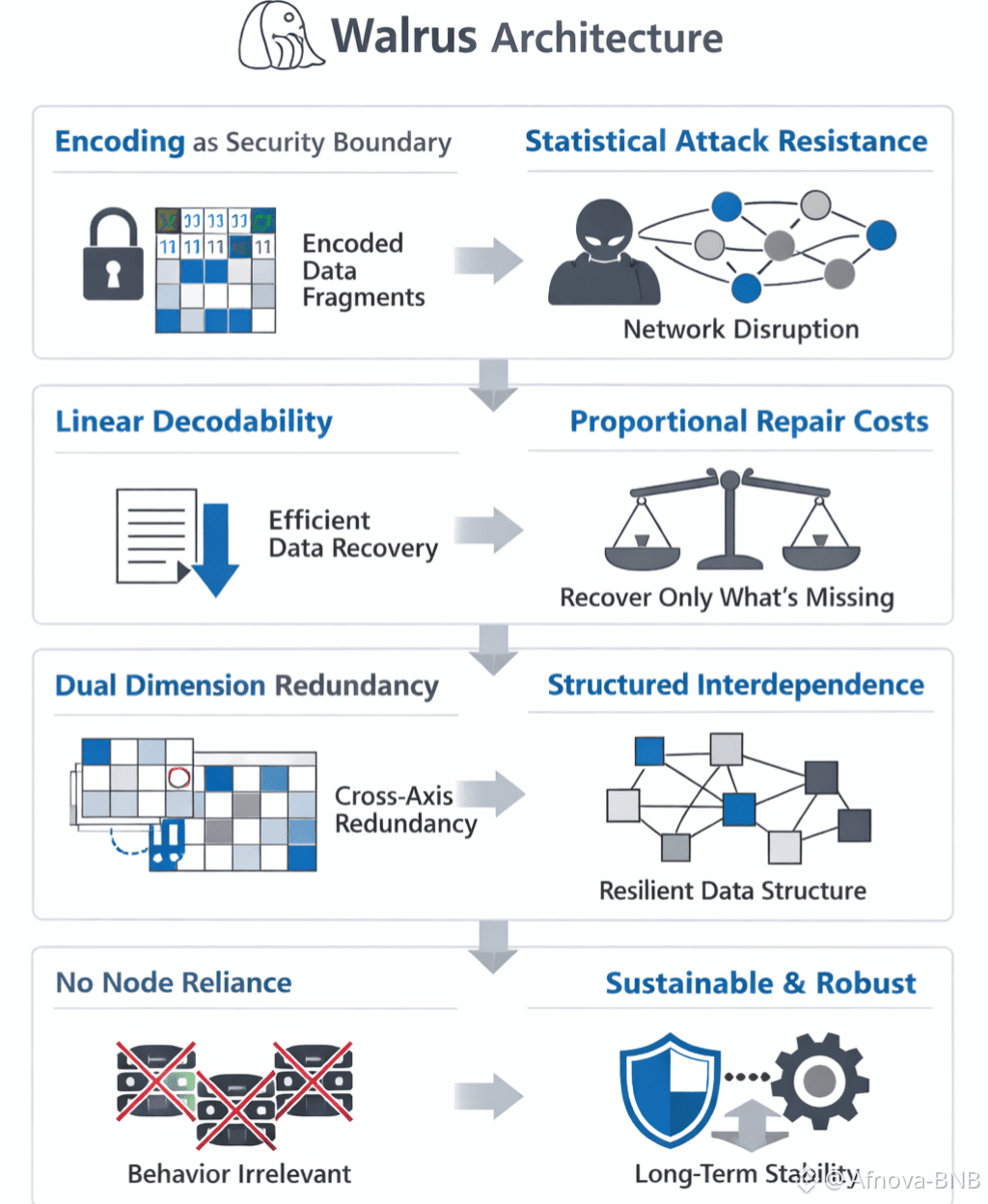
In Walrus, encoding isn’t a convenience or an optimization it’s the security boundary itself. Many storage systems still rely on the idea that if you choose the right operators, punish bad behavior, and replicate data aggressively, correctness will eventually emerge. That logic works until it suddenly doesn’t. Walrus removes the need to care about individual node behavior altogether. If enough encoded fragments are present, the data is recoverable. If they aren’t, no amount of coordination can save it. The rule is stark, but it’s honest.
This reframes the entire threat model. You stop worrying about which node might go offline or which operator might cut corners during a downturn. The only meaningful attack becomes statistical in nature. An adversary must disrupt a significant portion of the network simultaneously, rather than exploiting isolated weaknesses. Misbehavior doesn’t corrupt the system it simply stops mattering. That isn’t faith in incentives; it’s mathematics replacing them.
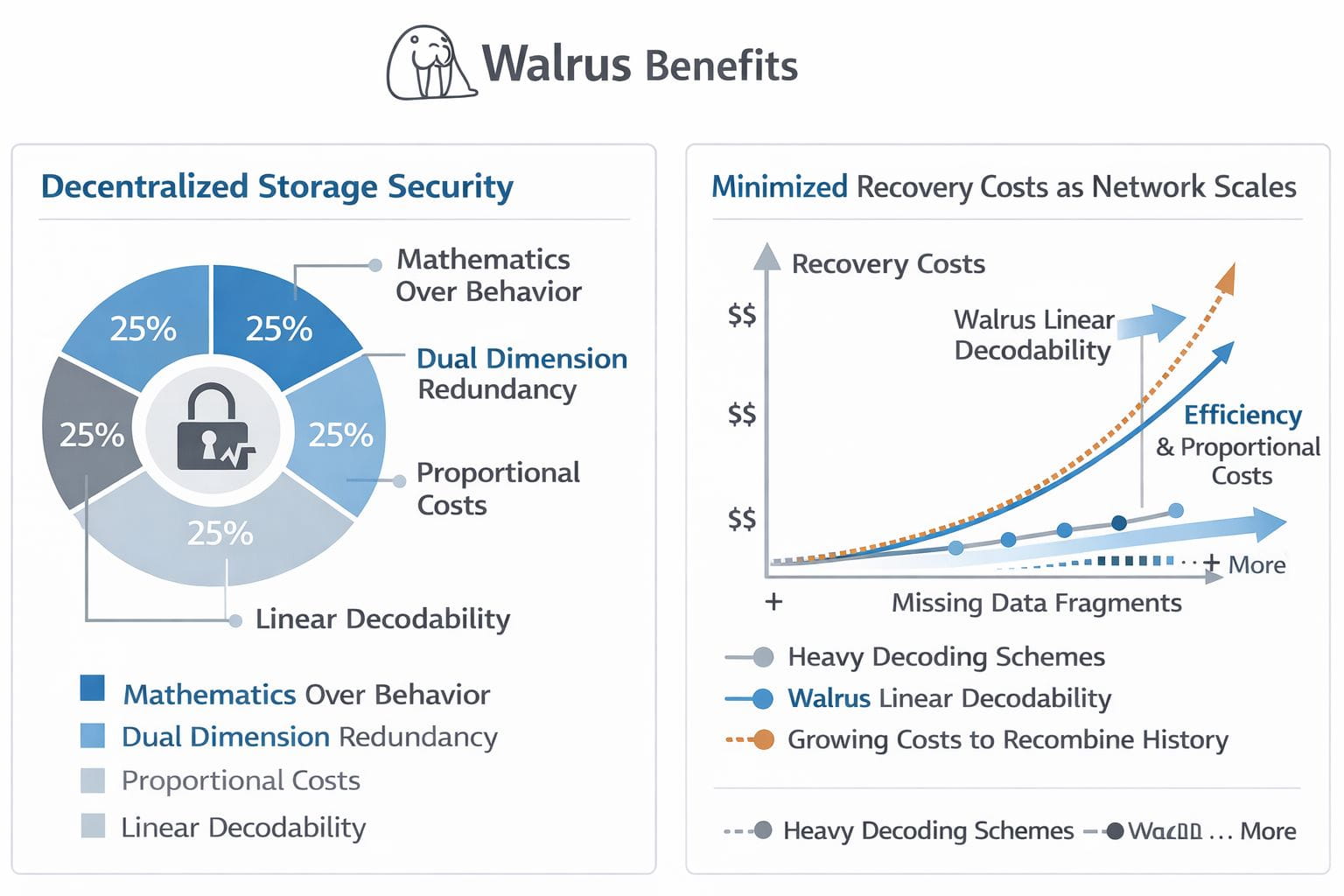
One of the most underestimated challenges in decentralized infrastructure is recovery cost. Not theoretical storage overhead, but the real-world expense of rebuilding after partial failure. Heavy decoding schemes look acceptable in early stages. Over time, they quietly centralize participation. Only the best-capitalized operators can afford repeated large-scale recomputation. Everyone else either exits or becomes dependent.
Walrus takes a different route by enforcing linear decodability. Recovery effort grows only with what’s missing, not with the entire history of stored data. It’s a subtle choice with long-term consequences. When failures happen and they always do recovery is proportional rather than punitive. The system bends instead of breaking.
That property matters more than it gets credit for. DeFi is already full of mechanisms that appear neutral while quietly rewarding short-term behavior. Systems that impose sudden, heavy recovery costs push operators to overprotect, over-replicate, or leave at the first sign of stress. Linear recovery removes that pressure. You repair what failed, not everything at once. Sustainability becomes mechanical rather than aspirational.
Redundancy is handled with the same discipline. Most networks choose between two inefficient extremes full replication that burns capital, or thin fragmentation that collapses under correlated failures. Walrus rejects that binary. By introducing redundancy across two independent dimensions, it ensures that no fragment ever stands alone. Each piece participates in multiple recovery paths without being blindly duplicated.
At this point, the design starts to feel almost philosophical. Resilience doesn’t come from hoarding copies it comes from structured interdependence. Loss along one axis is offset by strength along another. Efficiency isn’t achieved by storing less, but by storing more intelligently. Capital isn’t wasted on brute-force safety it’s embedded in the relationships between fragments.
Anyone who has watched systems age learns to distrust designs that only look strong when conditions are perfect. Real stress shows up slowly creeping correlations, rising operational costs, governance exhaustion. Walrus doesn’t claim to fix human behavior. It limits how much damage that behavior can inflict. Governance can stagnate. Nodes can disappear. Operators can leave. The data remains intact.
What stands out isn’t cleverness. Plenty of clever systems fail once they meet reality. What stands out is restraint. Walrus doesn’t chase narratives or growth curves. It assumes networks will age, incentives will blur, and participants will change. Its answers are structural, not motivational.
In the long run, the protocols that endure are rarely the loud ones. They’re the ones that quietly remove fragility. Walrus exists because too much on-chain value rests on storage assumptions few people want to examine closely. By shifting security from behavior to mathematics, from promises to reconstruction, it addresses a problem most only notice after something breaks.
That’s why Walrus matters. Not because it will redefine everything overnight, but because it’s built to remain functional after the noise fades doing its job steadily, without asking for attention.

