
Privacy in blockchain has often been treated as absolute. Either everything is visible or everything is hidden. This framing does not work in the real world. Financial systems operate on context. What must be private in one situation may need to be provable in another. When I look at how Dusk approaches privacy, what stands out is not secrecy but adaptability.
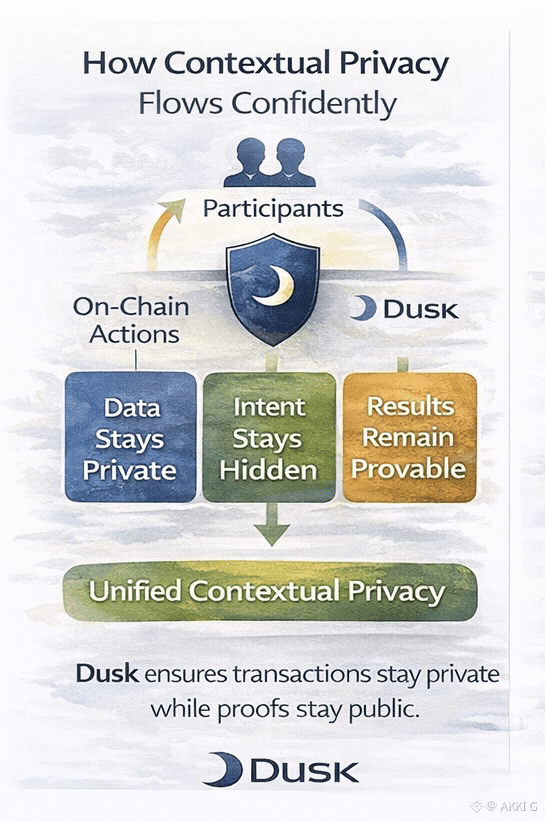
Dusk introduces contextual privacy, where intent, execution, and sensitive data remain protected, while outcomes and compliance proofs remain verifiable. This allows participants to operate without fear of exposure while still enabling oversight when required. It reflects how real institutions function. Internal strategies are private. Final results are auditable.
This design prevents two common failures. The first is surveillance chains, where excessive transparency discourages participation. The second is opaque systems, where total secrecy prevents trust. Dusk sits between these extremes. Privacy becomes a tool that adapts to circumstances rather than a rigid rule.
What makes this powerful is how naturally it fits regulated environments. Regulators do not need full visibility. They need proof that rules were followed. Dusk provides that without forcing participants to reveal everything all the time. In my view, this is how privacy becomes usable infrastructure rather than ideological design.
