

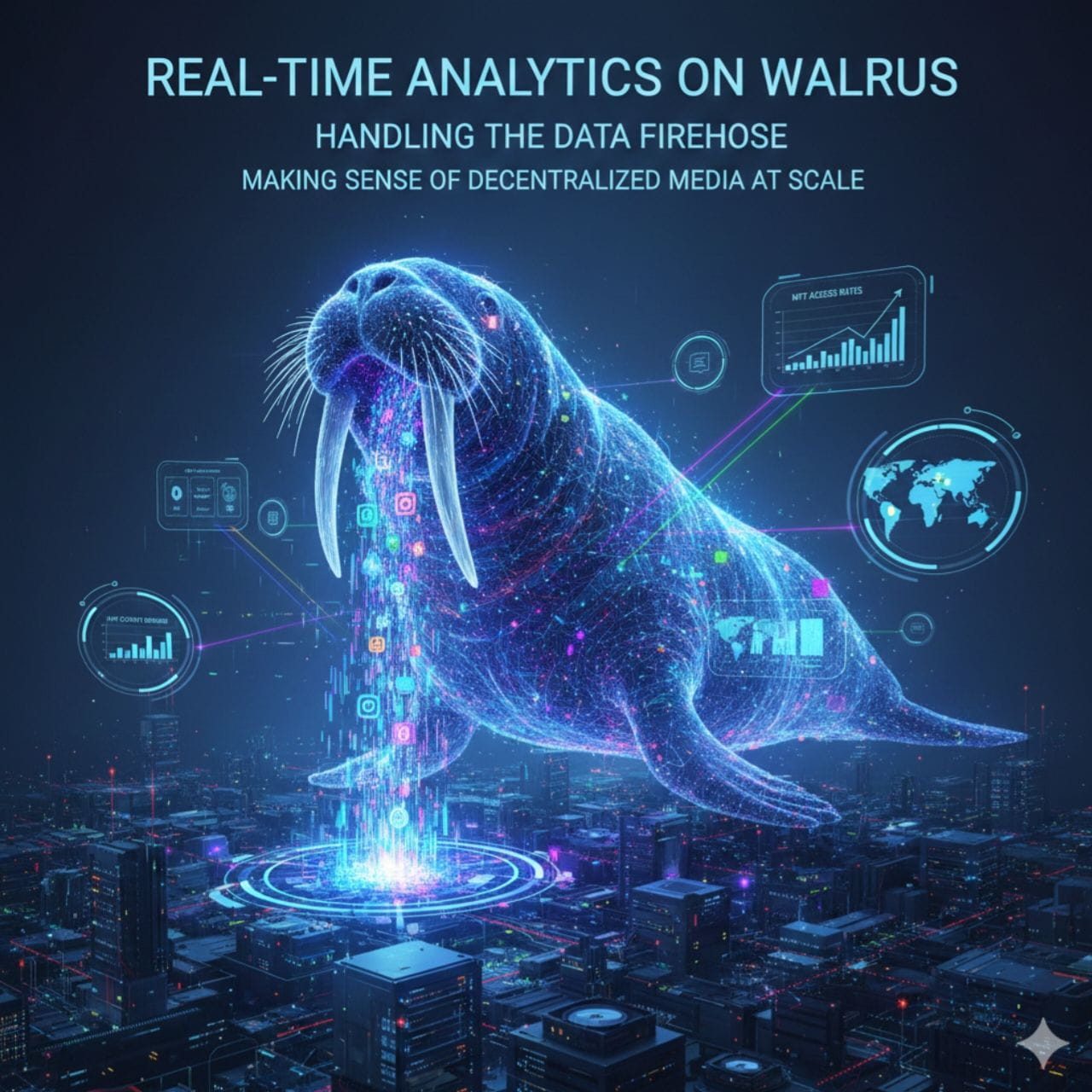
Handling the Data Firehose
Making sense of decentralized media at scale
Web3 apps are generating more data than ever before. NFTs are constantly changing, AI assets are updating themselves in real time, games are producing nonstop streams of activity, and users are always clicking, posting, or playing. It’s an overwhelming flood—one that developers must keep pace with if they want to truly understand what’s happening within their applications.
With centralized systems, analytics are straightforward—insights are built in by design. But when it comes to decentralized storage, things get much more complicated. Walrus is designed to enable real-time insights, all without sacrificing the decentralized nature of the ecosystem or reverting to centralized oversight.
Why Real-Time Analytics Matter in Web3
Analytics go far beyond just creating attractive charts. They are vital for keeping your application running smoothly. They help you detect issues early, optimize storage usage, and accurately understand how users are interacting with your platform.
Without immediate, accurate data, developers are left guessing. Delayed or missing information can result in broken features, inefficient storage, and slow response to critical issues.
This challenge is even more pronounced in decentralized environments—you need powerful insights without aggregating all data into a single central point.
The Analytics Challenge with Decentralized Storage
Walrus distributes large media files across numerous independent nodes. This architecture delivers superior resilience and redundancy, but it also makes observing system behavior much harder.
Here’s what complicates things:
- Data is stored on countless different machines
- Files are being uploaded, downloaded, and checked continuously
- The files themselves are large, and the overall network traffic is massive
Traditional analytics tools are built to operate on a single, unified database. In contrast, Walrus is more like managing traffic across an entire city—you need to understand the flow without attempting to control every individual vehicle.
How Walrus Handles the Data Firehose
1. Event-Based Data Streams
Walrus monitors for structured events rather than examining every file in detail. Whenever there’s an upload, retrieval, or availability check, it logs a discrete signal. These signals are lightweight and can be analyzed almost instantaneously.
The key advantage? Lower overhead and enhanced privacy.
2. Aggregation Without Centralization
Instead of forcing all data into a centralized repository, Walrus allows the aggregation of metrics across the entire network. Each node contributes just enough information to provide meaningful statistics, but never exposes the actual file contents.
It’s similar to counting the number of packages passing through a warehouse—you don’t need to open each one to gather useful insights.
3. Developer-Friendly Access
Walrus analytics are designed to integrate seamlessly with dashboards and monitoring tools. Developers can rapidly identify usage trends, pinpoint performance bottlenecks, and react quickly when demand spikes.
This is especially critical for AI-driven applications, where usage can surge unpredictably.
Real-World Use Cases
- NFT platforms monitoring media access rates and uptime in real time
- AI tools tracking asset updates and measuring actual usage patterns
- Games and metaverse platforms observing live demand for content
- Infrastructure teams detecting performance issues before they escalate
All these scenarios require rapid, accurate insights—and Walrus delivers them, without undermining the decentralized nature of the network.
Why This Matters Long Term
As Web3 ecosystems expand, it’s essential for storage networks to be easily observable and manageable. Real-time analytics are the foundation for efficiency, reliability, and user trust.
Walrus demonstrates that it’s possible to achieve both decentralization and visibility. With the right architecture, networks can remain open, responsive, and resilient under heavy demand.
Managing a data firehose requires more than just ample storage. True operational effectiveness comes from clear visibility and intelligent system design.
Walrus integrates analytics directly into its core. By providing real-time insights while preserving decentralization, it’s perfectly positioned for the next generation of media-rich, AI-powered Web3 applications.
When evaluating decentralized storage solutions, always ask how they handle analytics. Robust infrastructure is not only about storing data efficiently—it’s about understanding data as it flows through the network.
Educational overview of how Walrus enables real-time analytics for decentralized media and AI-driven Web3 applications.
Disclaimer: Not Financial Advice.

