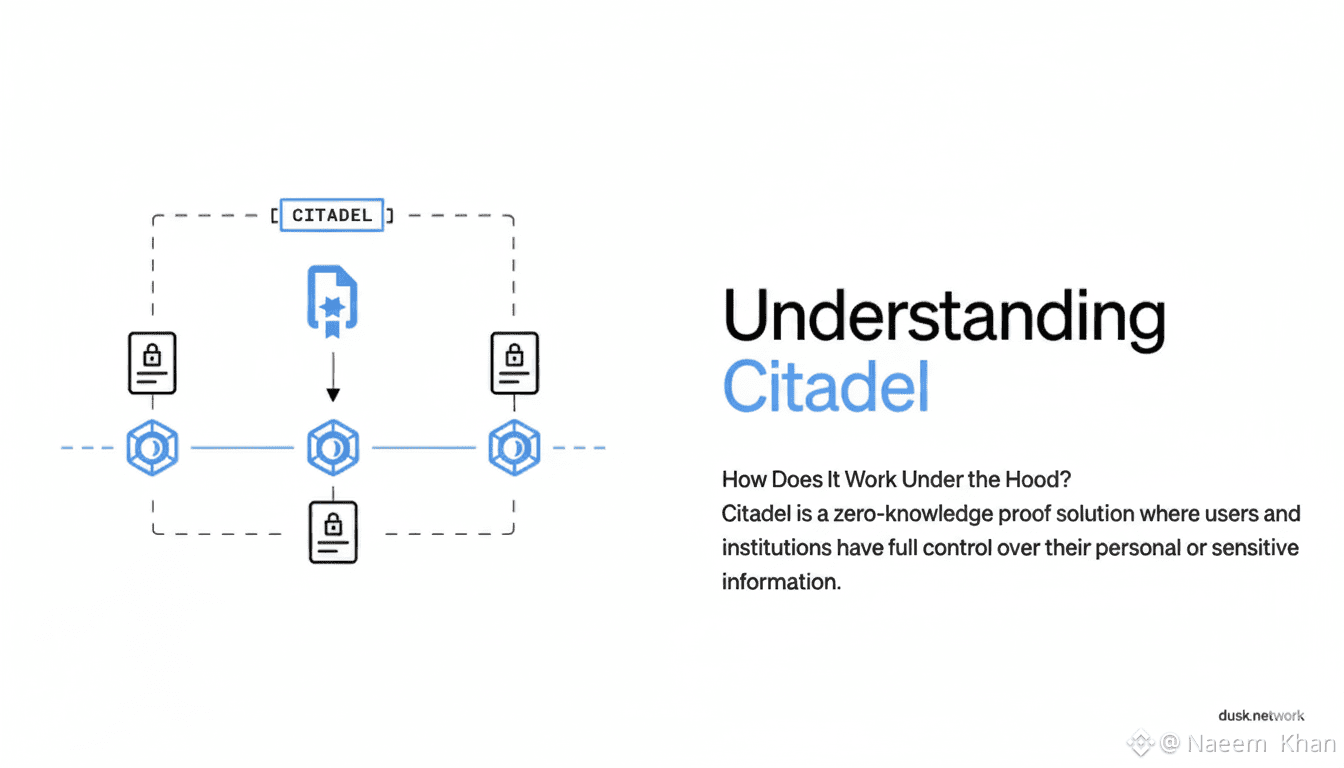
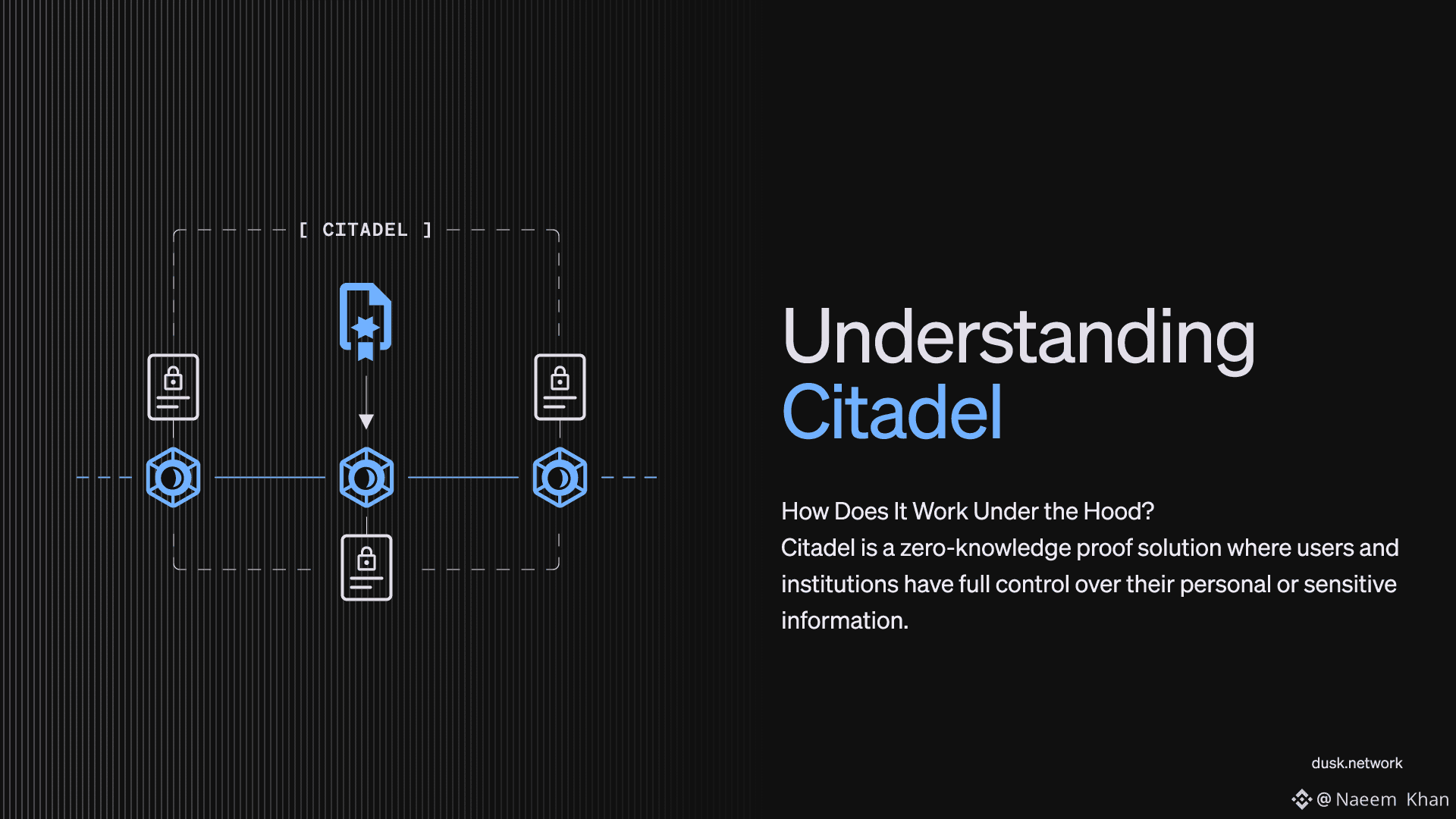
 In an era where digital privacy is under constant threat, Dusk Network is redefining how individuals and institutions manage sensitive information. Built with privacy, security, and self-sovereignty at its core, Dusk enables groundbreaking applications like Citadel, a zero-knowledge proof (ZKP) protocol that empowers users to maintain full control over their personal data while interacting with services online.
Traditional digital platforms often require users to relinquish control of their identities. On Web2 systems, companies store, manage, and monetize your data, making users dependent on centralized authorities. Dusk Network challenges this paradigm, offering a privacy-first, decentralized blockchain infrastructure that allows users to interact with services confidently, knowing their information remains secure. Citadel, one of Dusk’s flagship privacy applications, exemplifies this shift by providing self-sovereign identity (SSI) capabilities with unprecedented security and transparency.
Self-Sovereign Identity with Citadel
At its heart, Citadel enables users to manage their identity transparently and privately. Through Dusk Network, users can prove ownership of licenses, tickets, or credentials without exposing any additional personal information. This is achieved through zero-knowledge proofs, which verify statements (such as license ownership) without revealing underlying details.
The Citadel protocol ensures four key properties:
Proof of Ownership: Users can prove they own a license or credential without exposing the license itself.
Proof of Validity: Service providers (SPs) can revoke or update licenses, which are stored in a Merkle tree on Dusk, allowing users to verify a license’s current validity securely.
Unlinkability: Any user activity cannot be correlated with other actions, ensuring total privacy across interactions.
Decentralized Nullification: Once a license is spent, the network records it as used, preventing duplicate usage.
How Citadel Works
The backbone of Citadel is a novel private NFT model built on Dusk. In this system, NFTs are more than collectibles—they are private digital licenses. Users can mint NFTs representing credentials, access rights, or licenses. Each NFT is tied to a note public key (stealth address) that belongs exclusively to the user, ensuring the NFT cannot be transferred or misused.
When a user requests a license, the service provider verifies payment—potentially in Dusk coins—and mints an NFT containing the license attributes (like a ticket number or access rights). This NFT is sent to the user’s private address, allowing them to use the license securely.
To enforce privacy, the user generates a zero-knowledge proof (ZKP) confirming that the license belongs to them and is valid without revealing sensitive details. This proof is transacted on Dusk, nullifying the license so it cannot be reused. The SP can then verify the session using a secure off-chain “session cookie,” ensuring authentication without compromising privacy.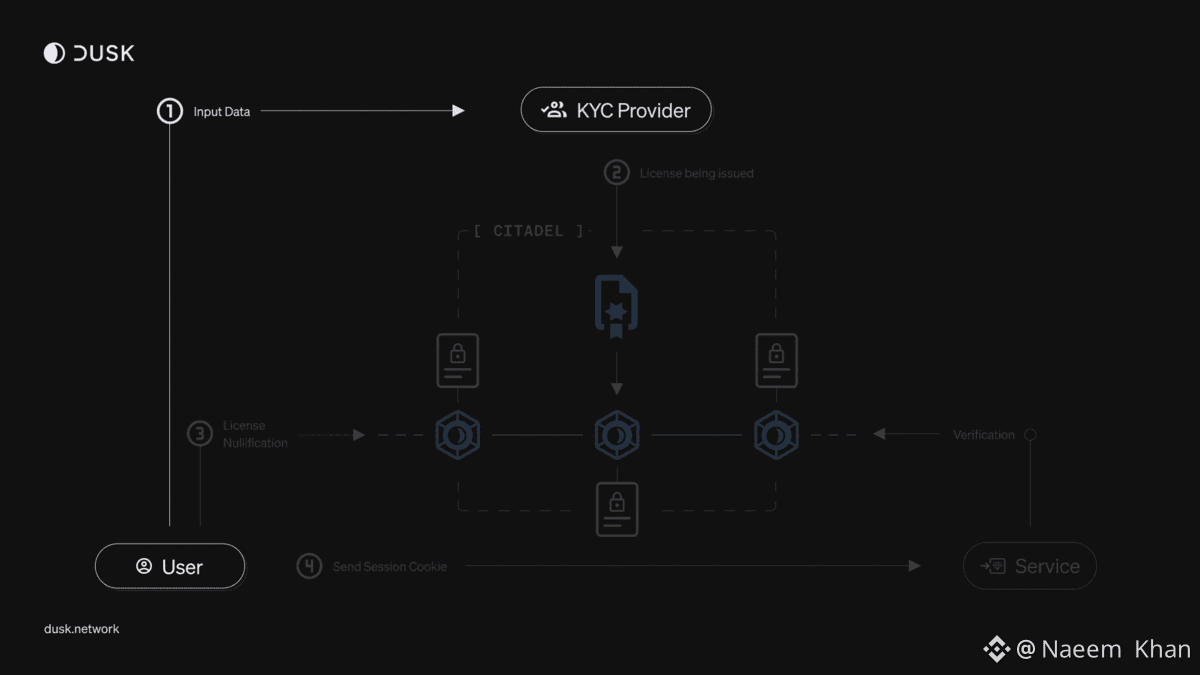
Attribute Blinding: Total Control
One of Citadel’s most innovative features is attribute blinding. Users commit to personal attributes, the SP’s public key, and challenge values privately within the proof circuit. Only the user and SP know these values, ensuring that sensitive information remains confidential while enabling the SP to authenticate transactions accurately.
This combination of private NFTs, zero-knowledge proofs, and attribute blinding guarantees that users have full ownership, control, and privacy over their digital identities. Unlike Web2 platforms, there’s no central authority dictating access or profiting from user data.
Integration with Dusk Network
Citadel fully leverages Dusk’s privacy-preserving blockchain infrastructure. Its operations integrate seamlessly with Dusk’s wallets, proof delegation mechanism, and on-chain architecture. Users don’t need to store extra information or complicated credentials—just their secret seed. Even if they switch devices, licenses and proofs remain accessible securely, without compromising privacy.
The system also allows flexibility in license usage. Depending on the service, licenses can be single-use, recurring, or time-based. This is achieved through dynamic nullifiers, which can change daily, monthly, or per session, while maintaining privacy and security guarantees.
Advantages for Users and Institutions
The Citadel protocol on Dusk Network offers tangible benefits for both creators and institutions:
Privacy-first design: Users control what information is shared, ensuring anonymity where needed.
Ownership and self-sovereignty: Licenses, credentials, and digital assets are fully owned by the user.
Security and immutability: Zero-knowledge proofs and on-chain validation prevent fraud or unauthorized access.
Interoperability: Licenses and credentials can be integrated into multiple dApps and services across the Dusk ecosystem.
Ease of use: Users manage licenses with minimal friction, requiring only the Dusk wallet seed for recovery or migration
Institutions benefit from efficient verification, fraud prevention, and compliance while reducing the risks associated with storing sensitive data. By leveraging Dusk’s architecture, SPs can issue, revoke, and track licenses without ever accessing the user’s private information directly.
The Future of Privacy on Blockchain
Citadel represents the next frontier of privacy-preserving applications on Dusk Network. By combining private NFTs, ZKPs, attribute blinding, and Merkle tree verification, it demonstrates how decentralized technology can empower users while maintaining regulatory compliance.
As Dusk Network continues to grow, more developers can build applications that prioritize self-sovereignty, privacy, and secure digital identity management. From event ticketing to professional certifications, licenses, and beyond, the potential applications of Citadel’s architecture are vast.
Dusk Network isn’t just a blockchain for financial transactions—it is a foundation for secure, private, and user-controlled digital interactions, where individuals reclaim ownership over their data and digital lives.
Conclusion
In a world dominated by centralized platforms that exploit user data, Dusk Network and Citadel offer a new paradigm. Privacy, ownership, and security are no longer optional—they are built into the core of the network. By leveraging advanced cryptography, zero-knowledge proofs, and private NFTs, users can interact with services confidently, knowing their personal information is protected.
Dusk Network is more than a blockchain—it is the backbone of a privacy-first digital future, enabling applications like Citadel that empower users, protect identities, and set a new standard for self-sovereign digital interactions.