

A Real-World Approach to Decentralized AI Collaboration
Training smarter models—without sacrificing control over your data
Introduction
AI is becoming increasingly prevalent in all aspects of life, but there’s a significant hurdle: data is sensitive, and most people aren’t willing to just hand it over. Maybe it’s due to privacy regulations, maybe it’s the fear of leaks, or maybe organizations simply don’t want to lose their competitive advantage. Regardless of the reason, sharing raw data is off the table for most groups, even if doing so could help create better AI models that would benefit everyone.
That’s where federated learning comes into play. Instead of moving data to a central server, you move the model to the data. Walrus is the tool that actually enables this to work smoothly within decentralized networks.
Federated Learning, Without the Jargon
Here’s the core idea: many people or organizations want to collaborate to train a shared AI model, but nobody wants to expose their private data. So, each participant trains the model locally on their own data, and then only shares the improvements (not the raw data itself) with the group.
It’s a bit like a group of chefs trading tips to improve a recipe, but everyone keeps their own kitchen and ingredients private.
Why Federated Learning Needs a Decentralized Backbone
The issue is, even federated learning often relies on a central server to coordinate everything. That still creates a single point of failure, or a place where trust is required. That’s not really the ideal scenario.
To create truly decentralized AI, you need decentralized coordination, decentralized storage, and decentralized trust. This is exactly where Walrus steps in.
How Walrus Makes Federated Learning Work
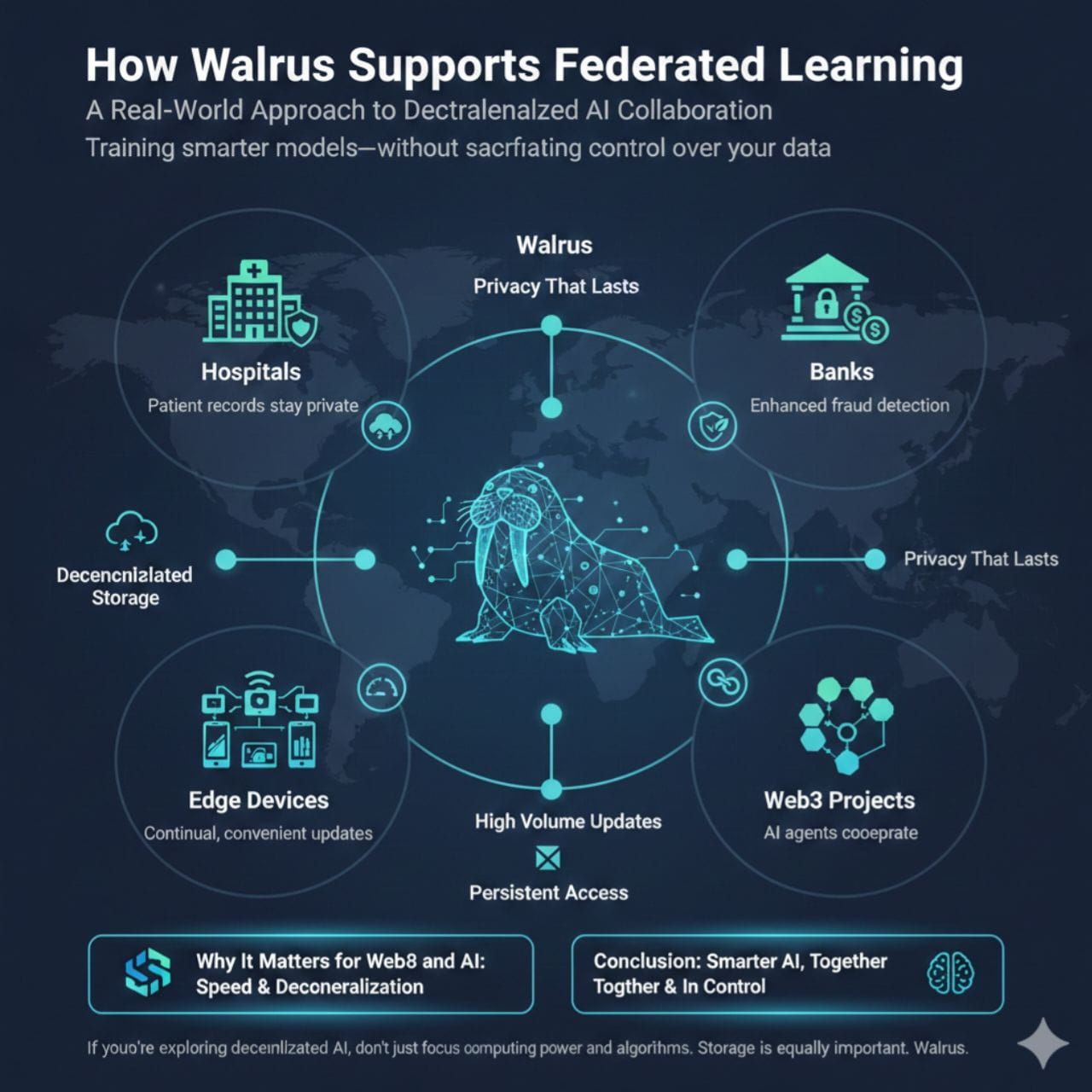
1. Decentralized Storage for Model Components
Walrus distributes all the large AI files—model checkpoints, gradients, updates—across numerous independent nodes. You’re not reliant on a single cloud provider or a single, potentially vulnerable server.
2. Privacy That Actually Lasts
Only the model updates are shared or stored. Your raw training data never leaves its original location, which keeps things private and helps with compliance issues. Walrus is focused on ensuring your data is accessible and unaltered, not on accessing your data itself.
3. Handling a High Volume of Updates
Federated learning means there’s a continuous flow of updates. Walrus is designed to handle high-speed data, so it can easily keep up with the constant back-and-forth of AI training.
4. Persistent Access, Even When Nodes Go Offline
Because everything is distributed, your model updates remain available—even if some nodes become unavailable. This is critical for long-running training jobs that can’t afford to lose progress.
Where This Actually Helps
- Hospitals can collaboratively train AI models, but patient records never leave the premises.
- Banks can improve fraud detection, but sensitive financial data stays secure.
- Edge devices—phones, sensors, and beyond—can participate, sending updates whenever it’s convenient.
- Web3 projects can enable AI agents to cooperate, without depending on any central server.
In all these situations, everyone benefits from better models, without anyone having to give up control.
Why It Matters for Web3 and AI
Federated learning is a natural fit with Web3’s foundational principles: users retain control, privacy is preserved, and the system remains resilient even if some parts fail. Walrus serves as the storage backbone that makes all this possible, and at scale.
Now, you no longer have to choose between speed and decentralization. You can have both.
Federated learning isn’t just another AI trend. It’s fundamentally changing the way we create and share intelligence.
Walrus is at the forefront, offering the decentralized and reliable storage that these systems require. It enables people and organizations to work together, without giving up privacy or control.
If you’re exploring decentralized AI, don’t just focus on computing power and algorithms. Storage is equally important.
Educational overview of how Walrus supports federated learning through decentralized, privacy-preserving data coordination.
Disclaimer: Not Financial Advice.

