

There is an uncomfortable truth in blockchain engineering that rarely gets discussed: many systems only function because a small group of people remember how they work. When those people leave, documentation decays, assumptions drift, and the protocol becomes fragile without realizing it.
Plasma is designed to avoid that fate.
From the beginning, Plasma treats understanding as a dependency, not a byproduct. The system assumes that future operators, developers, auditors, and integrators will arrive without context, without history, and without access to the original designers. That assumption changes how everything is written, structured, and exposed.
In most blockchains, clarity is layered on later. Whitepapers explain intent. Blog posts explain changes. Community members explain behavior. Over time, these explanations diverge. Plasma collapses that separation. Specification, execution, and explanation are tightly aligned. The protocol is built to be read as much as it is built to run.
This has a profound effect on developer experience. Plasma does not optimize for speed of deployment at the cost of cognitive load. Instead, it optimizes for legibility. Interfaces are explicit. Edge cases are named rather than implied. Behavior is described in ways that survive handoff between teams.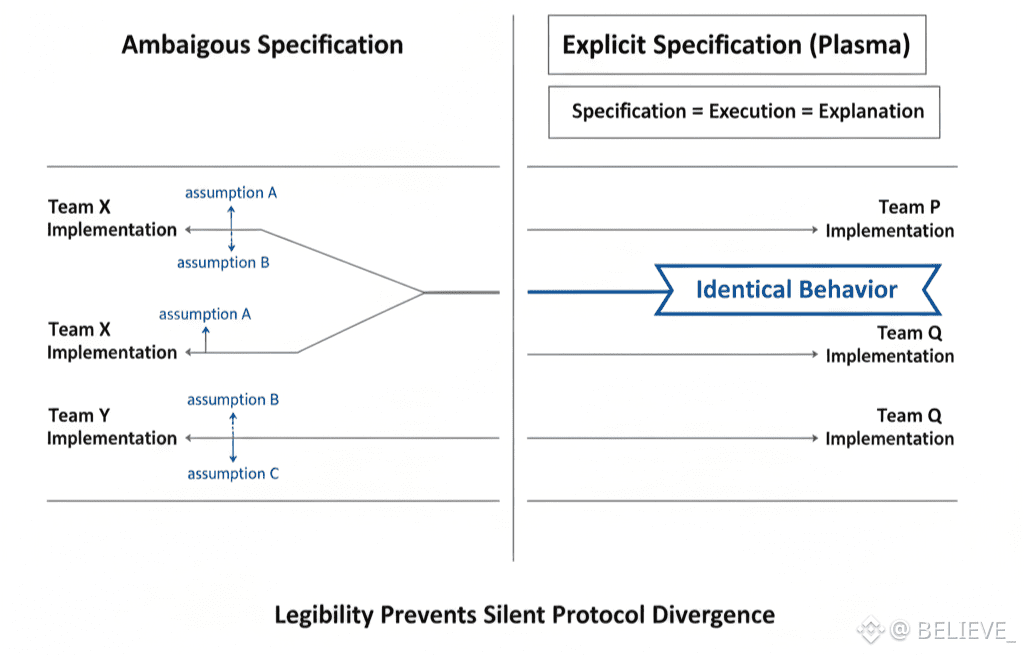
That discipline reduces a common but hidden risk: interpretive divergence. When two teams build against the same protocol but understand it differently, failures emerge quietly and expensively. Plasma minimizes that risk by making ambiguity difficult to introduce in the first place.
One way this shows up is in how Plasma defines behavior boundaries. Many systems rely on informal norms — “this usually doesn’t happen” or “clients shouldn’t do that.” Plasma avoids normative assumptions. If something is unsupported, it is explicitly unsupported. If something is allowed, its consequences are fully specified.
This matters for long-term maintenance. Protocols outlive tools. They outlive frameworks. They often outlive entire programming languages. Plasma’s design anticipates this by keeping core logic simple, stable, and well-scoped. Complexity is pushed outward, where it can evolve without destabilizing the base.
Another subtle but important choice is Plasma’s relationship with formal reasoning. While not everything is formally verified, the protocol is structured so that formal methods are possible where they matter most. State transitions are deterministic. Invariants are clear. Failure conditions are enumerable. This makes the system friendlier to audits, simulations, and long-horizon risk analysis.
In practice, this reduces reliance on trust-by-familiarity. Stakeholders do not need to “know the team” or “understand the culture” to evaluate Plasma. They can evaluate the system itself. That is a critical property when systems are expected to operate across organizations, borders, and generations of contributors.
There is also a cultural implication here. Plasma does not reward cleverness that cannot be explained. Elegant hacks that save lines of code but cost hours of reasoning are avoided. Readability is treated as a form of security. If behavior cannot be explained clearly, it is assumed to be dangerous.
This philosophy stands in contrast to much of crypto’s experimental tradition. Many protocols celebrate innovation through novelty. Plasma celebrates innovation through restraint. It asks a harder question: will this still make sense to someone encountering it for the first time, years from now, under pressure?
The answer to that question determines whether infrastructure remains usable or becomes legacy debt.
Documentation in Plasma is not marketing. It is not aspirational. It is operational. It exists to allow independent parties to reach the same conclusions about system behavior. That consistency is what enables scale without coordination overhead.
From an ecosystem perspective, this approach lowers the barrier for serious integration. External teams do not need insider knowledge to build confidently. Auditors do not need interpretive guidance to evaluate risk. Operators do not need oral history to respond to incidents.
Over time, this produces an ecosystem that is quieter but more resilient. Fewer misunderstandings. Fewer accidental dependencies. Fewer surprises when conditions change.
Plasma understands that systems fail not only when code breaks, but when knowledge fractures. When understanding becomes tribal, infrastructure becomes brittle. By embedding clarity into the protocol itself, Plasma reduces that brittleness at the root.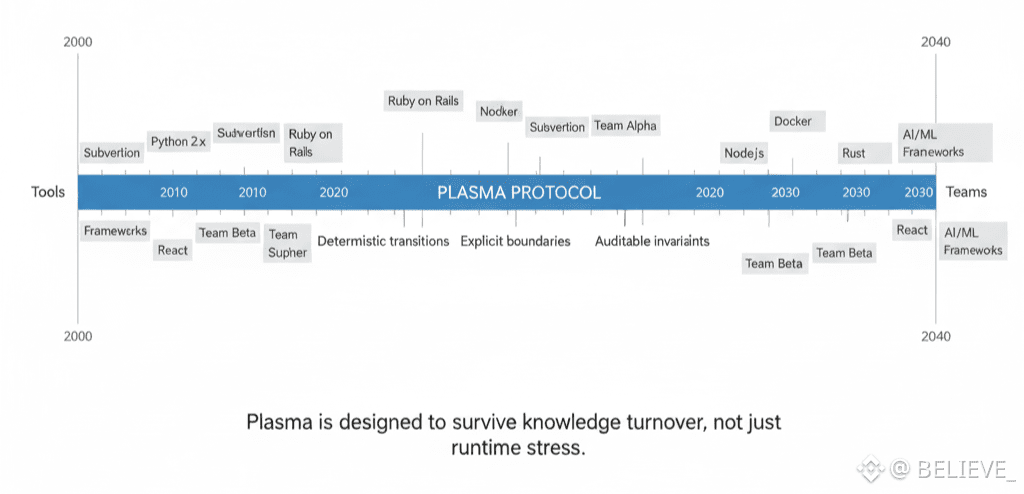
This is not a glamorous advantage. It does not show up in performance benchmarks or launch metrics. But it compounds. Every year the system remains legible is a year it remains governable, auditable, and adaptable without crisis.
In an industry where many networks depend on constant explanation to justify their existence, Plasma chooses a different path.
It builds systems that explain themselves.
And in the long run, that may be one of the most valuable forms of decentralization there is.

