
Vanar Chain has been on my mind lately, not because of headlines or price chatter, but because of how calmly it goes about its work. Vanar Chain and its token Vanry sit in an unusual place in today’s crypto landscape. While many projects rush to attach the word “AI” to whatever they already built, Vanar Chain feels like it started from a different question altogether: what would infrastructure look like if it assumed intelligent systems were the primary users, not humans clicking buttons.
Most chains today weren’t designed with that assumption. They were built for transactions, not thought. AI gets added later, usually as an external service or a thin layer on top of smart contracts. At first, it looks fine. The demos run. The dashboards light up. But once systems need memory, context, and autonomy, cracks appear. Data lives off-chain. Reasoning can’t be verified. Automation becomes brittle. Settlement still assumes a person is signing every action.
Vanar Chain takes a different path. Instead of adding AI as a feature, Vanar treats intelligence as something native, something that needs to live inside the infrastructure itself. That design choice changes everything downstream. It affects how applications behave, how operators think about uptime, and how Vanry fits into real usage rather than abstract narratives.
There’s a common misconception that being “AI-ready” means being fast. Higher throughput, lower latency, bigger numbers on a dashboard. Those metrics mattered when blockchains were mostly moving tokens around. But AI systems don’t fail because blocks are slow. They fail when they forget what happened yesterday, when they can’t explain why they acted, or when they can’t safely complete an action in the real world.
AI systems need memory that persists. They need reasoning that can be inspected. They need automation that doesn’t spiral out of control. And they need settlement that works without human wallet rituals. Vanar Chain is built around those needs, not as aspirations, but as infrastructure primitives.
You can see this most clearly in the products already live. myNeutron isn’t flashy. It doesn’t try to impress with clever responses. What it proves is quieter and more important: that semantic memory can exist at the infrastructure level. Information isn’t just retrieved, it’s remembered in context. For AI systems, that’s the difference between reacting and understanding.
Kayon adds another layer. Reasoning on-chain sounds abstract until you think about accountability. If an intelligent system makes decisions, someone needs to understand why. Kayon’s focus on explainability shows that Vanar isn’t chasing black-box intelligence. It’s building systems that can justify their actions, which matters far more in enterprise and real-world environments than clever outputs.
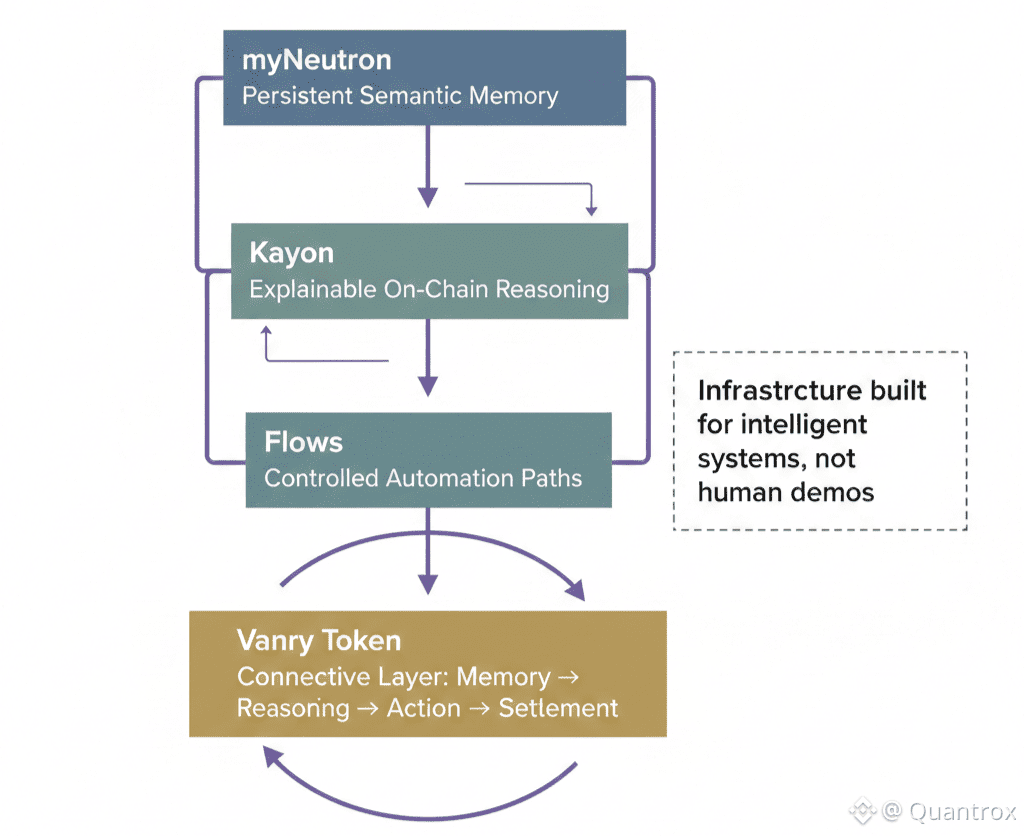
Flows complete that picture by turning reasoning into action. Automation isn’t new, but safe automation is. Flows are designed so intelligence can trigger outcomes without constant supervision, while still respecting constraints. This is where many retrofitted AI approaches struggle. They can think, but they can’t act reliably.
All of this shapes how Vanry functions. Instead of being a passive asset waiting for attention, Vanry becomes the connective tissue between memory, reasoning, automation, and settlement. Usage across these layers feeds back into the token naturally, without forcing artificial incentives.
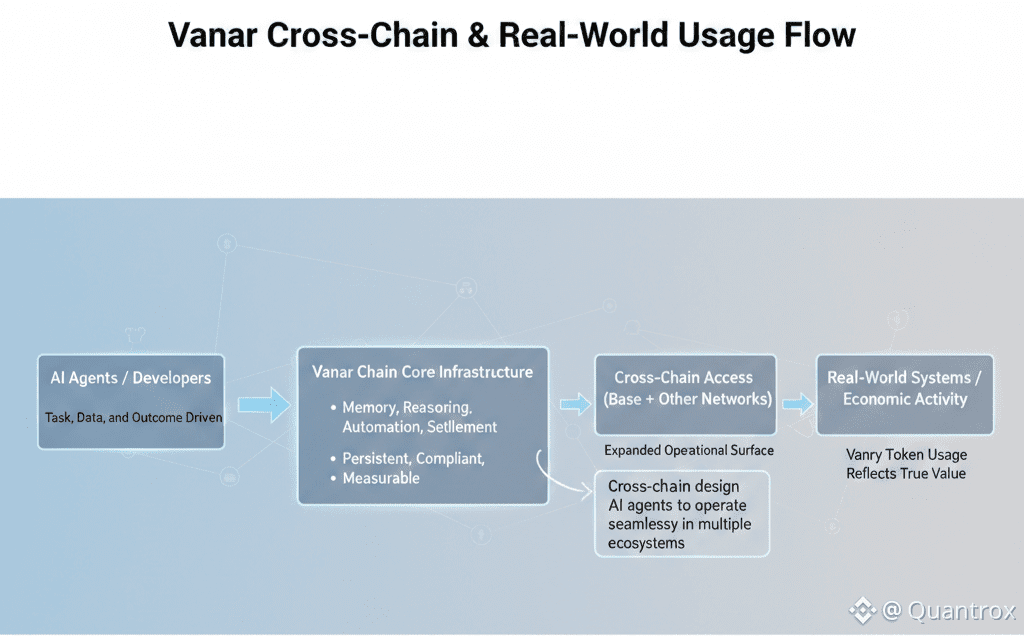
Another subtle but important choice is Vanar Chain’s approach to scale. AI-first infrastructure can’t afford to live in isolation. Users, developers, and data already exist across multiple ecosystems. Keeping intelligent systems locked to a single environment limits what they can do. Vanar recognized this early, which is why making its technology available cross-chain, starting with Base, matters.
Cross-chain access isn’t about chasing liquidity. It’s about letting intelligent systems operate where activity already exists. AI agents don’t respect ecosystem boundaries the way humans do. They follow tasks, data, and outcomes. By extending Vanar Chain beyond a single network, Vanar increases the surface area where Vanry can be used meaningfully, without changing the core design.
This also highlights why launching yet another generic Layer 1 is becoming harder. Base infrastructure is no longer the bottleneck in Web3. There are plenty of chains that can move data efficiently. What’s missing are systems that prove readiness for a world where software doesn’t just execute, but decides.
Vanar Chain doesn’t try to solve everything. It focuses on a specific gap: infrastructure that intelligent systems can actually rely on. That focus shows up in how operators run nodes, how products are designed, and how economic incentives are structured. Running this kind of network isn’t trivial. Persistent memory and reasoning introduce different operational considerations than simple transaction processing. That complexity isn’t hidden, and it isn’t marketed away.
Payments are where this design philosophy becomes most concrete. There’s a tendency to treat payments as a feature you tack on at the end. For AI systems, payments are foundational. Agents don’t open wallet apps. They need settlement to be automatic, compliant, and global. Without that, intelligent systems stay trapped in controlled demos.
Vanar Chain treats settlement as part of the intelligence stack. It’s not something added later for convenience. This is where Vanry’s alignment with real economic activity becomes clear. When agents can think, remember, act, and settle value on their own, usage stops being theoretical. It becomes measurable.
What I find most interesting about Vanar is how little it leans on narratives. Crypto cycles move quickly. Today’s story becomes tomorrow’s distraction. Readiness compounds more slowly, but it lasts. Infrastructure built for agents, enterprises, and real-world systems doesn’t spike overnight, but it tends to matter longer.
Vanar Chain feels built for that slower arc. Not dramatic. Not loud. Just deliberate. Vanry reflects that same posture. Its potential isn’t tied to a single trend, but to whether intelligent systems continue to move from experiments into everyday operations.
There’s still plenty that could go wrong. Adoption always takes longer than expected. Standards shift. Better ideas emerge. But Vanar Chain isn’t pretending those risks don’t exist. It’s building anyway, quietly, with a clear sense of who its users are meant to be.
As the idea of AI-native infrastructure becomes less theoretical and more practical, Vanar Chain stands out not by promising the future, but by preparing for it. And sometimes, that kind of preparation is the most honest signal you can get.
