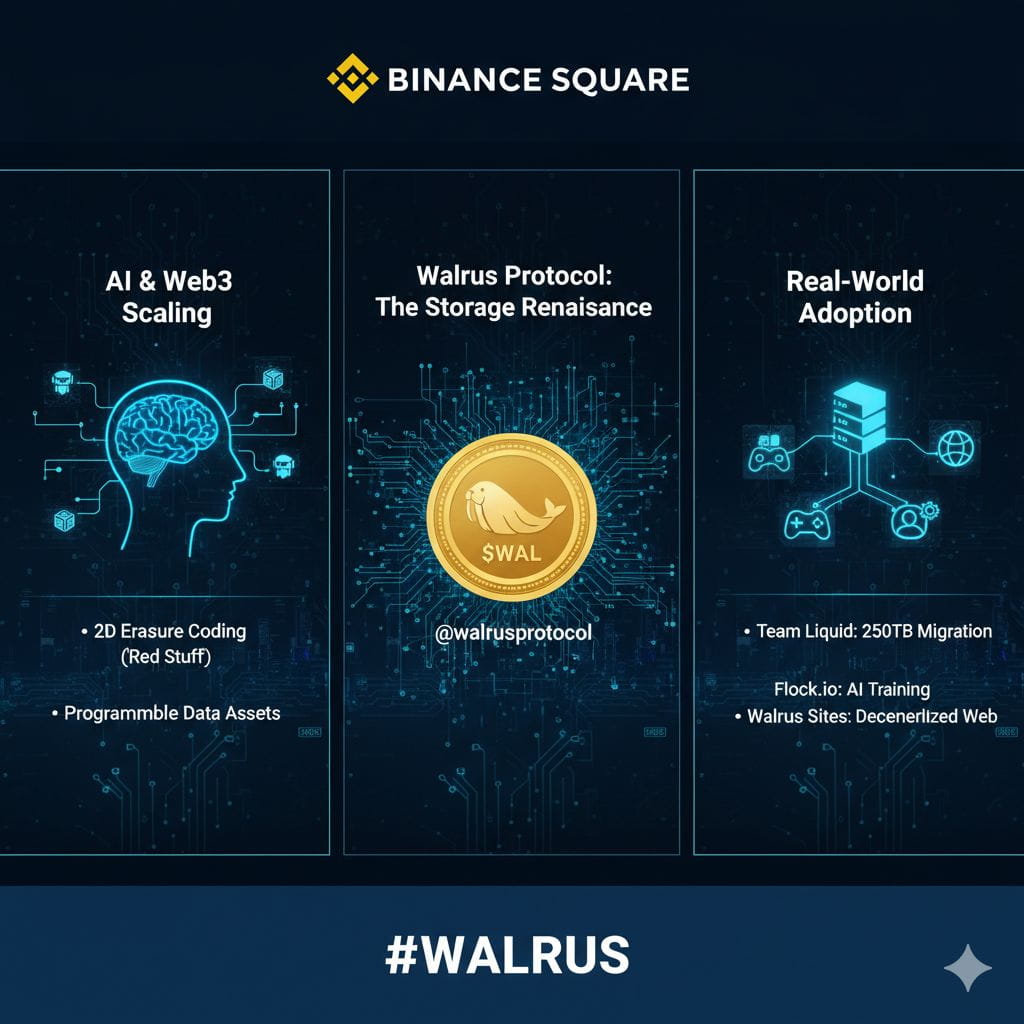
Most decentralized storage protocols rely on full data replication. which is prohibitively expensive for high-volume data like 4K video or AI training sets. @Walrus 🦭/acc introduces a paradigm shift with its "Red Stuff" erasure-coding algorithm.
By breaking data into erasure-coded slivers, Walrus ensures that files can be reconstructed even if 2/3 of the storage nodes go offline. This allows for a replication factor of only while maintaining 10x reliability, making WAL storage up to 100 times cheaper than competitors like Filecoin.
Data becomes "programmable" on Walrus. We aren't just talking about static files; we are talking about dynamic assets that smart contracts can interact with. Recent milestones have confirmed this:
Media Powerhouse: Esports giant Team Liquid recently migrated of match footage and brand content to Walrus, proving its enterprise-grade readiness.
AI Memory: Partnerships with elizaOS and Humanity Protocol use Walrus as the "long-term memory" for AI agents, allowing autonomous actors to store and retrieve data securelyF
The WAL token is far more than a governance tool; it is the fuel for a verifiable data market:
Users pay in WAL for fixed-rate storage, creating consistent buy-pressure.
Staking WAL is required for node operators. This aligns incentives and ensures the network remains censorship-resistant.
Token holders determine key protocol parameters, ensuring the community drives the evolution of the storage layer.#walrus $WAL