

We are standing on the edge of two massive super-cycles in technology: Artificial Intelligence (AI) and Web3 Gaming.
Every investor wants exposure to these narratives. We buy AI tokens, and we buy gaming tokens. But we are ignoring a fundamental law of computing: Intelligence requires Memory.
You cannot have a powerful AI model without massive datasets to train it.
You cannot have a AAA metaverse game without massive files for 3D textures, audio, and video.
Here lies the bottleneck: Blockchains are terrible at storage.
Layer-1 blockchains (like Solana, Sui, or Ethereum) are designed to be fast processors. They are the CPUs of the decentralized computer. If you try to store a 50GB game level or a 10TB AI training set directly on-chain, you will bankrupt the project in gas fees and clog the network instantly.
So, where does the data go? Until now, it went back to Amazon AWS or Google Cloud (Web2). But that defeats the purpose of decentralization.
Walrus (WAL) is the answer. It is the "External Hard Drive" for the decentralized web, and it is the only protocol efficient enough to handle the data tsunami coming from AI and Gaming.
The Gaming Problem: The Asset Trap
Let's look at Web3 Gaming. We promised players "true ownership" of their in-game assets. You own the NFT sword. You own the NFT skin.
But do you?
Usually, your NFT is just a receipt. The actual 3D model of that sword is stored on a centralized server. If the game studio stops paying their hosting bill, your sword disappears. It’s the "404 Error" nightmare.
Walrus solves this with Decentralized Blob Storage.
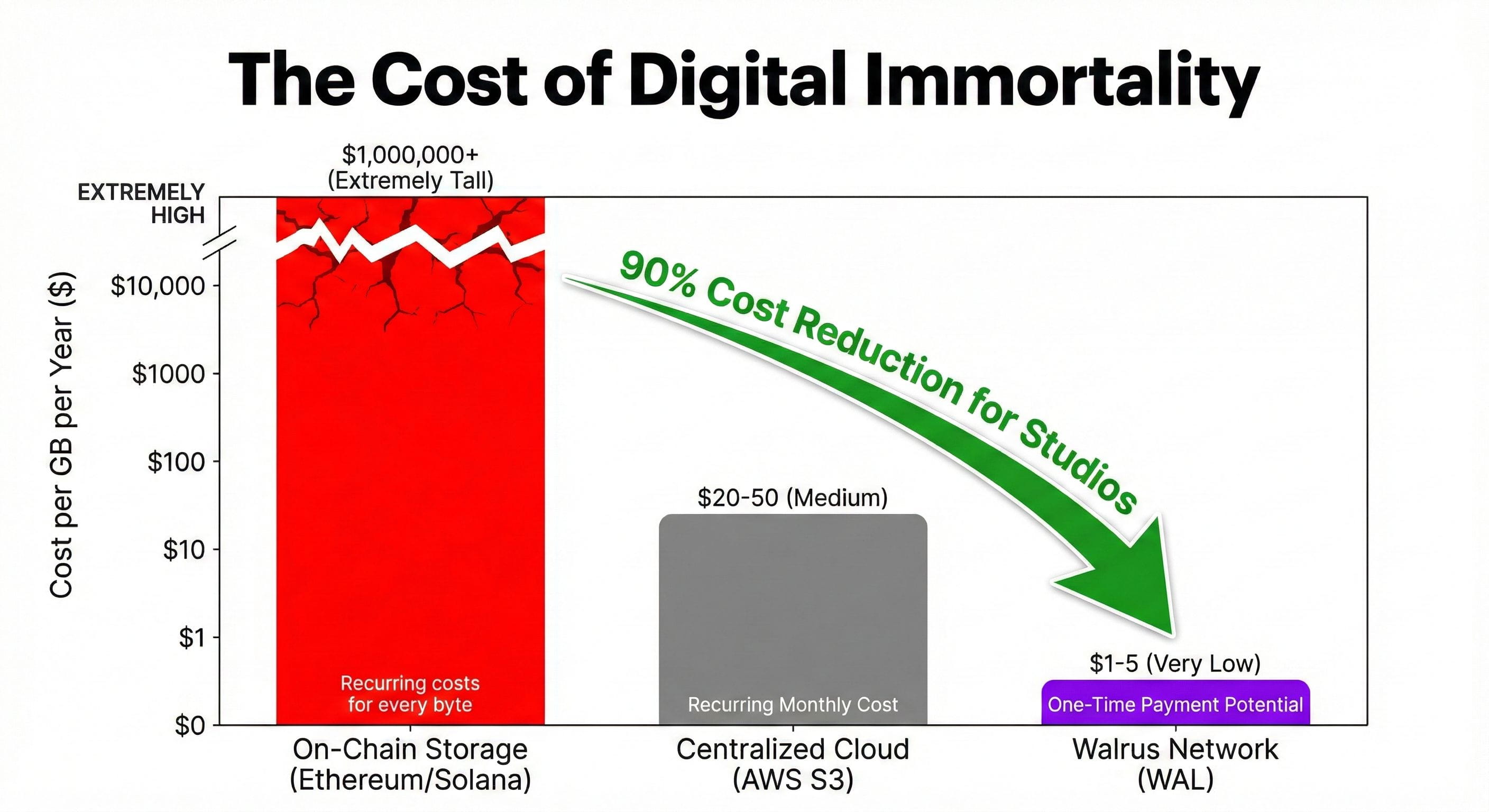
Because of its unique "Red Stuff" erasure coding tech, Walrus allows game developers to store massive game assets cheaply and permanently on a decentralized grid.
For Players: Your assets live forever, regardless of the studio's health.
For Devs: Storage costs are a fraction of AWS, and they don't have to manage servers.
This enables a new genre of "Fully On-Chain Games" where the entire game logic and the game assets live on Sui and Walrus. No servers. Just unstoppable code.
The AI Problem: The Data Monopoly
Now, let's look at AI. The biggest risk in the AI sector is centralization. OpenAI and Google control the models because they control the data and the servers.
Crypto wants to build Decentralized AI—open models owned by the community.
But where do you store the training data? You can't put a 500TB dataset on GitHub.
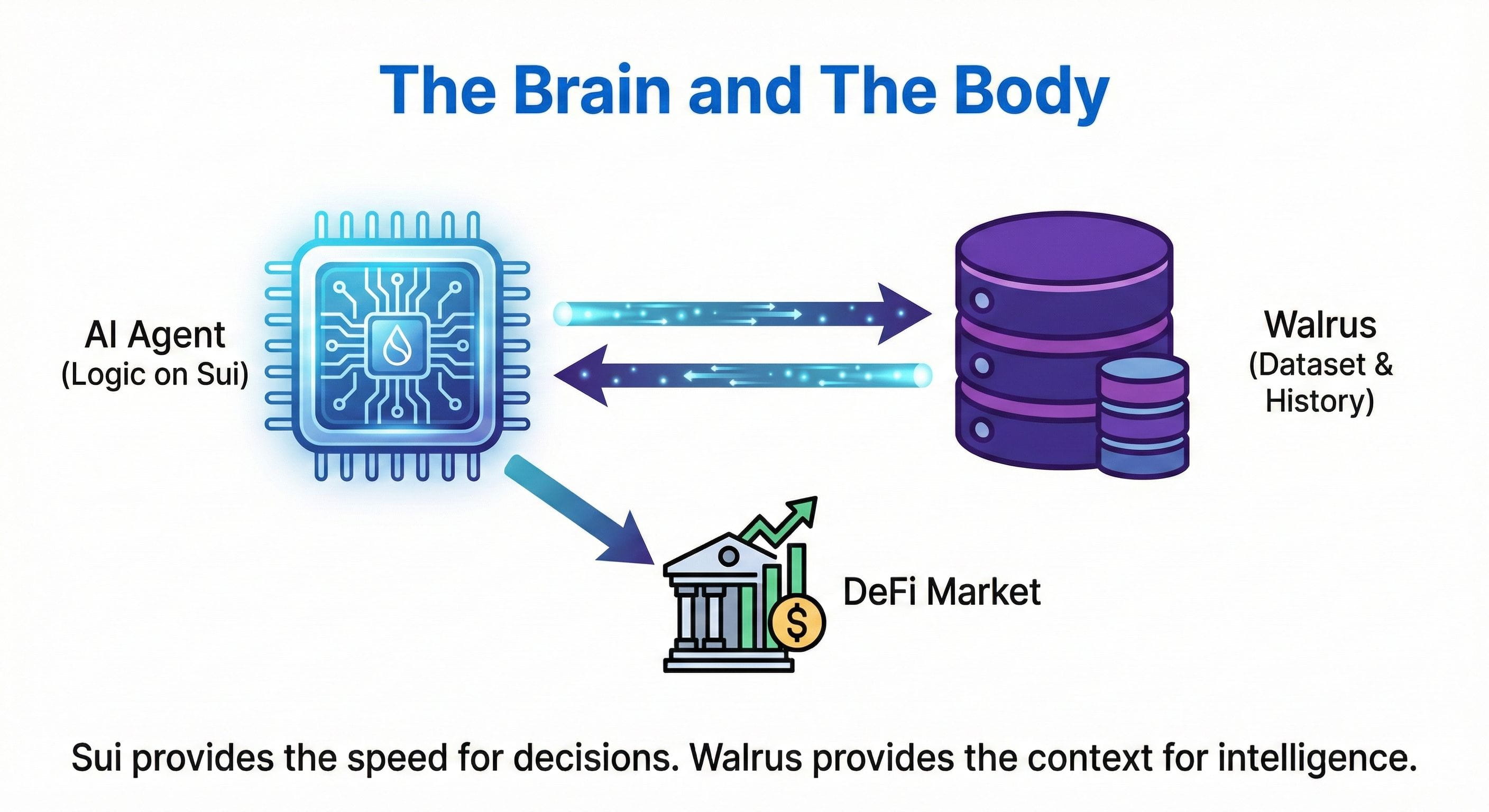
Walrus provides the Data Lake for Decentralized AI.
Training Data: Walrus can store the massive public datasets needed to train agents.
Model Weights: Once an AI is trained, the "brain" (the weights) can be stored on Walrus, making the model uncensorable and available to anyone.
Audit Trails: Walrus can store the history of AI decisions, creating a transparent "paper trail" for how an agent behaves something impossible in the "Black Box" of Web2 AI.
If you believe that AI Agents will soon be transacting on blockchains (paying for services, trading tokens), those agents will need a place to "remember" things. Walrus is that memory.
Conclusion:
In a gold rush, you can try to pick the winner (which AI coin will win? which GameFi token will pump?). It’s risky. Most will fail.
Or, you can buy the infrastructure that all of them need.
If the AI narrative succeeds, data storage demand explodes.
If the Gaming narrative succeeds, asset storage demand explodes.
$WAL captures the value of both sectors without betting on a specific winner. It is the heavy lifter that makes the next generation of crypto applications possible. We are moving from "DeFi Summer" (moving numbers) to "Content Summer" (moving media). And Walrus is the truck that moves it.
Disclaimer: This content is for educational and informational purposes only and does not constitute financial advice. Cryptocurrency investments are subject to high market risk and volatility. Always conduct your own research before making any investment decisions.