

Introduction:
Artificial intelligence is growing at a fast pace, but behind every AI model lies one critical resource: data. Without reliable, accessible, and trustworthy data, even the most advanced AI systems fail to deliver meaningful results. This growing demand has pushed the blockchain industry to rethink how data is stored, shared, and verified. Walrus (WAL) enters this space with a clear focus on building open and secure data markets that support the future of AI development.
Walrus is not trying to compete with traditional blockchains in speed or speculation. Instead, it focuses on long term data reliability, economic accountability, and fair access. As AI becomes more data hungry in 2025, Walrus is gaining attention for addressing problems that many decentralized storage networks struggle to solve.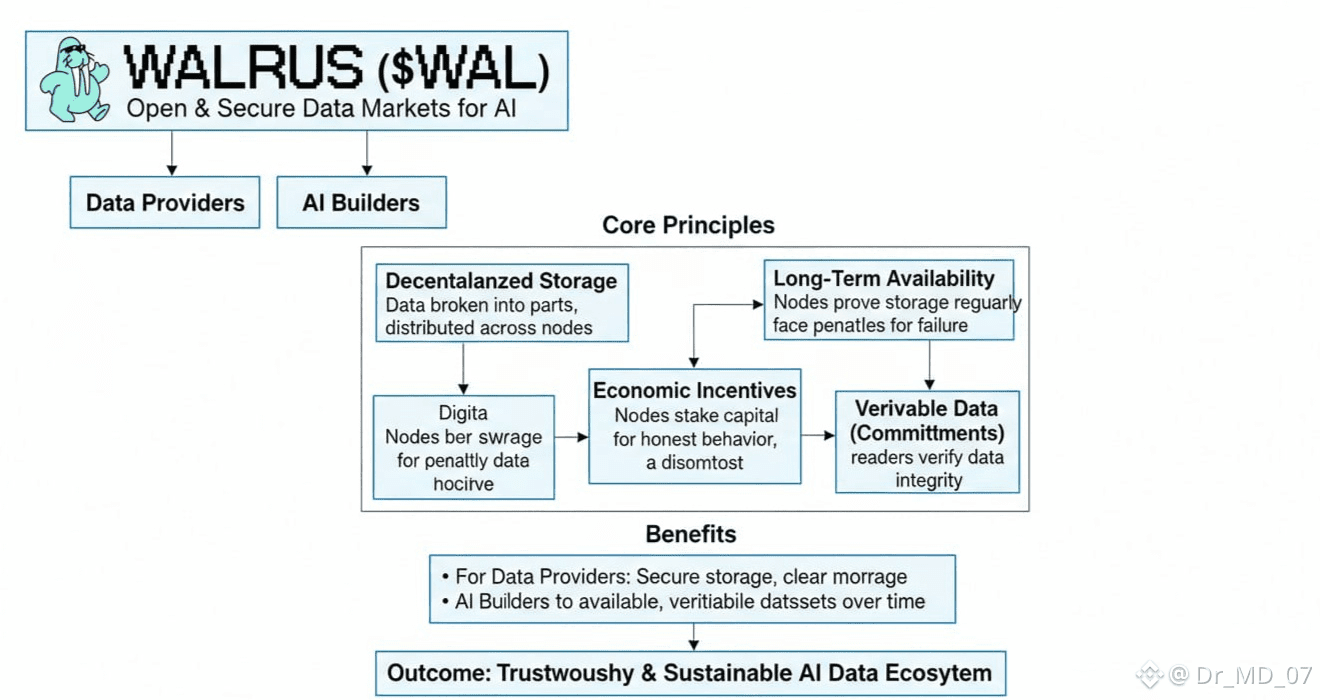
Why Data Markets Matter for AI:
AI systems learn from massive datasets. These datasets must remain available, unaltered, and verifiable over time. In centralized systems, data ownership often belongs to a few large platforms, creating trust issues and access limitations. Open data markets aim to change this by allowing users to store, share, and monetize data in a transparent environment.
Walrus supports this vision by enabling data to be stored in a decentralized way while still enforcing strong guarantees. Data providers can be confident that their information will remain accessible. AI builders can trust that the data they use has not been changed. From my perspective, this balance between openness and reliability is exactly what modern AI ecosystems need.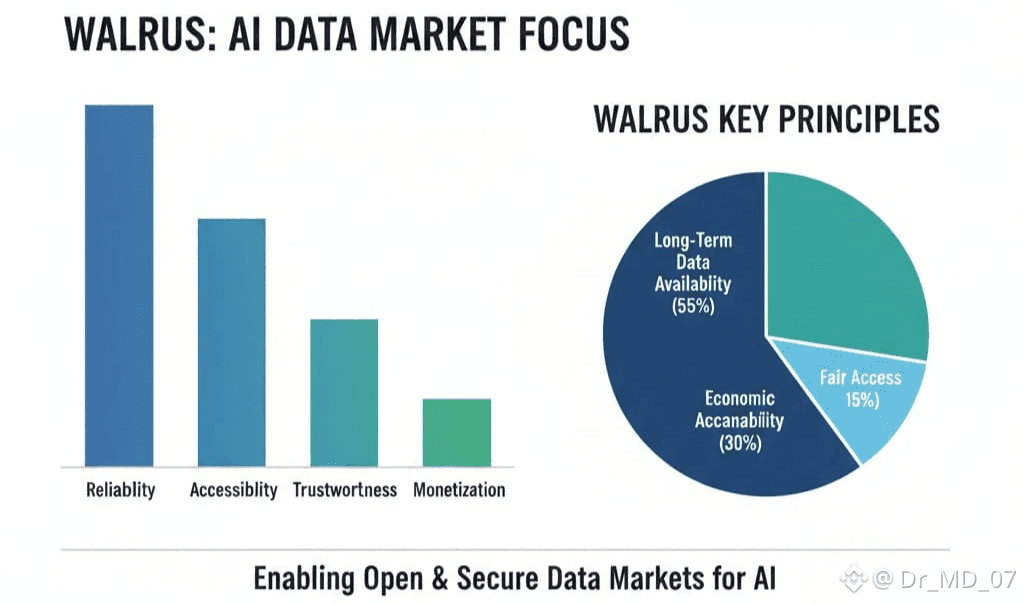
How Walrus Approaches Secure Data Storage:
Walrus uses a system where data is broken into smaller parts and distributed across many storage nodes. Each node holds a piece of the data and must prove over time that it still stores it correctly. This design reduces the risk of data loss and prevents any single party from controlling the full dataset.What makes Walrus stand out is its emphasis on long term availability. Storage nodes cannot simply upload data once and forget about it. They are regularly required to prove that the data still exists. If they fail, they face financial penalties. This makes the network dependable, which is critical for AI models that may rely on the same datasets for years.
Open Access Without Sacrificing Trust:
One of the biggest challenges in open data markets is trust. If anyone can participate, how do users know the data remains correct. Walrus solves this by using commitments that act like digital fingerprints for stored data. Readers can verify that the data they retrieve matches what was originally uploaded.This means AI developers do not need to trust individual storage providers. They only need to trust the protocol rules. As someone who closely follows blockchain infrastructure projects, I see this as a strong foundation for AI focused applications that require consistent and predictable data access.
Economic Incentives That Protect the Network:
Technology alone is not enough to secure data markets. Walrus combines technical design with economic incentives. Storage nodes must stake capital in the network. Honest behavior earns rewards, while dishonest actions result in penalties. This encourages nodes to act in the best interest of users and the ecosystem.
In 2025, sustainability has become a key concern in crypto infrastructure. Walrus addresses this by aligning rewards with long term storage commitments rather than short term activity. This makes the network more stable and suitable for enterprise level AI use cases.
Supporting AI Builders and Data Providers:
Walrus is designed to serve two important groups: those who provide data and those who use it. Data providers gain a system where their information can be stored securely and offered to the market under clear conditions. AI builders gain access to datasets that remain available and verifiable over time.
This structure supports fair pricing through market driven mechanisms rather than fixed rules. Storage costs can adjust based on demand and supply, making the ecosystem flexible. In my opinion, this market based approach increases the chances of long term adoption.
Why Walrus Is Gaining Attention in 2025:
The rise of AI regulation, data privacy discussions, and decentralized infrastructure has pushed projects like Walrus into the spotlight. As more developers look for alternatives to centralized data monopolies, Walrus presents a realistic option that focuses on reliability rather than hype.
Recent progress in protocol design and economic modeling has shown that Walrus is building patiently. It is not rushing features but prioritizing correctness and security. This slower but deliberate approach is becoming more appreciated in today’s market.
Real World Relevance and Future Outlook:
Open and secure data markets are not just a theoretical idea. They are becoming essential for AI research, training models, and data sharing across borders. Walrus positions itself as infrastructure that can support these needs without sacrificing decentralization.
Looking ahead, I believe Walrus has the potential to become a foundational layer for AI data economies. Its focus on accountability and long term storage aligns well with how AI systems actually operate in practice.
Conclusion:
Walrus (WAL) is building more than a storage network. It is creating the conditions for open and secure data markets that AI systems depend on. By combining decentralized storage, strong verification, and economic incentives, Walrus addresses real problems faced by AI developers and data providers today.
From a personal perspective, Walrus feels like a project designed for the next phase of blockchain adoption. It prioritizes trust, sustainability, and practical use cases over short term excitement. As AI continues to shape global technology trends, platforms like Walrus may play a quiet but essential role in powering that future.

