

Decentralized storage only works if users can trust that their data will still exist tomorrow. Walrus approaches this problem through a carefully designed system called Red Stuff, which focuses on data availability, fault tolerance, and verifiable storage behavior. Instead of relying on trust, Walrus relies on math, cryptography, and economic pressure.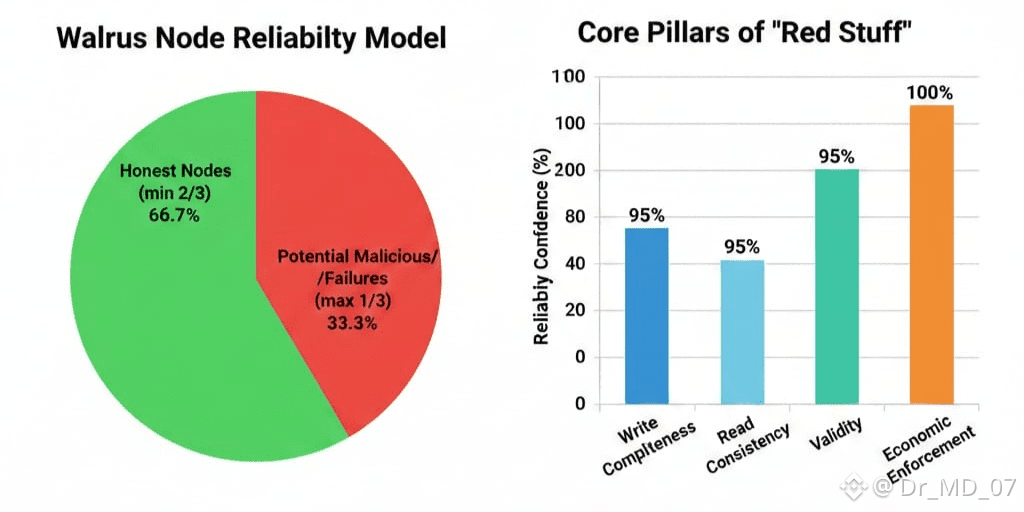
At the core of Red Stuff is erasure coding. When a user writes a blob of data, it is split into encoded slivers and distributed across storage nodes. The system assumes that up to one third of nodes may behave maliciously or fail. Even under this assumption, Walrus guarantees that honest behavior wins.
Write completeness is the first major guarantee. If an honest writer uploads data correctly, every honest storage node will eventually hold valid pieces of that data. This works because nodes can reconstruct missing slivers by requesting shared symbols from others. As long as enough honest nodes exist, reconstruction is inevitable. From my perspective, this design is powerful because it removes single points of failure without overloading the network with constant replication.
Read consistency is equally important. Walrus ensures that two honest readers never disagree on the result of a read. Either both retrieve the full data or both fail. This property comes from deterministic encoding and cryptographic commitments. If even a small inconsistency appears, the read fails safely. I see this as a strong user protection feature, especially for applications that depend on predictable data access.
Validity ties everything together. When an honest writer stores correct data, every honest reader will eventually retrieve it. This guarantee is subtle but critical. It means Walrus does not just store data, it preserves trust across time and participants. In decentralized systems, this is often where designs break down, but Walrus clearly prioritizes correctness over shortcuts.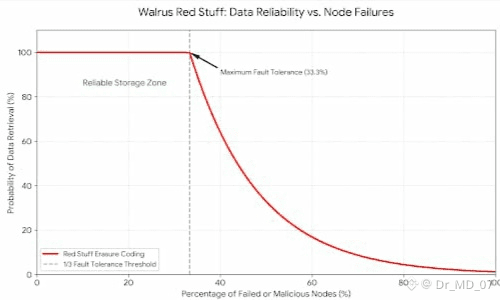
The asynchronous challenge protocol is what enforces honest storage. At specific moments, nodes enter a challenge phase and must prove they still hold their assigned data. Nodes that deleted data or tried to cheat cannot reconstruct enough symbols to pass the challenge. This makes cheating economically irrational. In my view, this is one of the smartest parts of Walrus because it aligns technical enforcement with economic consequences.
Overall, Red Stuff shows that Walrus is not chasing speed at the cost of safety. It is deliberately engineered for long term reliability, which is exactly what decentralized storage needs to succeed.

