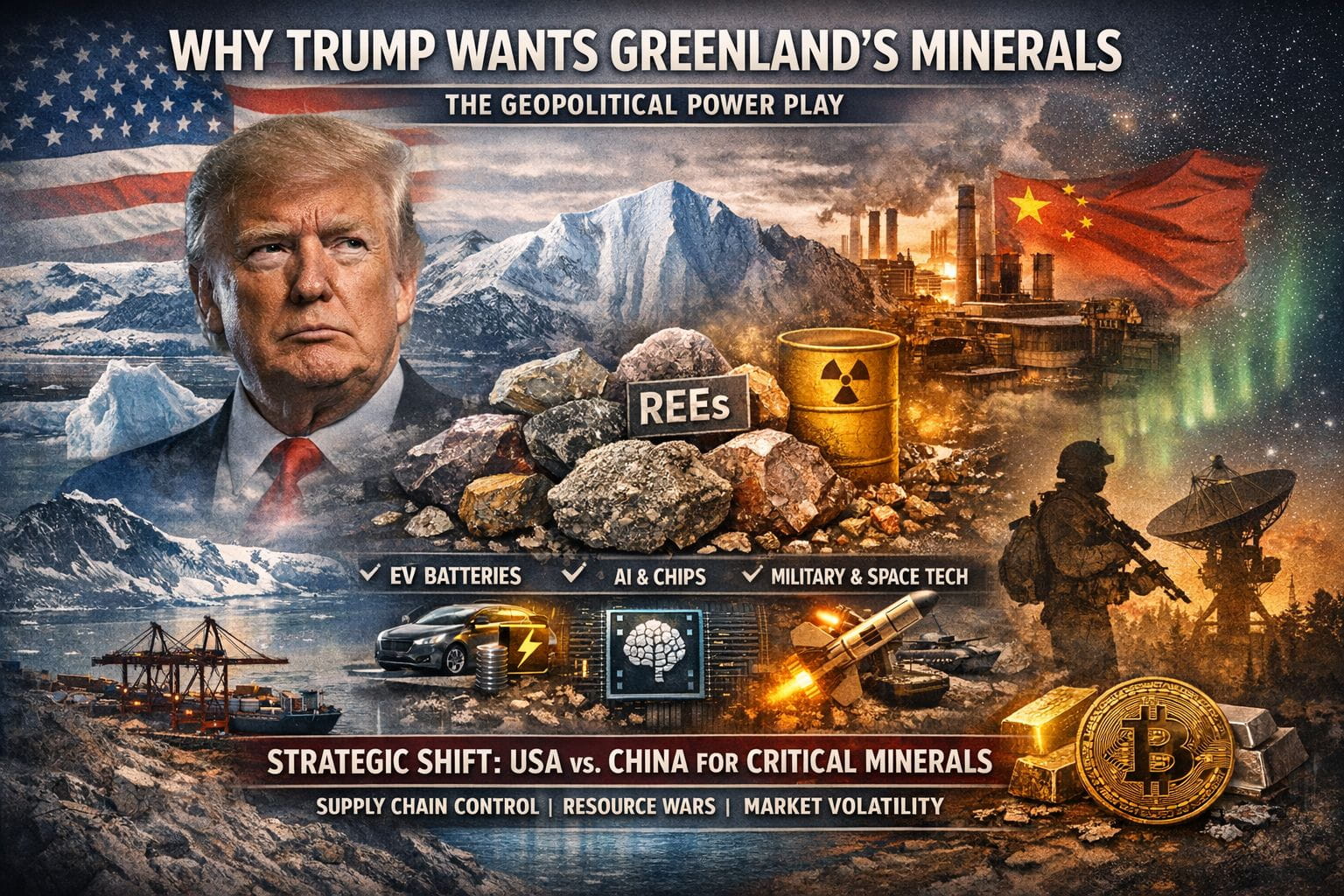
At first glance, renewed U.S. interest in Greenland looks like political theater or territorial ambition.
It isn’t.
Strip away the headlines, and one truth remains: this is about minerals — and control of the future supply chain.
🧭 The Mineral Reality Beneath the Ice
Greenland sits on one of the most underexploited mineral troves on Earth. Geological surveys and long-term exploration data point to vast reserves of critical resources, including:
• Rare Earth Elements (REEs) — essential for magnets, defense systems, and advanced electronics
• Lithium — the backbone of EV batteries and grid-scale energy storage ⚡
• Uranium — strategic for energy security and next-gen military applications
• Nickel, cobalt, and graphite — irreplaceable for AI hardware and semiconductor manufacturing 🤖
These aren’t optional resources.
They are foundational inputs for 21st-century power.
🌍 Why This Matters Now
The timing is not accidental.
China currently dominates the global rare-earth supply chain, from extraction to processing. For Washington, this represents a structural vulnerability — not just economically, but militarily and technologically.
Greenland offers something rare: ✔ Proximity to the U.S.
✔ Political alignment with Western institutions
✔ A chance to diversify supply away from China
✔ Long-term leverage over emerging industries
In strategic terms, control over Greenland’s mineral ecosystem would reshape global power balances for decades.
🧠 This Is Not About Territory — It’s About Optionality
Modern geopolitics isn’t fought over borders alone.
It’s fought over inputs.
Whoever controls the materials controls: • EV production • AI scaling • Semiconductor sovereignty • Defense readiness • Space and satellite infrastructure 🚀
This is why Greenland keeps re-entering the conversation — quietly, persistently, and at the highest levels of policy planning.
📊 Market Implications: Why Investors Are Watching
Markets don’t wait for treaties to be signed — they move on narratives and positioning.
As geopolitical competition over resources intensifies: • Commodities tend to reprice first
• Strategic metals attract long-term capital
• Crypto markets react through volatility and narrative-driven speculation
History shows that resource competition rarely stays localized. It spills into currencies, trade routes, risk assets, and alternative stores of value.
⚠️ The Takeaway
This isn’t a headline story.
It’s a structural shift.
Big power moves create: 📈 Volatility
📉 Dislocations
🎯 Opportunity — for those paying attention
Greenland is not the prize.
Control of future technology is.
Stay sharp.
When superpowers reposition, markets never stay quiet for long.




#WEFDavos2026 #TrumpTariffsOnEurope #CriticalMinerals #ResourceWars #GoldSilverAtRecordHighs #Geopolitics #MacroSignals