


The multilayer shift: why Dusk does not position itself as a single chain offering all services.
Dusk explains a development to a multilayer structure, with a bottom layer (commonly referred to in documentation as DuskDS) offering settlement and data availability, and execution environments allowed to inhabit the top of them. This is a highly narrow bet: instead of committing all developers to a single VM model, Dusk would also like to allow different execution models and retain settlement on the same core.
DuskDS as the "truth layer"
The base itself in the framing of Dusk provides settlement plus data availability, as well as a native bridge to transfer between layers of execution, without trust. The latter is significant: it is in cross-layer movement that most systems tend to become untidy (wrapped assets, custodians, additional trust assumptions). The point that is made by Dusk is that this bridging is indigenous and inherently suspicious in its construction.
DuskEVM: the compatibility of EVM is not a slogan, but a tactic.
DuskEVM is shown to be a complete EVM-compatible execution environment. It is not the fact that we have an EVM. The most important point is the way it is constructed: Dusk documentation indicates that it uses the OP Stack and is based on the ideas of EIP-4844 (proto-danksharding), but uses DuskDS instead of Ethereum to settle the transactions. That is Dusk making the effort of adopting existing Ethereum developer workflows without sacrificing its own settlement layer.
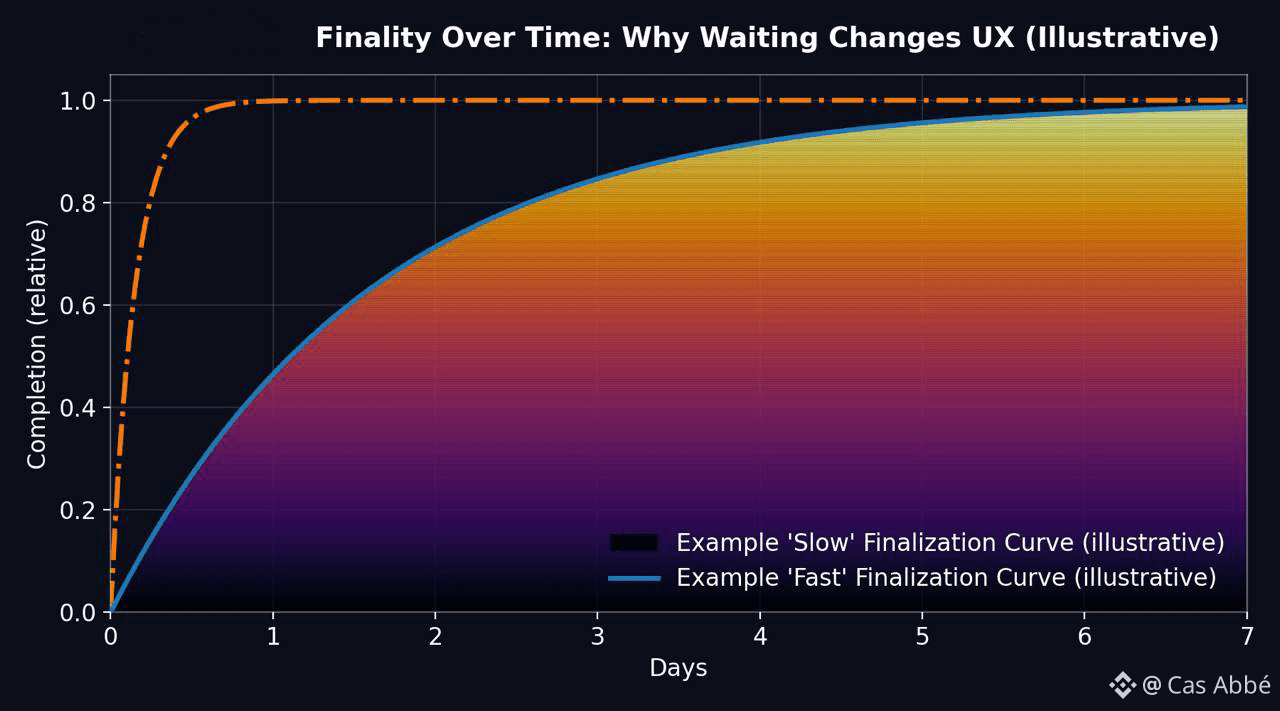
One sharp point: the 7-day finalization period that is inherited (the reason why it is important).
The documentation of DuskEVM specifically states that it will take the current OP Stack finalization period of 7 days as temporary, but that future updates would aim to speed up (even) a one-block) finality. This is one of the details that makes a high-level pitch and a high-level reality diverge: when you are creating serious financial applications finality time makes your risk model, user experience, and market structure different.
Consensus design: Not cosmetic private leader selection.
Dusk introduces a Proof-of-Stake-based consensus mechanism in the whitepaper that has Segregated Byzantine Agreement (SBA) and a privacy-preserving leader extraction process known as Proof-of-Blind Bid. This is important because it is not just the matter of covering-up transactions but also the matter of limiting the information that leaks about validator behavior and selection since leakage is a potential attack surface in PoS systems.
Tradeoffs: modularity purchases flexibility, however, it comes with moving parts.
A multilayer system is capable of scaling the adoption of the developers with greater speed (EVM tools, separate execution layers, specialized environments).
