
Resilience in Financial Systems
Modern finance and insurance work with uncertainty. Events like market shocks and operational failures create moments where disasters reek trust. Systems with outdated technology struggle in these moments. Fraud goes unnoticed and regulation oversight lags behind. Dusk Protocol solves this vulnerability by providing infrastructural resilience. Financial obligations are met when they truly matter without losing privacy and transparency.
Dusk is, in other words, a novel system, and is not an application-layer solution. It’s an invisible system and is indispensable. It doesn’t compete with users for attention, and leaves the surface of the value of the financial and insurance system. The real value is in the coordination of underlying data, contracts, and compliance. The Dusk Protocol adds value through dependence, and not through hype.
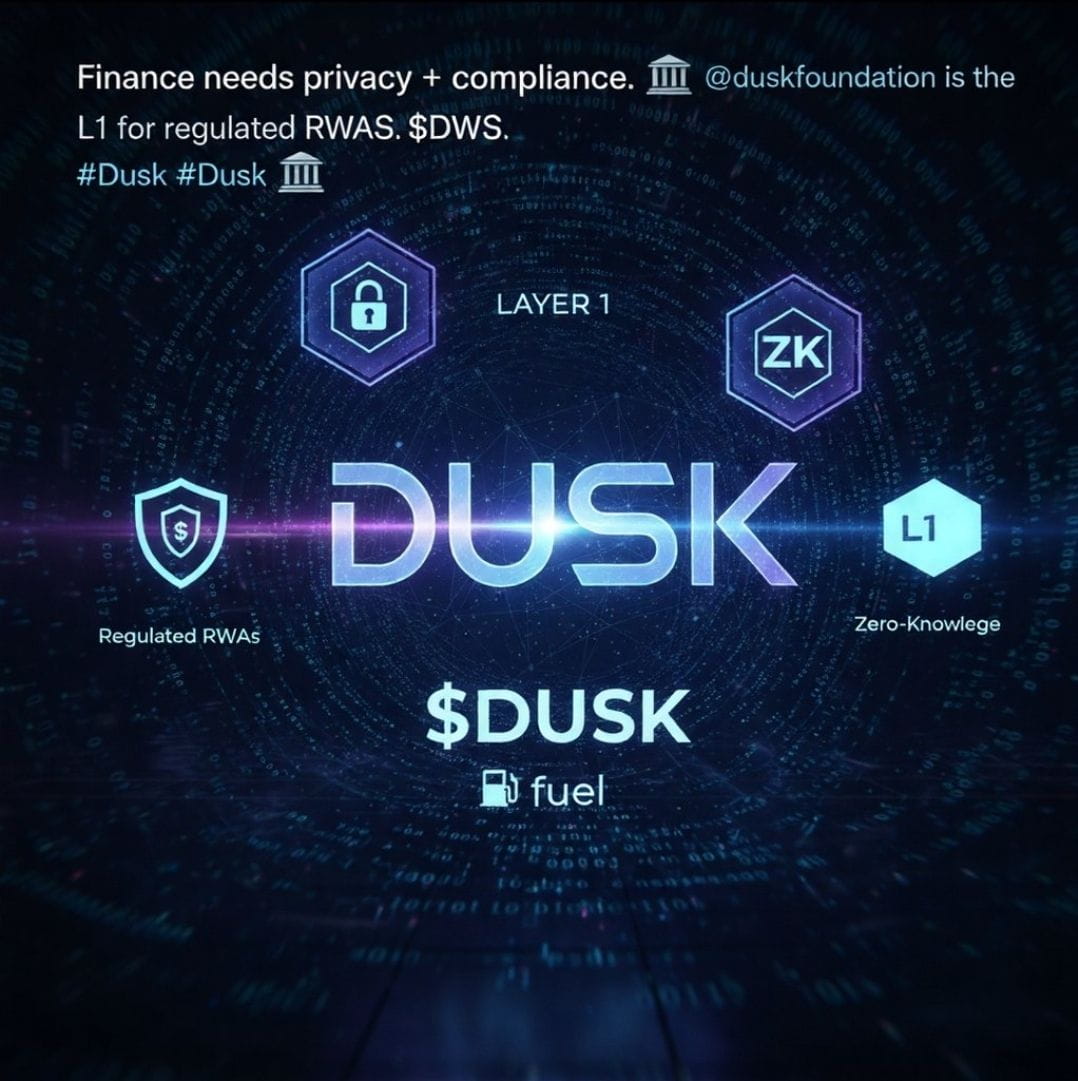
Structural Certainty as a Competitive Advantage
Certainty is an insurance and financial institution’s best friend. Dusk achieves this with a layered architecture that mirrors financial workflows.
The settlement layer guarantees the finality of all transactions and claims, the execution layer takes care of the rules and privacy, and the regulatory layer facilitates auditability while keeping sensitive information safe. Each layer satisfies a fundamental institutional need: certainty, reliability, and transparency.
For insurers, this means a claim is processed once and only once and will not be reversed or disputed. For banks and financial markets, finality means less work on reconciliation and less operational friction. This type of operational predictability is uncommon in decentralized finance, which is why Dusk is a strategic partner for institutions needing blockchain efficiency without operational risk.
Settlement layer: Certainty is Engine
The settlement layer is the most important part of Dusk's architecture. It is built for rapid, confidential, and deterministic results. The layer is able to process close to 2,000 transactions every second and guarantees finality in about five seconds. This means it will always keep claims, transfers, and reconciliations.
In insurance, speed, and certainty are two sides of the same coin. For example, parametric policies need rapid claim verification and an automated payout once a claim is verified.
Dusk harnesses the value of settlement as a dependable heartbeat. It transforms transactional uncertainty into actionable certainty while minimizing the risks of capital lockup and systemic latency. In financial markets, similar benefits arise: confidence in clearing, settlement, and risk transfer is achieved without the involvement of sensitive counterparty details.
Execution Layer: Rules Enforced, Privacy Preserved
Dusk execution layers translates financial and insurance logic into smart contracts with privacy-first enforcement. Manual intervention is eliminated as the consistent application of coverage rules, regulatory, solvency, and fraud rules is automated.
With Privacy Budgeting, institutions control what data is visible, to whom, and under what conditions. Regulators verify their reserves without customer data, auditors check the legitimacy of claims without underlying data, and policyholders’ data remains confidential. Substantial fraud can be signaled through encryption rather than the manual inspection of sensitive data.
Consider this a claims adjuster, with perfect procedural knowledge: spatial, temporal, and procedural limits are fully respected, and boundaries are never overstepped.
Shadow Ledger: Visibility Without Exposure.
The Shadow Ledger Framework helps Dusk tell its data assurance story by staying within the parameters of how to create audit trails in a way that builds a priori confidence in the audits without revealing sensitive data. Transactions, claims, and settlements are encrypted, time-stamped, and proof of alteration. Financial and personal data, such as who the policyholders are, the value of assets, and where someone stands in a trade, is only disclosed when strictly necessary.
This helps create a story for the investors that is unique because, for the first time, risk is measurable and not opaque. Stakeholders are able to ascertain correctness without access to sensitive data, so the lateral regulatory scrutiny is lightened, and the shadow banking system is set to disintermediate in a trust-less way. The Shadow Ledger sets a new paradigm in finance: Trust is the new assumed.
Consensus: Trust Through Verification.
Most of the time, finance relies on human +/- to look for things and rationalize an outcome, and this is how Dusk goes from human discretion to consensus that is verifiably mathematical. Dusk employs the use of the Byzantine Agreement Protocol alongside succinct attestation, validating such that if something a claim, settlement, or transaction goes through, it is right without the sensitive data.
The Shadow Ledger is also not a consensus or an agreement.
DUSK staking makes sure validators act right. This makes sure the honesty of the validators can entangle just the right institutional procedures without any extra overhead.
DUSK for Insurers
Four reasons make Dusk special for the insurance industry:
Claims can be processed in confidence. This means the privacy of the policyholders remain intact. Details for each insurance case are processed only for those that need to know.
Detection of Fraud. This means that because of the lower systemic exposure and insider threat, out of the full datasets that would otherwise be visible, only a single dataset that would be visible is utilized for the analysis.
This means that the absence of any manual intervention, the auditors would be able to confirm the metrics concerning solvency, capital, and compliance of the insurance company.
This activates the smart contracts that make payments. This could be for any of the conditions predefined within the smart contracts, be it a natural disaster, a delay in shipping, or other market conditions.
Dusk helps in creating an environment where strengthened trust and a reduction in the operational friction can occur. With Dusk, there are now systems in place that can be relied upon for the quantification, management, and resolution of risk.
Financial Market Applications Aside from insurance, Dusk has more innovative financial solutions:
Cross-Border Settlements: Secure and confidential payments between financial institutions or business entities which reduces operational and compliance friction.
Capital Allocation and Risk Transfer: Institutional investors can validate obligations without revealing the strategies, positions, or portfolio composition of the target.
Automated Derivatives and Structured Products: Smart Contracts trigger certain payoffs, in turn, ensuring compliance and reducing operational risk.
Dusk converts structural uncertainty into measurable and manageable outcomes.
Economic Alignment Through $DUSK $DUSK is not an asset meant for speculation, as an operational coordination token, its purpose include:
Staking: Aligns validators with obligations of uptime and correctness.
Dynamic Fees: Changes based on the complexity of the claim or transaction and the amount of privacy required.
Auditability Incentives: ties the reward of validators to the level of compliance to strengthen the network’s integrity as it grows.
$DUSK for investors directly correlates to the level of activity on the infrastructures and not to the market’s mood. The growth on the adoption of insurance and financial services will increase demand based on usage, rather than speculation.
Systemic Efficiency and Integration
Because of what Dusk’s architecture allows, institutions can keep sensitive data secure and still participate in mutual verification networks. Different organizational stakeholders, like hospitals, insurers, reinsurers, auditors, and regulators, can coordinate within a framework that keeps data silos intact. Smart contracts enforce rules, systems of checks keep data unaltered, and consensus mechanisms improve finality.
This type of systemic efficiency is operational cost reduction, risk mitigation, and the bolstering of the overall system’s adaptive capacity and robustness. System participants can incorporate Dusk in piecemeal fashion, Dusk’s systemic and operational improvements being integrated in alignment with existing workflows, rather than disrupting them. Investors are thus able to minimize adoption risk and improve the potential gain.
Durability and Long-Term Adoption
The insurance and finance industries operate on very long timeframes. Insurance policies mature over the years, the allocation of capital stretches over decades, and the regulatory review period covers multiple jurisdictions and can be years in length. Dusk’s architecture is designed and built with this timeframe in mind. Its layered, privacy-centric, consensus-based architecture ensures that operational commitments are preserved across various market conditions, regulatory changes, and institutional shifts.
In this context, a more reliable system architecture is arguably a more valuable proposition than a novel one.
Investors like infrastructure that can withstand the tests of time and stress. With time, data becomes sticky, and sufficiency adoption becomes dependent. This creates long lasting structural value.
Insurance and Finance that is Future-Proof
As digital insurance and decentralized finance become more dominant, the need for infrastructures that are privacy-preserving and can be verified is critical. By 2026, there are expectations for the following:
Automated and auditable settlements
Selective and role based disclosure
Clearly embedded compliance with the stated jurisdictional rules
Exposure-free fraud detection
Dusk has positioned itself to meet those expectations. It aims to be the primary layer for all digital finance that is regulated, integrating governance, verification, and privacy as primary features, not as afterthoughts.
Conclusion: Assurance, Not Hype.
Dusk Protocol is not trying to be a fad. It does not need to go viral or be a primary choice of consumers. The value of Dusk Protocol is dependent, reliable, and highly aligned with the needs of the institutions.In insurance and finance, it turns liability-related uncertainty into an operational feature. Risk leaves an unalterable trace. Claims can be tracked. Compliance is automated and privacy is protected. DUSK aligns incentives with system health. This makes it a long-term bet on modern finance's infrastructure.
As finance and insurance digitalize, DUSK provides rare calm and certainty when it matters most.
