
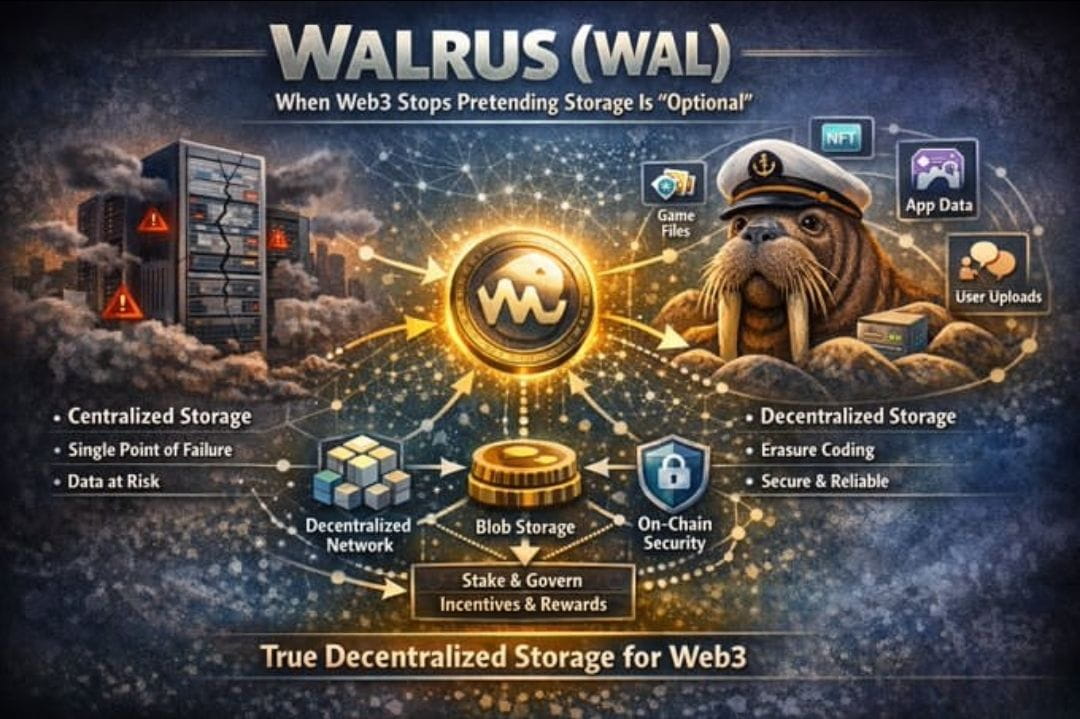
The real challenge is durability, as opposed to expansion ability. For systems maturing in Web3, expansion is straightforward, but long-term resilience is an enduring challenge. Applications are becoming faster, and without precedent, capital is moving along blockchains. However, as systems are faster, so too are the relentless manifestations of Web3’s long-term failures. Websites disappear. AI stutters. NFT metadata breaks. Data goes away and the systems built to serve it collapse. Most are structural problems, such as the one Walrus is built to fix.
Data, Not Execution, Determines Longevity
The most fragile systems are those built for speed, not lasting, sustainable operation. Most investment collapses into looking for better execution in infrastructure. These wins are short sighted and address, “what happens now?” instead of “what happens in the future?” In centralized systems, data degradation is handled through slotted systems, but in decentralized systems, those safeguards are nonexistent. A smart contract may be immutable, but if its referenced data is lost, immutability is meaningless. In the Walrus system, neglected, forgotten, outdated data is reframed as a load-bearing, flexible, and de-integral component, and without it, any system in Web3 is fragile.
One Job, Done Relentlessly Well
Concentration is better than dilution. Walrus has a singular focus: decentralized data storage infrastructure. This warrants no further explanation. AI data sets, NFT metadata, decentralized apps, rollup data, etc. all require persistent data. This infrastructure focus has a niche, but it is a necessary niche. With a focus on persistent data, other data types are avoided. This gives Walrus design and architectural clarity. Unlike ephemeral or high churn data, persistent data can be referenced and relied on for decades. No longer will the application or users be there to provide a solution. The same is true for Walrus’s infrastructure. The less fundamental problems it has, the more it will create additive value.
Built on Sui: Programmable, Verifiable, Persistent
What survives at the end of the day is the infrastructure. Walrus is on the Sui blockchain. It is built on an object-centric model, which means data is treated as programmable, verifiable, and modular containers, as opposed to treated as files. This means data can be addressable, inspectable, composable, and updatable without the need for obsolete centralized systems. Compared to other storage abstractions, Sui enables better scalability, modularity, and reliability. Walrus does not compete with execution layers; it addresses one of their most persistent weaknesses.
Durability Over Activity: Incentives That Work
Imagine all the best things in life that we think we’ll never need, and how important it is that we hang on to them. These valuable things are what we call dormant. For example, legal documents, training datasets, and provenance files. These must stay accessible, even if they must stay dormant. Usually, in computer and data networks, you will get advantages when you access files more often. Here, it’s the opposite. Walrus is the only service that rewards uninterrupted access, not engagement. Studies prove that when lost, dormant datasets cause significant problems. AI models can’t get updated, NFTs lose value, and decentralized websites disappear. From Walrus, you get the feeling of using a utility, not a platform. Utilities don’t go viral—they do become extremely important.
AI Needs Persistence, Not Hype
When it comes to data, it can outlast everything. Even companies. AI will always need a large dataset to stay relevant. If the dataset is not accessible, it will lose value. Walrus does not lose value because it sustains a more even and decentralized record of AI data. This means it avoids the risks that come with a platform and the problems that come with organization divides. Unlike other services that use AI, Walrus does not aim to own the models, but instead secures the data that makes them work. This is a key to making credible AI work.
NFTs and Websites: The Cost of Fragile Systems
Without grit, ownership truly means nothing. One of the first credibility gaps in Web3 NFTs is that the value is gone if the data structure is gone. Decentralized websites have the same problem. When the data is closed, the so-called decentralization is just an illusion. Walrus helps NFTs and websites to have data permanence in their media and metadata. This helps foster trust to the Web3 ecosystem, which is often broken when data goes missing. Evidence: numerous noteworthy NFT collections have data loss issues because the metadata is stored temporarily. Walrus helps NFT collections not have that issue.
Rollups: Data Availability is Non-Negotiable
Without visibility, execution layers cannot validate. Cuts like modular blockchain systems and roll ups are great, until the transaction data is lost. Walrus is a data availability layer and verifies that data is lost. Data persistence is vital to modular systems and Walrus solves that, differentiating itself from competition in the execution layer.
Economic Logic: Dependence Grows Naturally
Data has a certain effect on everything around it. Once something gets anchored onto Walrus’s Data, it doesn’t make any economic sense to try to move it. Data gets “stuck” with proofs, references, and application logic. This “data gravity” effect creates long-term stickiness without needing aggressive subsidies. Structural demand sticks around because reliability becomes more and more true over time. From the perspective of investors, Walrus is not dependent on hype, and that is why it is ideal. Its revenue potential increases the more the ecosystem grows.
Designed to Be Unremarkable—And That’s the Point
The value of invisible infrastructure is Walrus's lack of connecting, and constant reinvention. Walrus is like a bridge, a power grid, or a database. The value is only really appreciated once it stops working. By designing themselves to be invisible, Walrus creates systems that always function even if neglected or stressed. This is the mark of great infrastructure.
Conclusion: Continuity Over Acceleration
Systems will always fail if data sinks. Walrus builds with the understanding that hype will eventually fade, teams will switch, and enthusiasm will disappear. By using unyielding focus on the data decentralization, it guarantees that the digital systems will outlast the interest. For investors, this is the ultimate thesis: Walrus doesn’t wait on attention, it waits on necessity. It doesn’t promise to speed up a process. It promises that systems will function consistently. In infrastructure, this consistency is the greatest value.