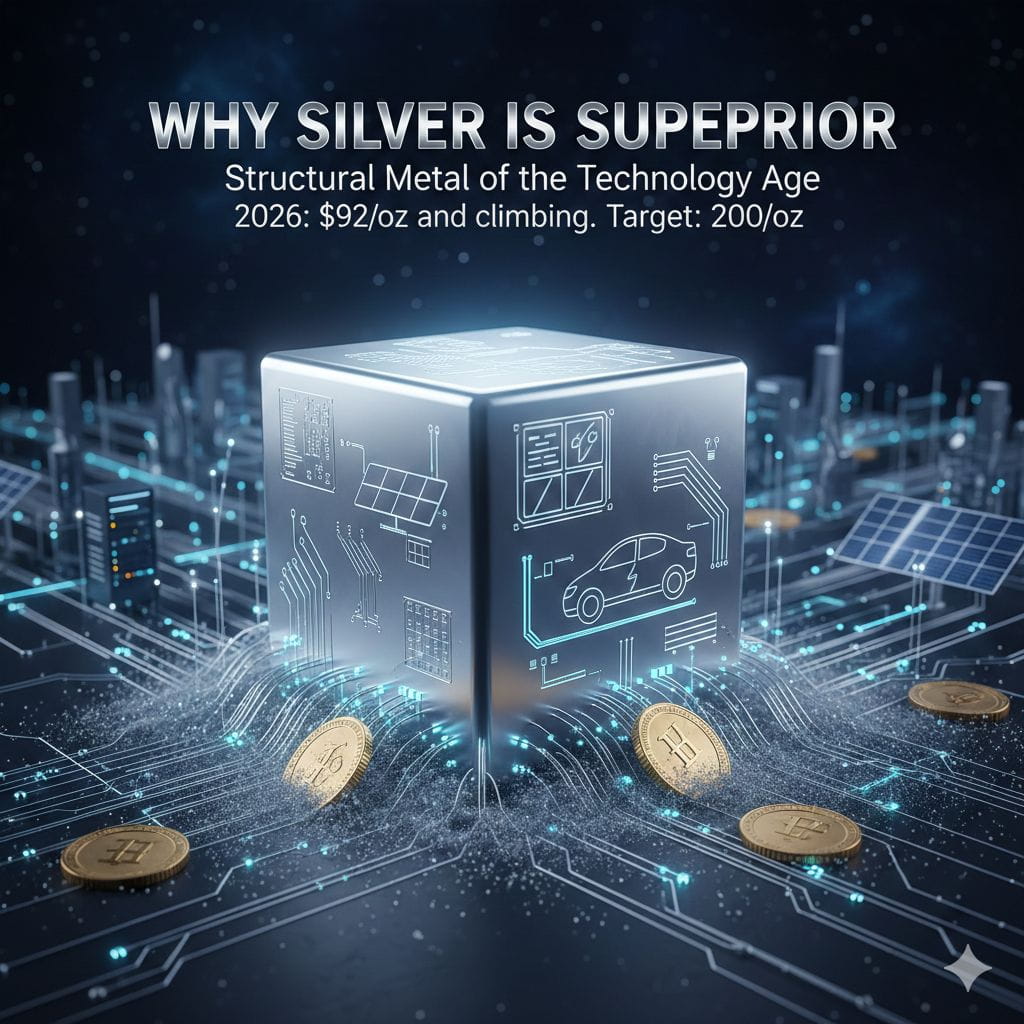
For millennia, gold and silver shared the throne as global money. But as we move deeper into 2026, a fundamental shift has occurred. Silver is no longer just a "precious metal"—it has become the structural backbone of the modern world, mirroring the role iron played during the Industrial Revolution.
1. The Industrial Imperative
Unlike gold, which is largely stored in vaults, silver is consumed. It is the most conductive element on Earth, making it irreplaceable in:
Green Energy: Every solar panel requires silver paste for conductivity.
Electric Vehicles (EVs): Silver is used in nearly every electrical connection in a modern EV.
The AI Boom: High-end computing hardware and 5G infrastructure rely heavily on silver’s unique physical properties.
2. The Supply-Demand Deficit
Silver supply is largely inelastic. Because most silver is mined as a byproduct of lead, zinc, and copper, production cannot simply "ramp up" because the price of silver rises. This creates a structural deficit in a world that requires more silver every year for technological survival.
3. The Path to $200
In 1990, silver sat at roughly $5.00/oz. Today, in 2026, we are seeing it trade at $92/oz. While a jump to $200/oz seems bold, consider the factors:
Monetary Debasement: As fiat currencies fluctuate, the "store of value" appeal of silver returns.
The Gold-to-Silver Ratio: Historically, this ratio has been much tighter. If silver corrects toward its historical relationship with gold, the triple-digit price point becomes a mathematical probability rather than a speculation.
Silver is the only asset that offers the safety of a "hard money" store of value combined with the explosive growth potential of a high-tech industrial commodity.
Why this framing works:
Historical Context: Comparing it to iron in the Industrial Age provides a powerful mental model for the reader.
Urgency: Highlighting that it is "consumed" rather than just "stored" explains why the supply is drying up.
Expert Tone: It balances bold price targets with the logical reasoning of supply/demand mechanics.