
In the fast-moving world of crypto infrastructure, most attention gravitates toward flashy DeFi apps or high-speed blockchains. Yet beneath the surface, a different kind of revolution has been unfolding—one that focuses not on speculation, but on something far more fundamental: data. Walrus Protocol, powered by its native token WAL, has emerged as one of the most compelling decentralized storage networks of this new era, especially as Web3, AI, and data-heavy applications collide in early 2026.
At its core, Walrus is not trying to be a traditional cloud replacement in disguise. Instead, it rethinks how large-scale data should exist in a decentralized environment. Built natively alongside the Sui blockchain, Walrus is designed for storing and serving massive binary objects—everything from AI model weights and training datasets to high-resolution media, NFT assets, and fully decentralized web content. Where centralized cloud systems rely on trust and permission, Walrus relies on cryptography, economic incentives, and verifiable availability.
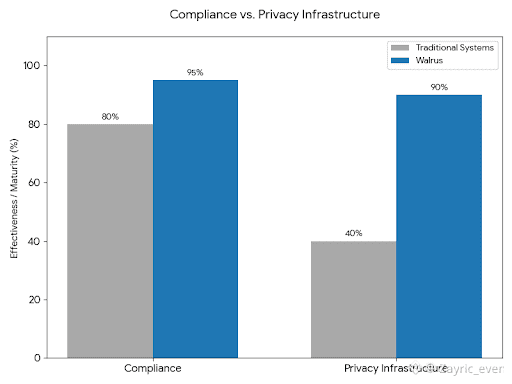
What makes Walrus stand out immediately is how it treats data itself. Rather than duplicating entire files across countless nodes, the protocol uses a custom erasure-coding scheme known internally as “Red Stuff.” Files are split into encoded fragments, or slivers, and distributed across the network in a way that allows reconstruction from only a subset of those pieces. This approach dramatically reduces storage overhead while preserving resilience. Nodes can fail, go offline, or be replaced, and the data remains intact and recoverable. The result is a system that is both cost-efficient and robust—two traits that rarely coexist in decentralized storage.
This architecture becomes even more powerful when combined with Sui’s object-centric blockchain design. Walrus stores metadata on-chain as native Sui objects, allowing smart contracts to reference stored blobs directly. Payments, proofs, availability checks, and epoch transitions are all coordinated on-chain, creating a seamless loop between data storage and programmable logic. For developers, this means storage is no longer an external service bolted onto an app—it becomes a first-class primitive that can be composed, automated, and monetized.
Security and reliability are enforced through a delegated proof-of-stake model. WAL holders can stake or delegate their tokens to storage nodes, which are evaluated continuously based on uptime and performance. High-performing nodes earn rewards, while delegators share in that upside. This mechanism aligns incentives across users, operators, and token holders, ensuring that data availability is not just promised, but economically enforced. Availability proofs submitted each epoch cryptographically confirm that nodes are still holding their assigned fragments, creating a transparent and trust-minimized system.
The WAL token itself sits at the center of this economy. It is used to pay for storage, secure the network through staking, and govern protocol upgrades and parameters. A portion of fees is burned, introducing deflationary pressure as network usage grows. With a capped supply of five billion tokens and a heavy emphasis on community incentives, Walrus has structured its tokenomics around long-term participation rather than short-term extraction. Notably, more than sixty percent of the supply is allocated to ecosystem growth through airdrops, grants, and storage subsidies, ensuring that developers and users remain the primary beneficiaries of adoption.
Beyond Web3-native use cases, Walrus has found growing relevance in the AI sector. As concerns around data provenance, model integrity, and reproducibility intensify, decentralized storage offers a compelling alternative to opaque cloud silos. Walrus enables AI teams to store datasets and model weights in a verifiable, tamper-resistant environment, making it possible to prove what data was used, when it was accessed, and whether it has been altered. This capability is increasingly valuable as AI systems become more regulated and more economically significant.
Since its mainnet launch in March 2025, Walrus has transitioned from theory to production. Real storage fees are now being paid in WAL, nodes are actively serving data, and the protocol has secured listings on major centralized exchanges, including Binance. Liquidity and trading activity have fluctuated with broader market cycles, but the presence of WAL across multiple trading pairs reflects growing market recognition. Community incentive programs, including high-profile exchange airdrops and educational campaigns like Walrus Academy, have further expanded the network’s reach.
In the competitive landscape, Walrus occupies a distinct position. Compared to archival-focused systems like Arweave or replication-heavy networks like Filecoin, Walrus is optimized for real-time, programmable storage. Its cost structure is significantly lower due to erasure coding, and its tight integration with Sui allows for performance and composability that older systems struggle to match. Rather than competing head-on with centralized clouds on branding, Walrus competes on fundamentals: cryptographic guarantees, economic efficiency, and developer flexibility.
Its impact on the Sui ecosystem is also notable. Every storage write consumes SUI gas, creating additional demand for the base asset and reinforcing the economic loop between infrastructure layers. As Walrus scales, it doesn’t just benefit its own token holders—it strengthens the underlying blockchain it is built on, attracting more developers, more applications, and more data-intensive projects into the ecosystem.
As of early 2026, Walrus Protocol feels less like an experiment and more like a foundational layer quietly doing essential work. It doesn’t promise overnight hype or viral narratives. Instead, it offers something far more durable: a credible, scalable way to store the world’s decentralized data. In an age where data is value, infrastructure is destiny, and trust is increasingly programmable, Walrus is positioning itself not as a trend, but as a cornerstone.
Walrus Protocol: The Quiet Giant Redefining How the Decentralized World Stores Data

