
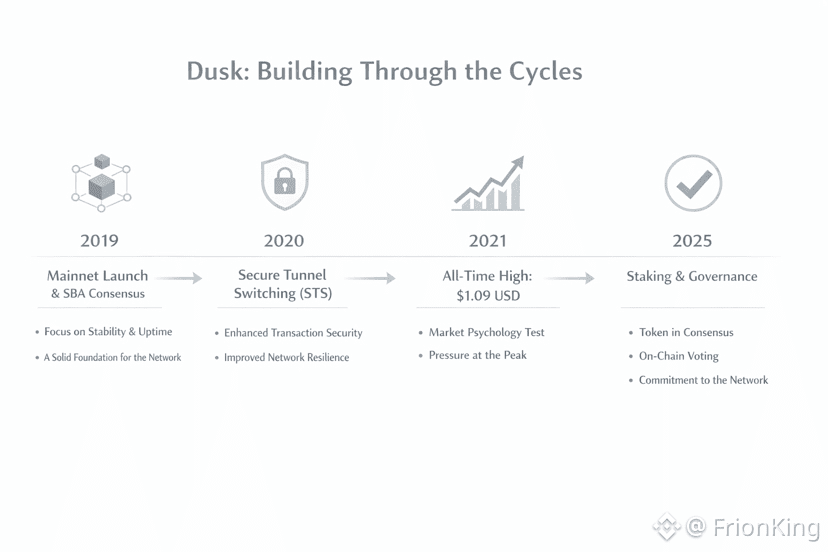
Looking back at Dusk, I always place it in the same frame I use for any infrastructure project that has survived more than one cycle, I do not judge it by emotion, I do not judge it by noise, I judge it by which milestones actually made the system harder, and whether the DUSK token is used like a real operating part, or just treated like a symbol. The four milestones below, for me, are four moments where Dusk shaped itself through engineering and operations, the kind of work the market ignores during euphoria, but rushes to demand the moment conditions turn harsh.
The 2019 milestone is when Dusk moved out of the safe zone of drafts and promises, and into a phase where everything is measured by uptime and stability. Launching mainnet is not a date you celebrate for a few days, it is the moment every small bug starts to cost money, every design choice gets tested by node operators, and every bottleneck shows up the moment traffic increases. SBA consensus was introduced around this phase, and to me it was a clear message, Dusk wanted a disciplined base layer, something that runs under bad conditions, and holds under pressure, instead of looking good only in a demo. Have you ever looked at a chain and asked yourself, does it exist because of narrative, or because its consensus is strong enough to not crack when the market rushes in.
The 2020 milestone, Secure Tunnel Switching, STS, sounds purely technical, and those are usually the changes people ignore, but anyone who has been around long enough knows most disasters happen in the “pipes”. When transactions, data, and message flow need stronger protection, the hard part is not adding a security layer, the hard part is adding it without making the system heavy, slow, and painful to operate. STS is described as improving security for streaming transactions, and I read that as Dusk prioritizing long term operational resilience, reducing risk at handoffs, transitions, and unstable network moments. Have you ever watched one project die from chasing features, while the one that survives is the one quietly cleaning up what users never see.
The 2021 milestone is a price milestone, DUSK reached its all time high of 1.09 USD on December 30, and I treat this more like a “psychology test” than a trophy. At the top, everyone feels right, but the top is also where expectations turn into pressure, communities turn into crowds, and projects get pulled off their engineering rhythm to follow market rhythm. I have seen too many tokens hit an ATH and then lose direction, because the team starts optimizing for excitement instead of optimizing for network durability. So the real question is, after the top, did Dusk keep building like infrastructure, or did it get dragged into the marketing loop like most of the market.
The 2025 milestone is where the token is pulled back into its proper role as “a token of the system”, DUSK is emphasized for staking, participation in consensus, and on chain governance. This is the part I always examine, because tokenomics is not about a pretty allocation chart, it is about whether the token forces holders to carry responsibility for the network. Staking is locked capital and locked conviction, consensus is real participation in securing the chain, governance is accepting the consequences of decisions, not just voting for fun. If DUSK is used to operate, to secure, and to decide upgrades, then it has a reason to exist beyond a cycle, if it is only a speculation tool, the market will replace it the moment a new story appears. Are you looking at DUSK as a short term trading asset, or as a working component of the consensus machine.
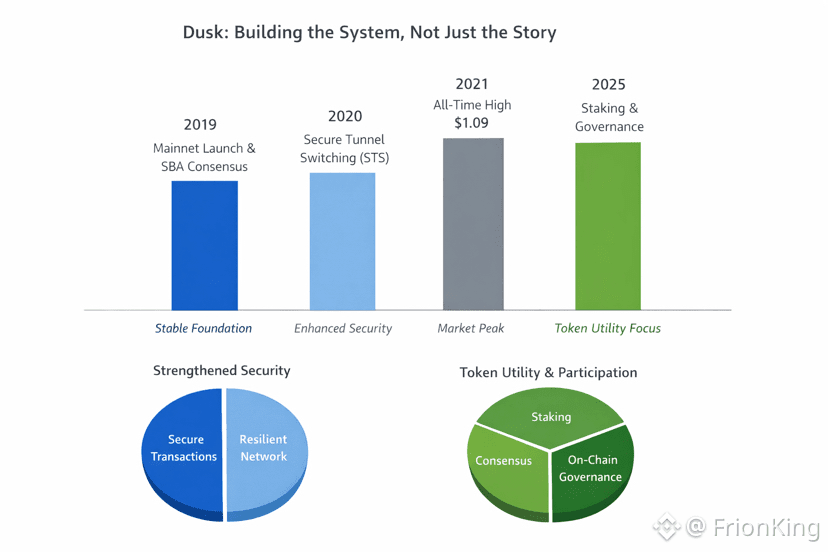
When I put these four milestones together, I see Dusk following the pattern of “build the base first, let the story follow”, from mainnet and consensus, to improving security in transaction flow, through a market psychology test at the top, and back to strengthening the token’s role in staking, consensus, and governance. In this market, what lasts is rarely what is the loudest, it is usually what breaks the least. And my final question for you is, when you judge Dusk, are you judging a chart, or are you judging a system that can keep running into the next cycle.
