
I look at Dusk announcing a three layer architecture with DuskDS, DuskEVM, and a privacy layer aimed at RegDeFi the way a long time market participant does, I have seen enough cycles, enough promises, and enough networks break because the foundation could not handle pressure. This market loves speed and narrative, but in the end only two things decide whether infrastructure survives, engineering discipline and the ability to operate when conditions turn ugly. Have you ever watched a project talk beautifully about the future, then when traffic spikes, when nodes get stressed, when an upgrade hits, everything turns into a mess like a system that never matured. To me, Dusk’s three layer design is a statement that they want the long game, and they are willing to do the hard work first, then talk about expansion later.
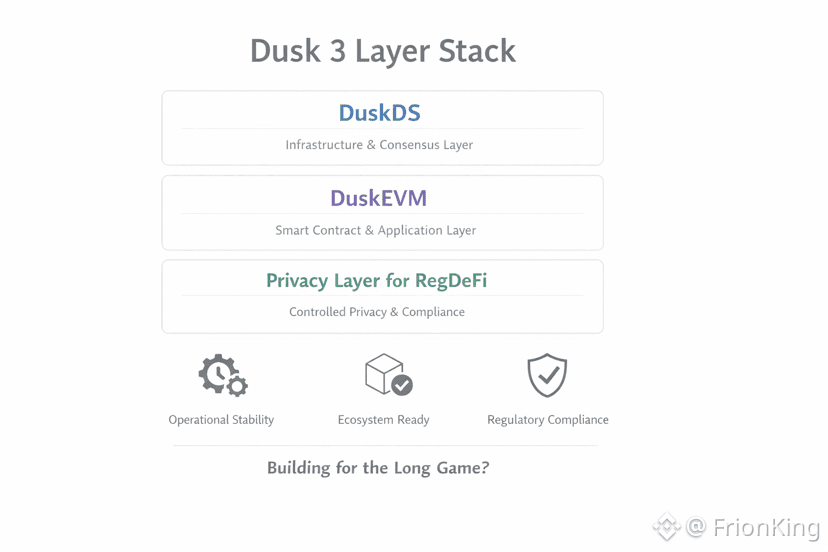
On top of that is DuskEVM, and I understand why they did it. EVM is not new, but it is the common language for application markets, and if you want a real ecosystem you need to give developers an entry path that is familiar, fast, and low friction. But the point is not the EVM label, the point is how Dusk places EVM inside a RegDeFi minded architecture. They are not only trying to run smart contracts, they want them to run in an environment that can be explained to enterprises, to institutions, to players bound by process. Have you ever seen a DeFi product run smoothly, but the moment you ask about audits, access control, and risk reporting, it starts to stumble. In this picture, DuskEVM looks like the application deployment layer, but inside a system where operational control and governance are accounted for upfront, not improvised later.
The privacy layer aimed at RegDeFi is what really gets my attention, because privacy in crypto has been misunderstood or misused for a long time. One side treats privacy like a cover for everything, the other side fears privacy because they think it means zero compliance. A market veteran like me sits in the middle, privacy has value when it protects sensitive data while still leaving a path to prove validity and support audits when needed. Dusk is aiming for “controlled privacy”, and this is the harder road, because you have to build mechanisms that hide what must be hidden, while allowing what must be revealed, to the right party, at the right time, under a clear process. Do you think this is a marketing phrase or an engineering problem. I believe it is an engineering problem, and if it is solved, it becomes a practical bridge between DeFi and regulated finance.
When you put the three layers together, DuskDS keeps operating discipline, DuskEVM opens the door for applications in a market standard way, and the privacy layer sets a RegDeFi foundation through controlled privacy. The full picture tells me Dusk is not trying to chase a short lived spike. I have seen many projects win one season and disappear because they had no structure to survive when things got hard. If Dusk is on the right track, what will you see next. You will see them measured by uptime, by upgrade stability, by node experience, and by whether applications can deploy without sacrificing discipline. Are you waiting for a big story, or are you waiting for a system that can actually take pressure, and step into RegDeFi with real capability.
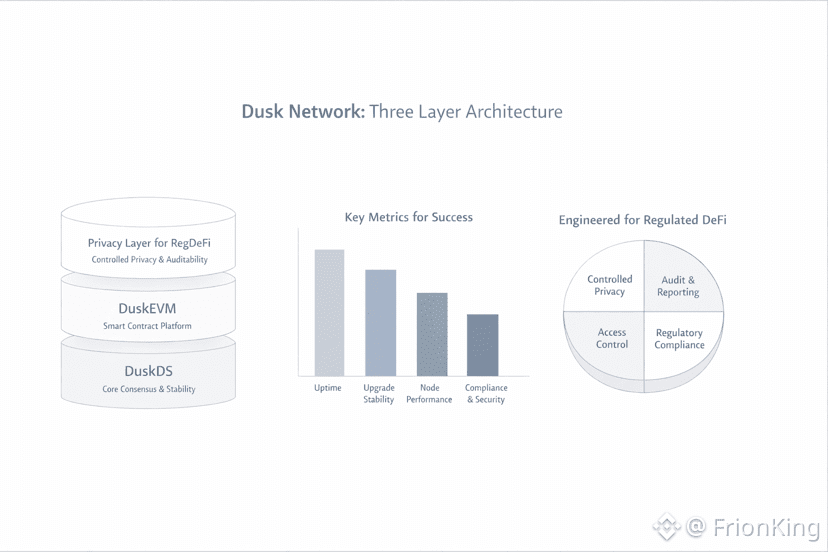
The DuskDS layer, bluntly said, is the type of thing people on the outside rarely concern themselves with, while the people involved in operation, construction, etc., know exactly the reason for it. This is the tale of the operations involved concerning a consensus, the flow of core data, the rhythm of the network, as well as the mechanism by which the entire balance adjusts once things cease to be as fluid as a well-run demo. There is a lot of networks out there which, far from the intention being incorrect, were destroyed due to the architecture requiring too many operation modes be lined up through a single location, thus the optimized operation of a single location destroyed the balance thereof. Dusk, by leaving DuskDS as a distinct operation, tells me they wish to set the core foundation firmly down as a type of operating standard, before the other layers even attempt to engage. Have you ever wondered the reason for so many networks continually updating, continually patching, while seeming more unstable with every iteration? It lies in the fact the foundation never had the means by which it could handle the sorts of impacts thrown its way.
