
I’ve been in this market long enough to know one simple truth, ecosystems are not built on noise, they are built on process, tooling, and real runs that do not break. With Dusk Network, if you look seriously, the ecosystem strategy is not about pulling people in with promises, it is about laying down technical rails so anyone who steps in can move forward, and anyone who stays can actually operate. In a space where every project talks about the future, Dusk tries to speak with the present, with the things that feel small but decide survival, network stability, upgrade ability, and the deployment experience for real teams. How many ecosystems have you seen that looked big, and then collapsed after one congestion event, one failed upgrade.
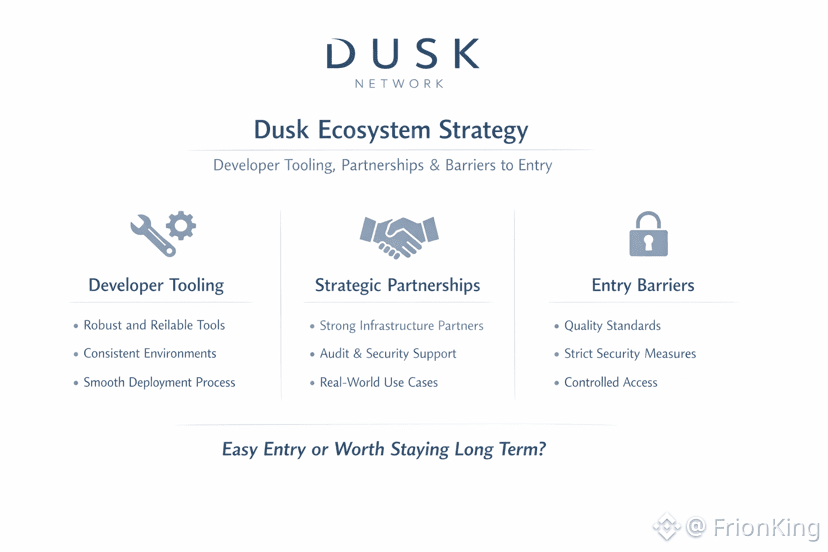
Developer tooling is where Dusk has to be truly strong, because it is the bridge between ideas and products. I do not see tooling as toys for developers, I see it as a risk reduction layer for the entire ecosystem. Good tooling means consistent development environments, documentation that removes guessing, node operations that are repeatable, sync, monitoring, and incident handling that teams can execute under pressure. When a new team joins, they need that steady feel, they should not have to gamble every time they deploy. The more Dusk smooths that experience, the more the ecosystem expands naturally, because integration time drops, mistakes cost less, and shipping speed rises. Do you want to build on a platform where every update is a bet, or one where updates feel like a packaged procedure.
When it comes to partners, I’m not impressed by logo lists, I’m interested in the value chain Dusk builds around the network. An ecosystem aimed at finance needs a different kind of partner set, infrastructure teams that keep nodes stable, audit and security groups that enforce standards, builders who ship real applications, and integrators who make reporting and control flows work alongside data without breaking. A strong partner is a partner that accepts being measured by SLA, incident response time, and traceability, not by press releases. If Dusk wants institutional proximity, it must get used to cold questions, do you have a playbook when the network fails, do you have upgrade standards that avoid downtime, do you have a way to prove validity without exposing sensitive data. Do you think an institution buys emotion, or checklists and operational evidence.
Entry barriers, in my view, are something Dusk should hold firmly, because the right barriers keep an ecosystem from being diluted. In this market, opening the doors too wide usually pulls in junk projects, junk code, and junk expectations, and the teams building for real end up paying the price. Dusk does not need bureaucracy style barriers, it needs strictness exactly where quality matters, deployment standards, security standards, upgrade discipline, and how applications follow the system’s operational rules. When you force the ecosystem to move by standards, you reduce repeated failure patterns, reduce chaos, and increase trust. Do you want an ecosystem where anyone can enter but nobody owns responsibility, or one where entry is hard enough that the people who stay are forced to do things correctly.
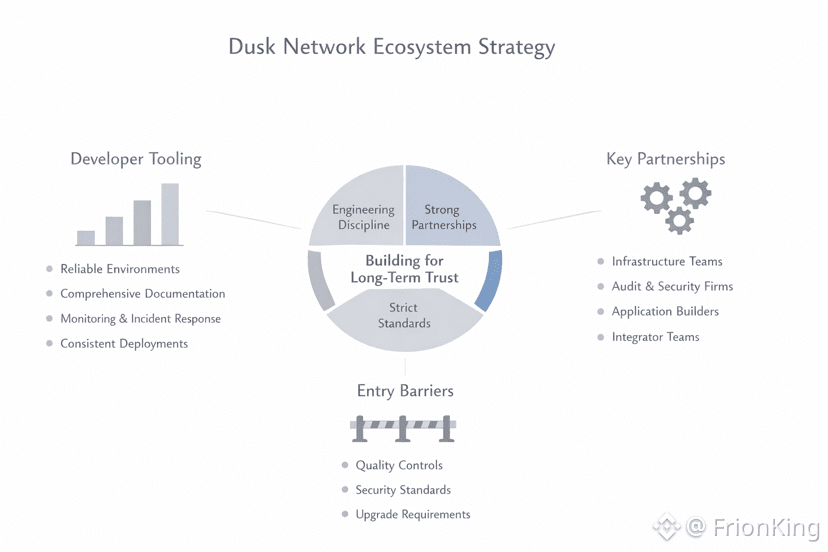
In the end, through the lens of someone who has lived through multiple cycles, Dusk Network’s ecosystem strategy is about trading engineering discipline for long term trust. Tooling turns building into a process, not a game of luck. Partners turn deployment into a reliable supply chain, not a loose collection of connections. Entry barriers protect standards, so the network is not dragged down by its weakest layer. And the question I keep asking the reader is, are you looking for a place that is easy to enter, or a place worth staying in, when the market shifts into a phase where only infrastructure that survives pressure deserves to be called infrastructure.
