
The first time you try to move meaningful size using “crypto rails,” you learn a quiet truth: the blockchain is rarely the weakest link. The weakest link is usually everything wrapped around itb validators with incentives you don’t fully trust, bridges that can be paused, governance that can be captured, and infrastructure that starts to look neutral only until the day it isn’t. For traders and investors, neutrality is not a philosophy. It’s operational safety. It’s the difference between a settlement layer that behaves like public infrastructure and one that behaves like a company.
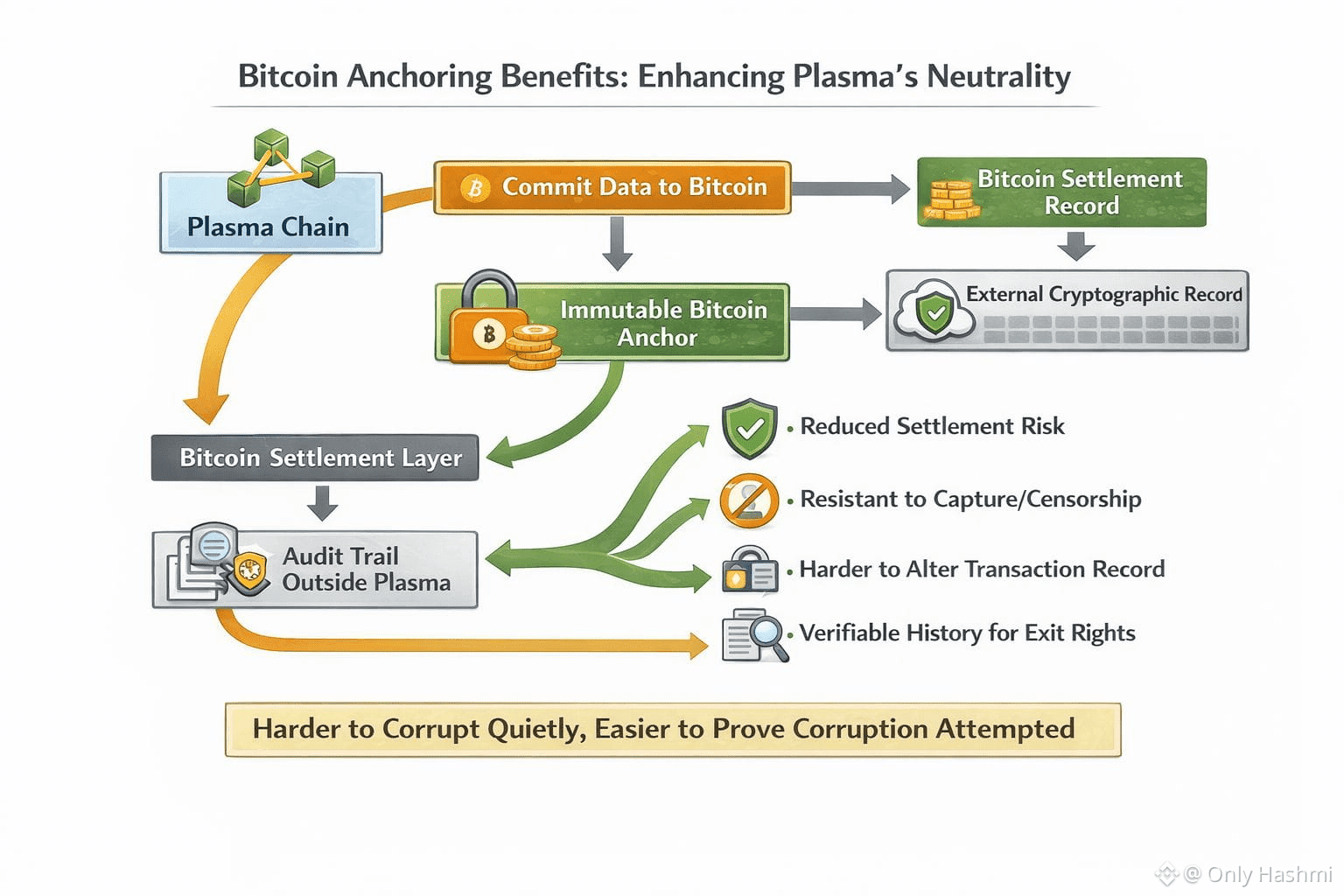
That’s why the phrase “Bitcoin anchored security” matters in the Plasma conversation especially when people talk about Plasma’s neutrality. Plasma positions itself as a stablecoin-focused chain designed for payments and settlement, with an architecture that periodically anchors state commitments to Bitcoin. In simple terms, Plasma can run fast and flexible day-to-day, while using Bitcoin as a durable public record for checkpoints something closer to a “final truth layer” than another internal database. This approach shows up in multiple Plasma explainer materials and technical writeups: Plasma anchors state roots or transaction history summaries into Bitcoin so that rewriting history becomes dramatically harder once those commitments are embedded in Bitcoin blocks
To understand why this improves neutrality, it helps to define what neutrality actually means in markets. Neutrality is not “decentralization” as a marketing line. Neutrality is credible non discrimination the sense that no single stakeholder group can easily decide who gets delayed, who gets censored, or which transactions become “less equal.” Most L1s and L2s eventually reveal political surfaces validator concentration, sequencer control, emergency admin keys, or governance whales with enough weight to change rules in a weekend. Even if those powers are used responsibly, traders price the risk that they could be used differently under pressure.
Bitcoin anchoring changes the power geometry because it externalizes part of the trust away from Plasma’s internal operator set and into the most battle-tested, widely observed settlement network in crypto. Bitcoin’s proof-of-work chain is expensive to attack and extremely difficult to rewrite at scale, which is exactly why major institutions treat it differently from newer networks. Plasma doesn’t magically become Bitcoin, and it does not inherit Bitcoin’s consensus in real time, but it can borrow Bitcoin’s “immutability aura” for history once checkpoints are posted.
That matters because neutrality in practice is often about exit rights. If you trade on a venue and something goes wrong, what evidence can you prove to the outside world? If a chain reorgs or a privileged group rewrites history, can you independently demonstrate what the ledger looked like before the change? Anchoring creates an audit trail that sits outside Plasma. It’s not a promise from Plasma; it’s a cryptographic receipt embedded in Bitcoin.
A real-life parallel: years ago, when I first started taking on chain trading seriously, I assumed “finality” was a technical detail. Then I lived through the kind of day every trader remembers congestion spikes, delayed confirmations, rumors of validators coordinating, and conflicting narratives about what “really happened.” Nothing catastrophic, but enough ambiguity to feel the risk in your chest. The trade wasn’t even my biggest problem. The bigger problem was uncertainty if the internal actors had chosen to prioritize certain flows, would anyone outside that ecosystem be able to prove it cleanly? That experience changed what I look for. Not just throughput, not just fees, but the ability to anchor truth somewhere that no one in the local ecosystem controls.
Plasma’s Bitcoin anchoring tries to solve exactly that class of problem. If Plasma periodically commits state roots into Bitcoin, then the cost of rewriting Plasma’s past rises sharply after each anchor. To alter earlier transactions, an attacker would need to either (a) change Plasma and still match the already anchored commitment (cryptographically infeasible if the hash function holds), or (b) rewrite Bitcoin history to remove or alter the anchor (economically and operationally extreme). For investors, that reduces long-horizon settlement risk. For traders, it reduces the tail risk that “policy” becomes “history.”
There’s also a softer but important neutrality effect: reputational constraint. When a chain’s history is anchored externally, insiders can’t quietly smooth over uncomfortable events. Anchoring pushes the system toward transparency by design. Even if Plasma validators retain real-time control over ordering, the existence of externally anchored checkpoints limits how much retrospective control they can exercise without leaving obvious evidence.
Now the honest caveat: anchoring does not eliminate all trust. Plasma still relies on its own validator set (or equivalent consensus participants) for block production and day to day security. That means censorship or preferential inclusion can still happen in the short term. Even some pro-Plasma summaries acknowledge this tradeoff: anchoring improves long-term settlement guarantees and auditability, but it adds complexity and doesn’t replace real-time consensus security.
So what is the “unique angle” for a trader or investor here?
Bitcoin anchoring isn’t mainly about speed or marketing. It’s a governance and credibility move. Plasma is effectively saying: “Don’t just trust us. Verify our history against Bitcoin.” In an industry where neutrality fails most often under stress regulatory pressure, exchange collapses, validator cartels, geopolitical events that design choice matters. It creates an external reference point that is not easy to bargain with, intimidate, or coordinate behind closed doors.
And that’s why Bitcoin-anchored security can enhance Plasma’s neutrality. It does not make Plasma perfect. It makes it harder to corrupt quietly, and easier to prove when corruption is attempted. For market participants who think in risk distributions instead of narratives, that is the kind of engineering choice that deserves attention.
If you’re evaluating Plasma as an infrastructure bet whether for stablecoin flows, settlement tooling, or ecosystem exposure the most practical question to ask is simple how frequently does it anchor, what exactly is being committed, and what are the escape hatches if things go wrong before the next anchor? Those details will matter more than slogans, because neutrality in crypto isn’t something you claim. It’s something you can still defend when the day turns chaotic.

