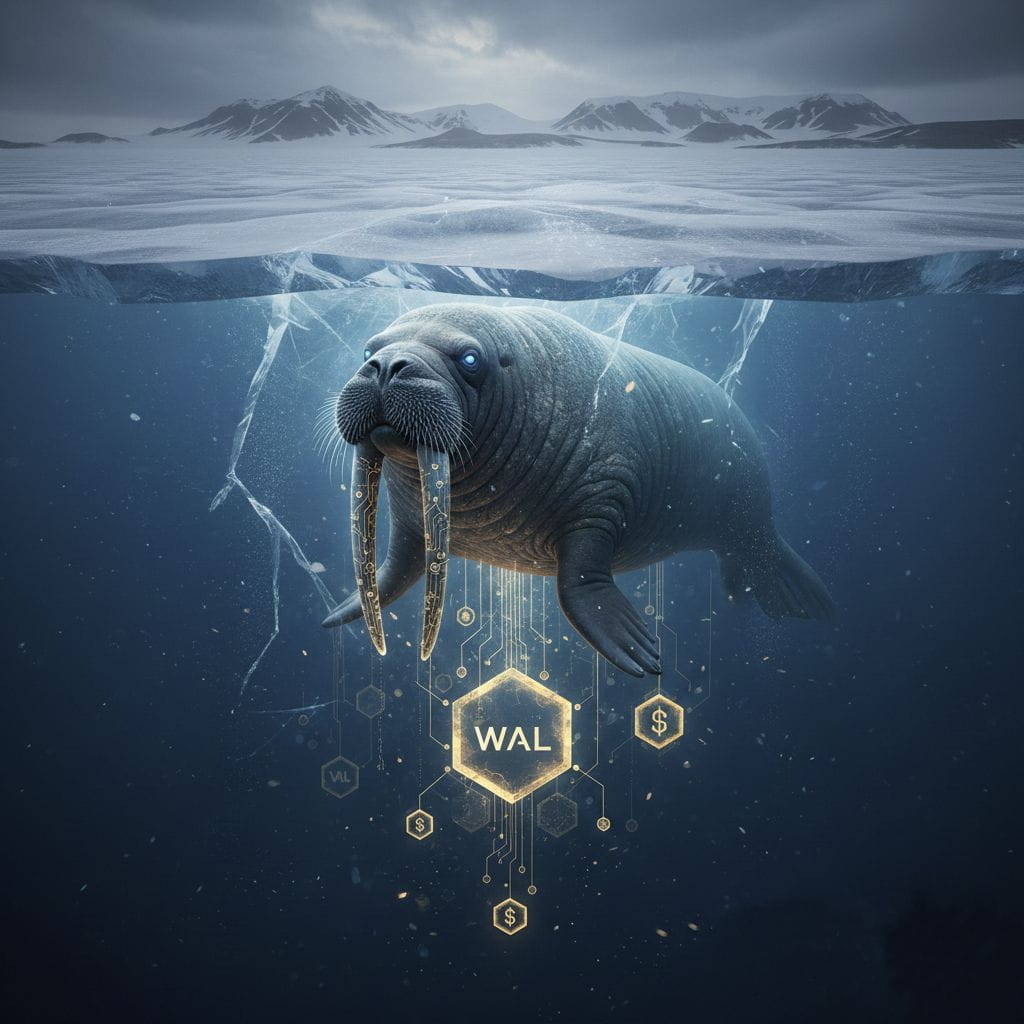
Some technologies announce themselves loudly, wrapped in hype cycles and flashing price charts. Others move like deep currents beneath the surface, quietly reshaping the environment before most people realize the landscape has changed. The Walrus protocol belongs to the second category. It does not merely add another token to the ever-growing universe of digital assets; it attempts to redesign the relationship between people, their data, and the systems that store and move it. At the center of this design is WAL, the native token that acts not just as fuel, but as a key to participation in a privacy-focused, decentralized ecosystem that feels less like an app and more like digital infrastructure being rebuilt from the ground up.
We live in an era where data is both currency and vulnerability. Every file uploaded, every message sent, every digital footprint left behind feeds into vast centralized storage systems that are efficient but deeply asymmetrical. Control concentrates at the top, while users surrender ownership in exchange for convenience. Walrus challenges this silent trade-off by asking a radical question in a deceptively calm way: what if storage itself could be decentralized, private, and still practical at scale? Instead of treating privacy as an optional layer pasted on top of a transparent system, Walrus weaves it into the core mechanics of how information is stored and retrieved.
The protocol’s approach to data feels almost biological. Rather than keeping a file whole in a single place, it breaks information into encoded fragments and distributes them across a network. These fragments on their own are meaningless, like pieces of a puzzle that reveal nothing until enough of them are brought together. This technique, combined with blob storage designed to handle large volumes of data, allows the system to manage heavy digital loads without sacrificing decentralization. The result is a structure where resilience is not an afterthought. If one part of the network fails or disappears, the data does not vanish with it. It survives, reassembled when needed, protected by mathematics instead of institutional promises.
Operating on the Sui blockchain gives Walrus a foundation built for performance and flexibility. This matters because decentralized ideals often collapse under the weight of real-world usage. Slow transactions, high fees, and limited scalability have historically made some blockchain storage visions feel more symbolic than usable. Walrus positions itself differently, aligning with an environment that supports fast interactions and complex applications. This opens the door for developers to build tools that rely on private, decentralized storage without forcing users to endure clunky experiences. Privacy, in this vision, does not have to mean friction.
WAL, the native token, plays multiple roles in this ecosystem, and its significance grows clearer the deeper one looks. It powers transactions within the protocol, enabling users to pay for storage and services. It also supports staking, where participants lock tokens to help secure the network and align themselves with its long-term stability. Beyond that, WAL becomes a governance instrument. Holders can influence decisions about upgrades, parameters, and incentive structures, shaping how the protocol evolves. This blend of utility and voice turns the token into a form of digital citizenship. Participation is not passive; it is structural.
What makes the Walrus story compelling is not just the technology, but the emotional undercurrent behind it. Privacy online has become a defensive posture, a constant negotiation between visibility and exposure. Many users no longer expect true control; they settle for settings and policies that can change without warning. Walrus offers a different psychological experience. By design, it reduces the need to trust a single entity with sensitive data. Trust is distributed across a network, and enforced through cryptography and incentives rather than brand reputation. This shift changes how individuals and organizations might think about their digital lives. Data becomes something you steward, not something you surrender.
For creators, this can be transformative. Digital art, video, research archives, and personal projects often live at the mercy of centralized platforms that can remove, restrict, or monetize access unpredictably. Decentralized, censorship-resistant storage creates an alternative path. It does not guarantee immunity from all external pressures, but it raises the threshold for erasure and control. Content can persist in a way that aligns more closely with the creator’s intentions rather than platform policies. That persistence carries a quiet sense of dignity: the idea that digital work deserves durability and respect.
Enterprises, too, may find a new kind of flexibility here. Backup strategies, archival systems, and data-sharing frameworks can be reimagined in a decentralized context. Instead of concentrating sensitive information in a few massive silos, organizations can leverage distributed storage that is harder to compromise or manipulate. Combined with private transaction capabilities, this creates possibilities for collaboration and record-keeping that are less exposed to surveillance or single points of failure. The appeal is not ideological alone; it is operational.
Governance within Walrus reflects the broader ethos of decentralization. Decisions are not solely handed down by a central authority but influenced by token holders who have a stake in the network’s future. This does not eliminate complexity or disagreement. In fact, it invites them. But it also creates a living system where evolution is collective. Protocols are no longer static products; they are ongoing conversations encoded in proposals, votes, and updates. WAL holders become participants in a digital polity, shaping rules that affect storage costs, reward structures, and technical directions.
The theme that runs through everything is endurance. Walrus is built on the belief that digital information should be as resilient as possible, and that privacy should not be a luxury feature. By combining erasure coding, distributed blob storage, blockchain infrastructure, and token-based incentives, the protocol constructs an environment where data can outlast disruptions and where interactions can occur without constant exposure. It does not claim perfection. No system can. But it pushes the boundary of what decentralized technology can realistically offer.
In a world increasingly defined by invisible data flows and centralized power, Walrus feels like an attempt to restore balance. It acknowledges the scale and complexity of modern digital life while refusing to concede that centralization is the only workable model. WAL, as the native token, ties the whole vision together, translating abstract principles into an operational economy where storage, security, and governance intersect. The story of Walrus is still unfolding, but its direction is clear: toward a digital environment where privacy is structural, ownership is meaningful, and the infrastructure of the internet feels a little less like a walled garden and a little more like a shared, resilient commons.