

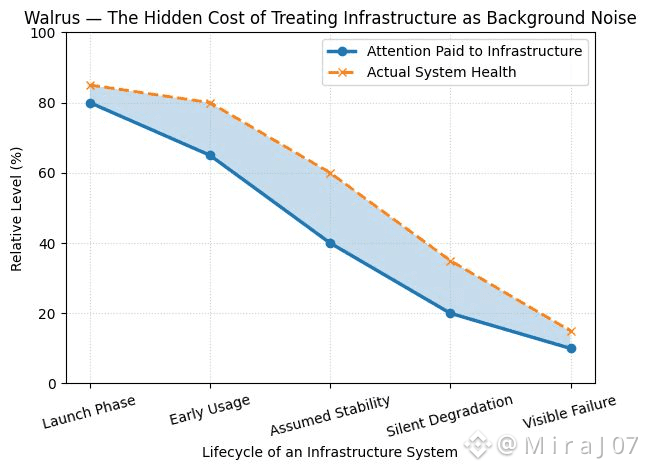
 Infrastructure only feels like background noise until it becomes the main character.
Most users don’t think about storage. They shouldn’t have to. When infrastructure works, it fades into the background like electricity invisible, assumed, unappreciated.
But in Web3, that assumption carries a cost.
Because decentralized infrastructure doesn’t fail like centralized infrastructure. It doesn’t always fail loudly. It fails by drifting, fragmenting, and quietly transferring responsibility to the user.
So the real question isn’t whether storage works today.
It’s what happens when we treat it like it doesn’t matter.
That is the right lens for evaluating Walrus (WAL).
Background noise is how risk hides in plain sight.
When infrastructure becomes “background,” users stop asking:
Who maintains this?
Who is responsible when it degrades?
What are the failure boundaries?
What does recovery look like under stress?
When should I exit?
Instead, they rely on vibes:
“It’s decentralized, so it must be safe.”
“There are replicas, so it must be recoverable.”
“The docs say it works.”
This is how risk becomes invisible not because it disappears, but because attention disappears.
The first cost is delayed discovery.
In decentralized storage, the most damaging failures are quiet:
redundancy thins slowly,
retrieval becomes inconsistent,
repair becomes less frequent,
long-tail data becomes neglected.
If infrastructure is treated as background noise, these signals aren’t noticed early.
And in storage, “early” is everything.
Because recoverability has an expiration date.
The longer degradation goes unseen, the more expensive recovery becomes until it stops being possible at all.
The second cost is accidental centralization.
When users ignore infrastructure, they default to whatever feels easiest:
a single gateway,
a single indexer,
a single retrieval path,
a single provider that “always works.”
This creates a silent shift:
the protocol may be decentralized, but the user experience becomes centralized.
And once retrieval centralizes, control centralizes:
throttling becomes possible,
censorship becomes practical,
prioritization becomes pay-to-play,
outages become correlated.
Background thinking turns decentralization into a label, not a reality.
The third cost is responsibility evaporating into “the network.”
In Web2, someone is contractually responsible.
In Web3, responsibility is often social.
When infrastructure is ignored, responsibility becomes optional:
repair is postponed,
maintenance is under-incentivized,
silence becomes the dominant strategy,
blame becomes untraceable.
Then when something goes wrong, users hear:
“That’s decentralization.”
“It’s an edge case.”
“Try again later.”
And the cost lands downstream on the people least able to absorb it.
The fourth cost is losing disputes even when you’re right.
Storage isn’t just about files. It’s about proof.
Infrastructure now underwrites:
settlement evidence,
governance legitimacy,
audit trails,
recovery snapshots,
AI dataset provenance.
When infrastructure is treated as background noise, users discover too late that:
the data exists but is slow to retrieve,
the index is fragmented,
the cost spikes during urgency,
the recovery window closed.
So disputes aren’t won by truth.
They’re won by whoever can retrieve proof in time.
That is the real cost of ignoring infrastructure: you lose with reality on your side.
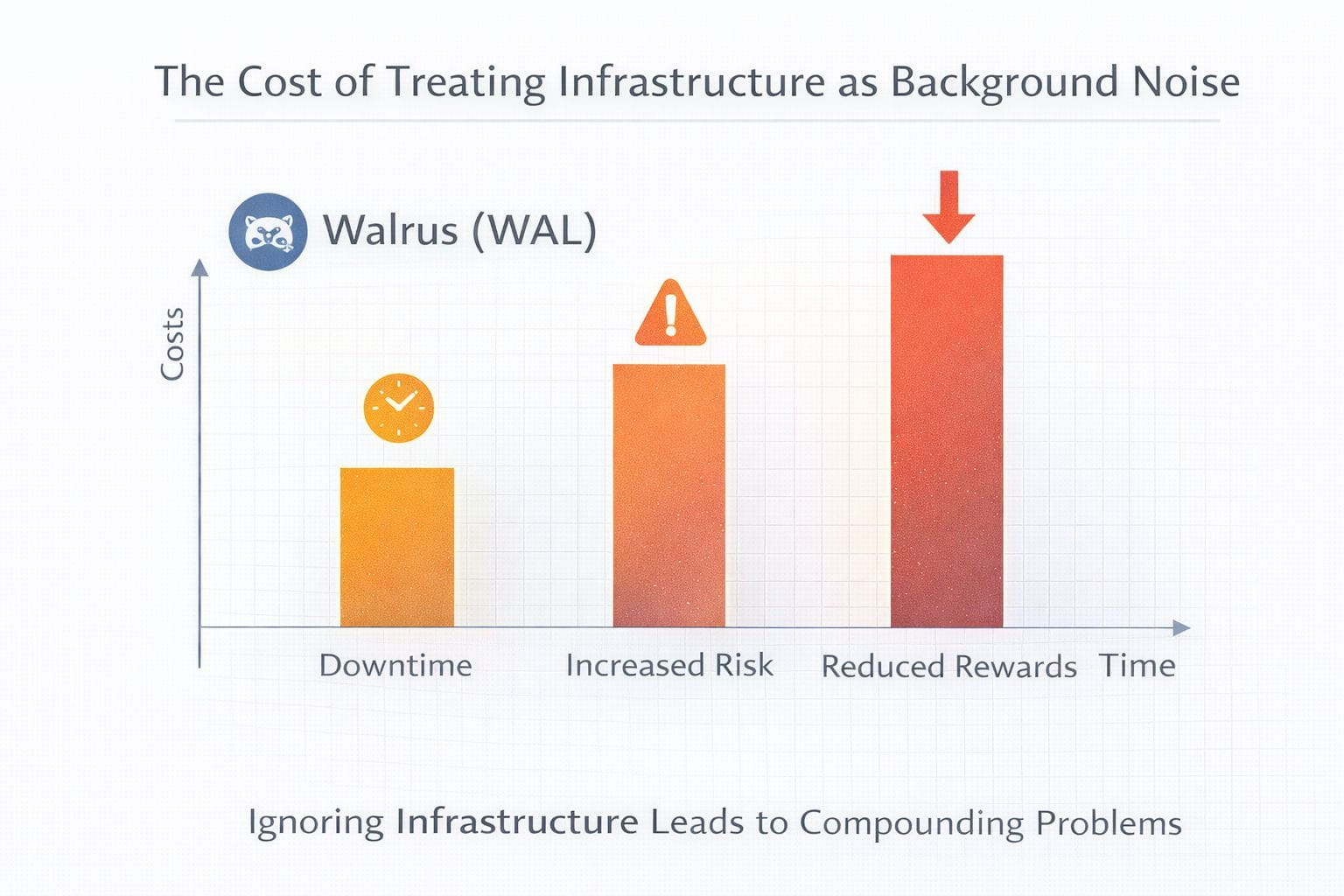
Walrus is built for the exact moment background noise becomes urgent.
Walrus doesn’t assume users will constantly monitor the network. It assumes they won’t because that’s normal.
So the system must do the work that users won’t:
surface degradation early,
penalize neglect upstream,
keep repair economically rational even when demand fades,
preserve recoverability before urgency arrives.
Walrus earns relevance by treating storage as a long-horizon obligation not as invisible plumbing.
Why this matters now: Web3 is moving from experimentation to consequences.
In early crypto, failure was mostly personal:
you lost a trade,
you lost access,
you learned a lesson.
Now failure becomes systemic:
protocols settle real capital,
DAOs govern real treasuries,
RWAs require auditability,
institutions demand defensible records.
In this phase, treating infrastructure as background noise is not just careless it’s expensive.
Walrus aligns with this maturity because it’s designed around accountability, drift resistance, and time-based safety.
I stopped treating storage like a utility.
Because utilities don’t negotiate availability.
They don’t quietly expire trust.
They don’t shift responsibility onto users.
I started treating storage like what it really is in Web3:
a long-term risk contract between incentives, time, and recoverability.
And that’s why Walrus matters: it’s designed for the moments when infrastructure stops being background noise and becomes the deciding factor in whether users can act, recover, or prove anything at all.
Infrastructure becomes “background” only for people who can afford surprises everyone else pays interest on ignorance.

