

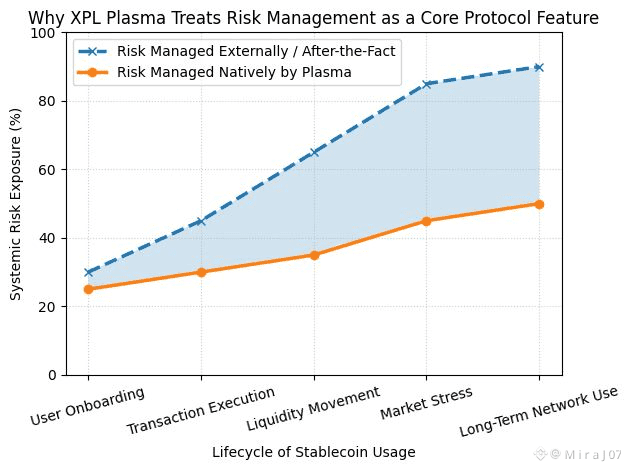
 Most blockchains treat risk management as something users should handle. XPL Plasma treats it as something the protocol must engineer.
In many ecosystems, “risk” is outsourced to the user: choose the right bridge, avoid malicious contracts, manage gas volatility, and hope the network stays stable under stress. That model doesn’t scale to mainstream adoption.
XPL Plasma approaches the problem differently. It assumes that if a chain wants billions of transactions and consumer-grade usage, risk management cannot be optional it must be embedded into the architecture, enforced by design, and resilient in worst-case conditions.
The first principle of risk management is acknowledging reality: scaling systems fail differently than Layer-1s.
High-throughput environments introduce risks that are not always visible in normal usage:
operator downtime
data availability stress
congestion bursts
exit coordination challenges
dispute window timing risks
adversarial behavior during market panic
If these risks are treated as edge cases, they become existential failures.
XPL Plasma treats them as expected conditions and builds around them.
That’s what it means to make risk management a protocol feature: design for failure before failure arrives.
Plasma’s exit mechanism is risk management in its purest form: enforceable recoverability.
Most protocols measure safety by how well they prevent bad outcomes.
XPL Plasma measures safety by how well users can recover from them.
The exit mechanism functions like an insurance-grade safety system:
if the operator misbehaves, users can exit
if the network halts, users can exit
if censorship occurs, users can exit
if uncertainty rises, users can exit
This is risk management that does not depend on trust, support tickets, or emergency governance votes.
It depends on proof and enforcement at Layer-1.
Predictable performance is not only UX it is a risk control system.
In finance and consumer payments, unpredictability is a hidden risk multiplier.
When users cannot predict:
confirmation time
failure rates
network responsiveness
congestion behavior
they react defensively. They overpay fees rush exits and create panic loops that destabilize the system further.
XPL Plasma’s focus on predictable performance reduces systemic risk by stabilizing user behavior under load.
This is how infrastructure prevents chaos: by preventing surprise.
Fee stability is a form of economic risk management.
Unstable fee levels cause second-order failures:
microtransactions become irrational
marketplaces lose velocity
Gaming economies break their reward loop
apps throttle activity
users delay transactions in dangerous ways
XPL Plasma helps stabilize the ecosystem by reducing reliance on variable and volatile fee conditions inherent in the current L1 fee paradigm.
In fact, a system which contains a demand surge while holding costs constant is not only equitable, it is secure.
Also included is the risk management concept, which entails the design of incentives that do not promote behaviors that are likely to destabilize the
Sustainable chains don’t just process transactions they shape what kinds of transactions happen.
XPL Plasma’s architecture must incentivize:
useful throughput rather than spam
consistent participation rather than bursty abuse
monitoring and contestability rather than complacency
predictable state growth rather than bloat
This prevents “throughput inflation,” where the network appears active but becomes fragile due to low-quality usage.
Healthy activity is a risk control mechanism.
Validators and watchers are not optional participants they are the protocol’s enforcement workforce.
In Plasma systems, risk management depends on contestability: fraud must be challengeable.
That requires a strong ecosystem of:
validators verifying commitments
watchers monitoring exits
automated systems detecting invalid claims
challenge infrastructure operating reliably under stress
XPL Plasma’s risk posture depends on making this enforcement layer economically sustainable.
If monitoring is unpaid, it becomes unreliable.
If monitoring is rewarded, it becomes an industry.
This is why the “watcher economy” is not a side feature it is risk management at scale.
Worst-case resilience is the highest standard of protocol risk management.
Risk is not tested in calm markets.
It is tested when:
volatility spikes
users panic
exits surge
attackers attempt exploits
network load becomes adversarial
XPL Plasma’s emphasis on exits, contestability, and predictable performance suggests an architecture built to survive exactly these moments.
A chain that cannot handle stress is not a scalable chain it is a temporary chain.
The deeper insight: risk management is what turns scalability into sustainability.
Scaling without risk management creates fragility:
more users amplify failure modes
more volume increases attack incentives
more assets raise systemic consequences
more reliance increases trust collapse during outages
XPL Plasma treats scaling as a sustainability problem because it recognizes that growth without control mechanisms is not progress it is leverage.
Risk management is what prevents leverage from becoming collapse.
In the long run, risk-managed scaling becomes the competitive advantage that users don’t notice until they need it.
Users rarely reward safety during good times.
They reward it when things break.
If XPL Plasma continues to encode risk management into its core protocol design, it positions itself as a network where:
consumer apps can rely on predictable execution
funds remain recoverable under worst-case conditions
economic loops remain stable under stress
trust survives volatility
That is how infrastructure earns long-term adoption not through marketing, but through survival.
Speed attracts attention, but resilience earns trust. The protocols that treat risk management as architecture not advice will define the next decade of scalable crypto.

