

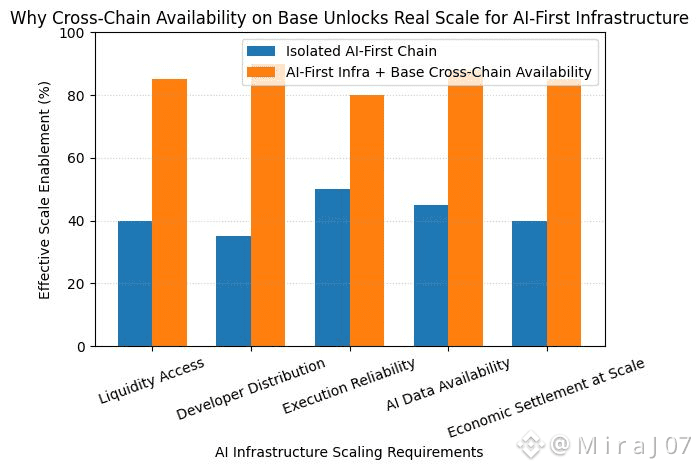
 AI-first infrastructure doesn’t win by being “better.” It wins by being everywhere users already are.
Most AI-first chains and protocols are trying to build a new destination: a new ecosystem, a new liquidity center, a new developer gravity well. But the AI era won’t reward isolation. It will reward distribution.
That’s why cross-chain availability on Base is not a cosmetic expansion it’s a scale unlock. Base has become one of the strongest consumer-facing environments in crypto, and plugging AI-first infrastructure into that flow changes the adoption curve from slow onboarding to immediate reach.
Base matters because AI-native apps are consumer apps first and consumer apps need frictionless rails.
The majority of AI-driven products that will reach millions won’t look like traditional DeFi. They’ll look like:
agent-powered wallets
creator tools that mint, license, and monetize content
AI companions inside social apps
automated commerce assistants
gaming and entertainment experiences
microtask marketplaces and skill routing systems
These applications require high-frequency interactions, simple UX, and low user tolerance for complexity. Base has positioned itself as an ecosystem where consumer-grade crypto UX is a priority, which makes it a natural environment for AI-first infrastructure to scale.
Cross-chain availability turns AI infrastructure from a “platform” into a service layer.
There’s a major difference between:
“Build on our chain”
and
“Use our infrastructure wherever you are”
AI-first systems that want mainstream adoption must become portable primitives, not isolated ecosystems.
When AI-first infrastructure is available on Base, it becomes:
composable with Base-native apps
accessible to developers without chain switching
integrated into existing wallets and onramps
deployable into real user flows immediately
This is how infrastructure becomes invisible and invisibility is what mainstream adoption demands.
The real scaling bottleneck for AI is not compute it’s coordination and settlement at microtransaction frequency.
AI agents don’t transact occasionally. They transact continuously:
paying for data access
paying for inference calls
paying other agents for specialized tasks
settling rewards in micro-increments
updating state constantly
executing conditional workflows
Most blockchains weren’t designed for this pattern. Even if they can handle throughput, they struggle with the economic layer: fees, settlement reliability, and composability across apps.
Base offers a strong environment for high-volume application activity, and cross-chain AI infrastructure can ride that wave without needing to rebuild an ecosystem from scratch.
Base unlocks distribution, but cross-chain unlocks composability at scale.
The value of being on Base is not only users it’s the ability to plug into:
DeFi liquidity
stablecoin rails
consumer wallets
on-chain identity and social graphs
NFT markets and creator tooling
app-to-app composability
For AI-first infrastructure, this matters because agents are not standalone products. Agents are economic participants that must integrate into existing markets.
Cross-chain availability turns AI infrastructure into a universal layer that can:
settle in Base liquidity
route payments in stablecoins
interact with Base-native protocols
monetize services through existing demand
This is how AI becomes an economy rather than a feature.
AI-first infrastructure needs “execution proximity” to users Base provides that.
If AI apps require users to bridge assets, learn new wallets, or enter new ecosystems, adoption collapses.
Base reduces friction because it is already where:
consumer crypto activity is growing
new users are onboarding
app ecosystems are forming
distribution channels are expanding
Cross-chain availability places AI infrastructure within the same execution environment as real demand, which increases:
conversion rates
retention
transaction volume
developer adoption
ecosystem stickiness
This is what “real scale” looks like.
Cross-chain availability also reduces single-chain risk a critical requirement for AI-native systems.
AI-first infrastructure is too important to be fragile.
If an AI network is isolated to one chain, it inherits that chain’s:
congestion risk
fee volatility
governance uncertainty
ecosystem dependency
adoption limitations
By expanding to Base, AI-first infrastructure gains:
redundancy
resilience
multi-market reach
diversified liquidity access
broader developer surface area
This is how infrastructure evolves from “project” into “standard.”
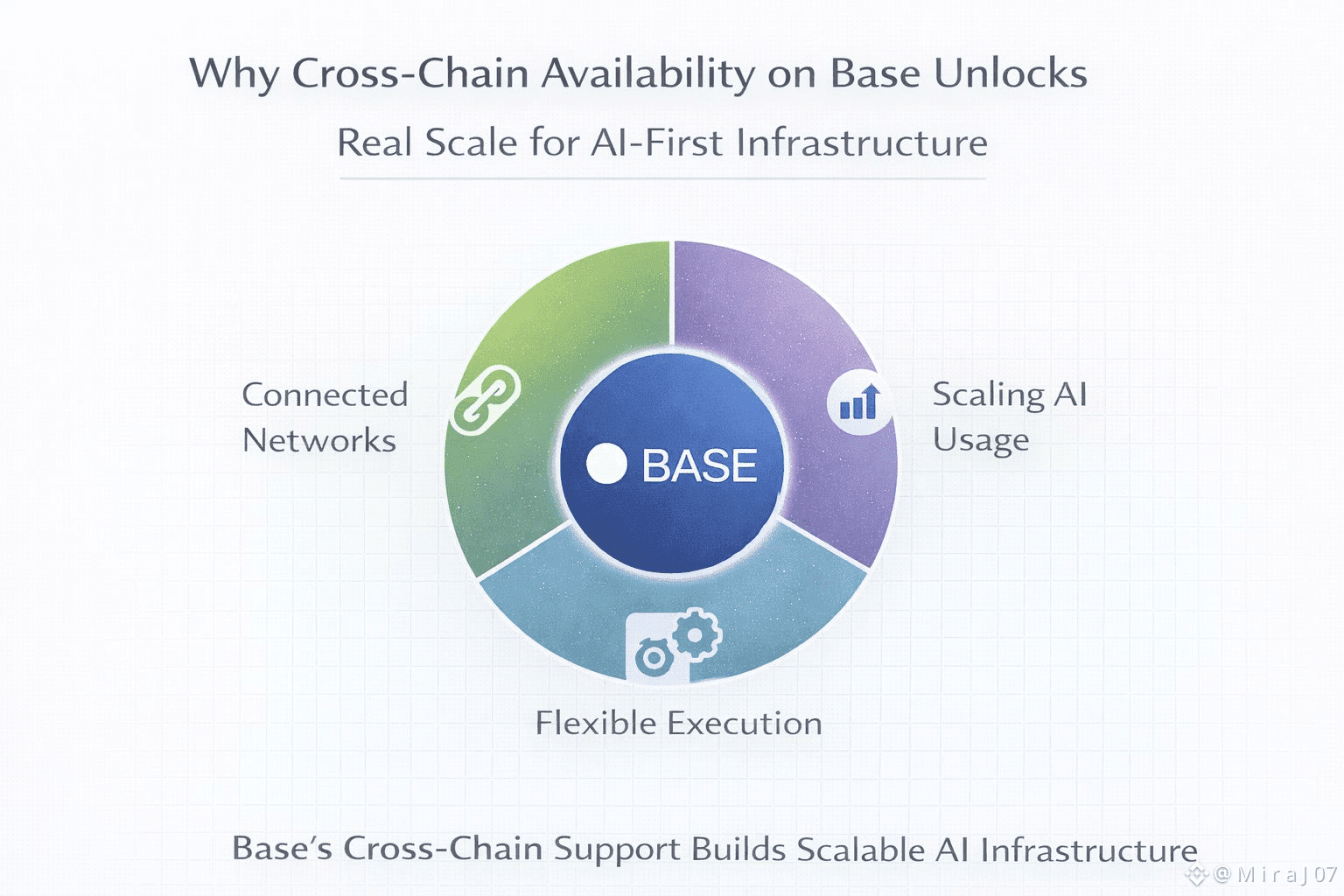
The strategic shift: Base turns AI-first infrastructure into an adoption engine, not just a technology thesis.
Many AI-first networks are technologically impressive but distribution-poor.
Base changes the equation because it provides:
a live user base
active consumer applications
strong stablecoin activity
developer momentum
composability with real products
When AI-first infrastructure becomes usable inside this environment, it stops being speculative. It becomes operational.
Conclusion: Cross-chain availability on Base is not expansion it’s the moment AI-first infrastructure becomes deployable at internet scale.
The AI era will be defined by systems that are:
portable
composable
low-friction
microtransaction-friendly
distribution-connected
capable of integrating into real consumer flows
Base offers the distribution layer.
AI-first infrastructure offers the machine-native logic.
Together, they create the conditions for autonomous applications to scale beyond crypto-native users and into mainstream digital life.
Technology becomes a standard when it stops asking users to come to it and starts showing up wherever demand already exists.
