
On Plasma, settlement happens before most people finish rereading the receipt.
USDT moves. The state closes. The system is already calm again.
The trouble starts later, in places the chain never sees.
A merchant notices it on an ordinary afternoon. Not during a spike. Not during an incident. A customer paid for the wrong variant. Same product, wrong size. They ask for a change a minute later. Polite message. Reasonable request.
The payment is already final.
Nothing is broken. That’s the problem.
On slower rails, this lives in a gray zone. You can pause. You can intercept. You can pretend the transaction is still “in flight” long enough to fix something small without making it expensive or awkward.
Plasma doesn’t leave that space open.
Finality closes the door early, and recovery moves somewhere else. Out of the protocol. Into ops.
Now a correction isn’t a rewind. It’s a second transfer. A deliberate refund. A new accounting entry. Someone chooses which wallet sends it. Someone decides whether to wait, batch, or do it immediately. Someone has to explain why “instant” didn’t mean flexible.
That decision isn’t technical. It’s procedural.
Merchants don’t struggle with the idea of finality. They struggle with the timing of responsibility. A mistake that used to be absorbed quietly now has a paper trail. A small change request now touches fees, reconciliation, and support tone. Not because Plasma is unforgiving, but because it’s fast enough to be done before humans finish reacting.
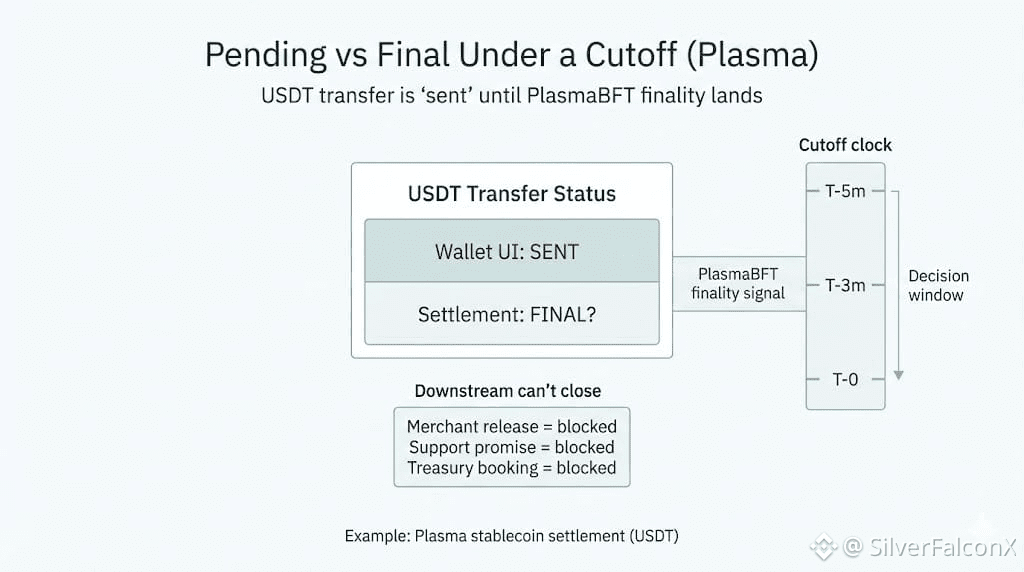
So teams adapt.
Not publicly. Not in docs.
They add soft rules. Refunds processed later in the day. Digital delivery delayed for higher-value baskets. Manual review if something feels off, even when the chain already says “confirmed.” The UI still looks clean. The checkout still feels instant. The adjustment lives behind the scenes.
This doesn’t contradict Plasma’s design. It sits above it.
PlasmaBFT can keep closing blocks. That’s not where the work is anymore. The work moved to the moment after, where mistakes are no longer hypothetical and recovery has a cost attached.
What changes first isn’t trust in the chain. It’s tolerance for fixing things casually.
Support feels it when conversations get longer. Accounting feels it when refunds stop being symmetrical. Ops feels it when someone asks why a simple correction now needs approval.
None of this shows up in throughput charts.
It shows up in habits.
Teams stop promising flexibility they can’t afford at speed. They stop relying on ambiguity to smooth over small errors. They decide, quietly, how much human slack they can keep once the ledger has already moved on.
Plasma finishes fast.
The adjustment doesn’t.
And every merchant learns, sooner or later, that faster settlement doesn’t remove recovery work.
It just schedules it earlier. #plasma