
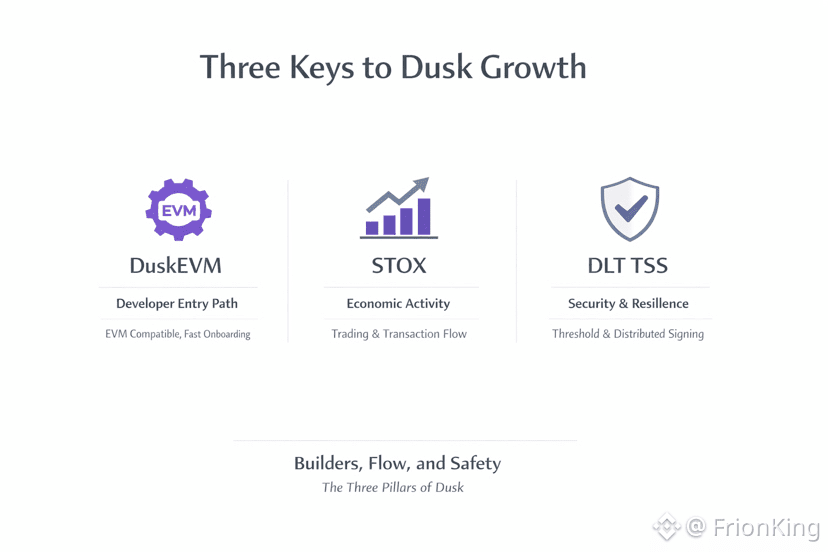
I have been through enough cycles to know this, sustainable growth in crypto does not come from one hype spike, it comes from three very practical things, a clear entry path for developers, a product that creates real transaction flow, and an operational security layer that does not burn the system down when pressure rises. Dusk was founded in 2018, and when they frame their three growth keys as DuskEVM, STOX, and DLT TSS, I read it as a plan to move beyond growth by slogans. Are you looking for an ecosystem that grows on real demand, or one that grows on noise.
DuskEVM, to me, is the entry path. This market has already proven that EVM is the common standard, developers are not short on ideas, they are short on time and certainty. A chain can be technically strong and still fail because it asks builders to relearn everything. That is friction, not quality. If DuskEVM is done well, it brings Dusk closer to the application flow, lowers onboarding time, lowers switching costs, and opens the door for teams already fluent in EVM tooling to ship and iterate fast. Have you ever seen a solid ecosystem stay empty simply because developers felt it was too annoying to build there.
But I will be blunt, having EVM support does not automatically create growth. A lot of EVM chains exist and still sit quiet, because they lack the most important ingredient, a place where economic activity happens consistently. STOX, even as a codename, is the part I watch because it suggests Dusk wants a market style product, a trading venue, or something similar, where volume shows up, users return, and the network gets used daily. Crypto only becomes real when there is flow, when transactions happen, when people need the network instead of talking about it. Do you feel the difference between an ecosystem with activity, and an ecosystem that lives mostly in PR posts.
Then there is DLT TSS, the unsexy piece that decides whether you survive after one serious incident. I have watched projects die not because the product was bad, but because key management and operations were amateur, one single point of failure, one compromised key, one bad signing event, and trust disappears overnight. TSS, viewed as threshold or distributed signing, is a way to reduce centralized risk, improve organizational readiness, and make the system feel closer to institutional workflows. If Dusk wants to touch RegDeFi or finance adjacent use cases, DLT TSS is how they speak the language of risk control, signing governance, process, and accountability. Would you trust a large trading platform if its key governance still looked like a small project.
What I respect is that these three pieces are not isolated. DuskEVM attracts builders and apps, STOX creates economic pull, and DLT TSS provides the safety layer to carry load and stress. Without DuskEVM, you lack builders. Without STOX, you lack flow. Without DLT TSS, you lack survivability when things get tight. This market punishes systems that grow fast but operate weakly, because one bad season will test them with real failures, not theories.
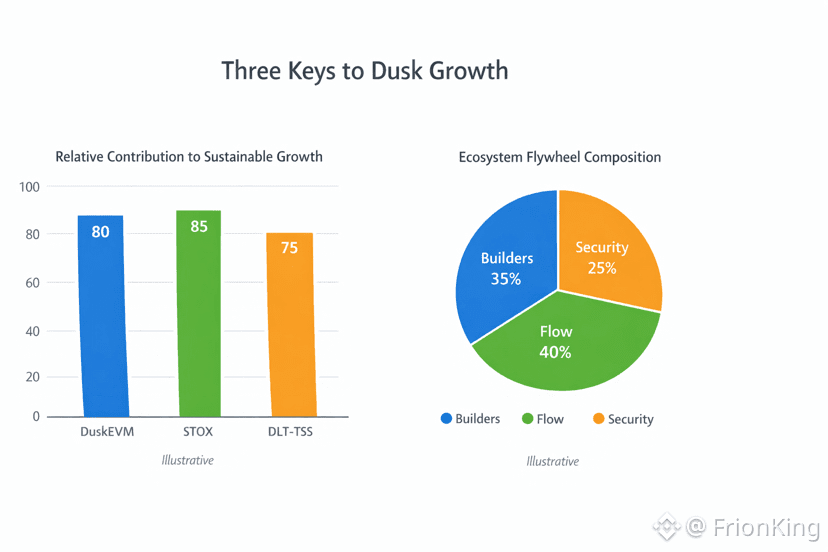
So I see Dusk’s three keys as three questions they are answering. How do we meet mainstream developers where they already are, how do we ship a product that generates flow, and how do we operate at a standard that can stand in a finance context. And you, are you choosing a project because the story sounds good, or because it is assembling the right parts to grow across multiple cycles. I tend to judge structure, because structure is what decides who is still standing when the market turns.
