
🦭 Walrus: How a Web3 Sea Mammal Is Reinventing Data Storage
When we talk about crypto projects, most people imagine tokens, coins, or complex blockchains doing something “out there.” But once in a while, a project shows up with a clear, simple mission that actually solves a real problem. Walrus is one of those.
It’s not just another coin or smart contract platform. Walrus is a decentralized storage network that aims to make storing and delivering data — like images, videos, or PDFs — faster, cheaper, and censorship-resistant.
Let’s break it down in simple words and see why Walrus is making waves in the Web3 world.
📦 What Is Walrus?
Imagine uploading a video to YouTube or saving files on Dropbox — but instead of relying on big companies like Google or Amazon to store your data, you rely on a decentralized network that no one controls.
That’s exactly what Walrus offers.
Walrus is a high-performance decentralized network for storing raw data and media files in a secure, efficient, and accessible way. The project is focused on making data storage in Web3 truly permissionless, while offering speeds and reliability close to centralized platforms.
Its main mission? To keep your data available and safe — without trusting a single authority.
🧠 Who’s Behind Walrus?
Walrus was originally developed by Mysten Labs, the creators of the Sui blockchain. That’s right — the same team that’s building some of the most advanced infrastructure in the crypto space today.
This isn’t some unknown startup. Mysten Labs is backed by some of the biggest names in crypto and tech, and they’ve built Walrus as a key piece of the Sui ecosystem, offering a decentralized backbone for storing and retrieving content-rich data.
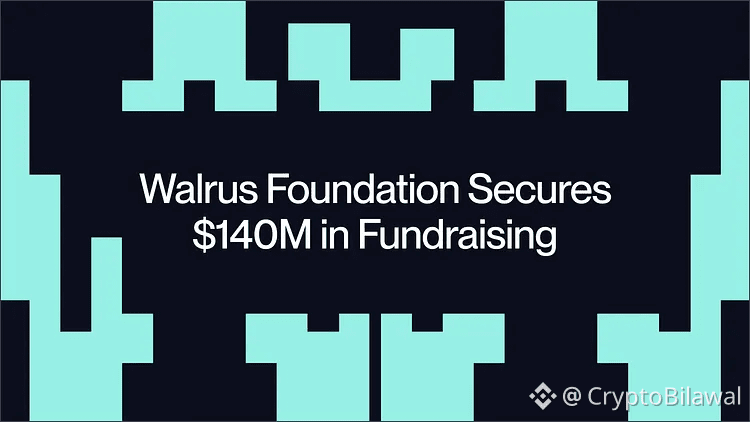
In March 2025, the project raised a whopping $140 million in a token sale from investors like a16z, Lightspeed Faction, Coinbase Ventures, and many others — proving there’s serious belief in the project
🚀 Is Walrus Live?
Yes! And that’s a big deal.
Unlike many crypto projects that stay in “coming soon” mode forever, Walrus is launching its mainnet on March 27, 2025. That means it’s not just an idea — it’s real infrastructure that people will start using right away.
With the mainnet launch, Walrus becomes a live, working network — ready for developers, storage providers, and users.
⚙️ How Does It Work?
Walrus is powered by a network of different types of nodes, each doing a specific job:
🔹 Storage Nodes
These are the backbone. They actually store the raw data — videos, images, documents. Anyone can run a storage node and earn rewards for contributing space and band
💡 How Is It Different From Other Projects?
You may have heard of similar projects, like:
Filecoin — great for archival, long-term storage, but not ideal for fast, responsive access.
Arweave — focuses on permanent storage, but it can be expensive and rigid.
Celestia, EigenDA, Avail — they specialize in data availability, not actual media or file storage.
Walrus combines both worlds:
It stores actual raw data and media.
It provides verifiable data availability (DA) for other blockchains and rollups.
This makes it uniquely flexible — it can be used as a content storage solution or as an infrastructure layer for other blockchain pro
💰 Tokenomics: Meet $WAL
The Walrus network will be powered by the $WAL token, which plays several roles:
Payment for storage services.
Staking for node operators.
Governance — token holders can participate in decisions about the network.
This creates a decentralized economy where users and operators are incentivized to keep the network secure and performant.
🎯 Who Is It For?
Developers who want to build dApps that store files and media.
NFT and gaming projects that need scalable and fast media delivery.
Users who want censorship-resistant and reliable file storage.
Blockchain projects that need a flexible DA layer.
👥 What Has the Community Done?
Walrus has already engaged its early community through testnet activities, allowing user
🏁 Final Thoughts: Why Walrus Matters
Walrus is more than just another blockchain. It’s an infrastructure project solving one of the most fundamental problems in Web3 — where and how to store real data.
With a strong team, real funding, and a mainnet launch ready to go, Walrus is poised to become an essential layer of the decentralized internet.#WALRUS $WAL @Walrus 🦭/acc

