
Dusk is quietly constructing a robust governance and validator structure designed for financial-grade blockchain systems.
Beyond its focus on privacy and regulatory alignment, one of the most overlooked yet critical strengths of the Dusk Network lies in how it handles governance and network security. While many blockchain ecosystems prioritize fast decision-making, social influence, or token-holder dominance, Dusk takes a different route by shaping its validators and governance around a single core objective: functioning dependably as financial infrastructure where errors have tangible real-world impact.
At the center of this strategy is Dusk’s Proof-of-Stake consensus, intentionally built to emphasize stability over constant experimentation. Validators are not treated as short-term profit hunters, but as long-term operators with responsibilities similar to traditional financial infrastructure providers. This distinction is crucial, because regulated markets cannot operate under conditions of frequent rule changes, governance volatility, or attacks enabled by temporary capital concentration. Dusk mitigates these risks through stake alignment, strict uptime expectations, and built-in protocol protections.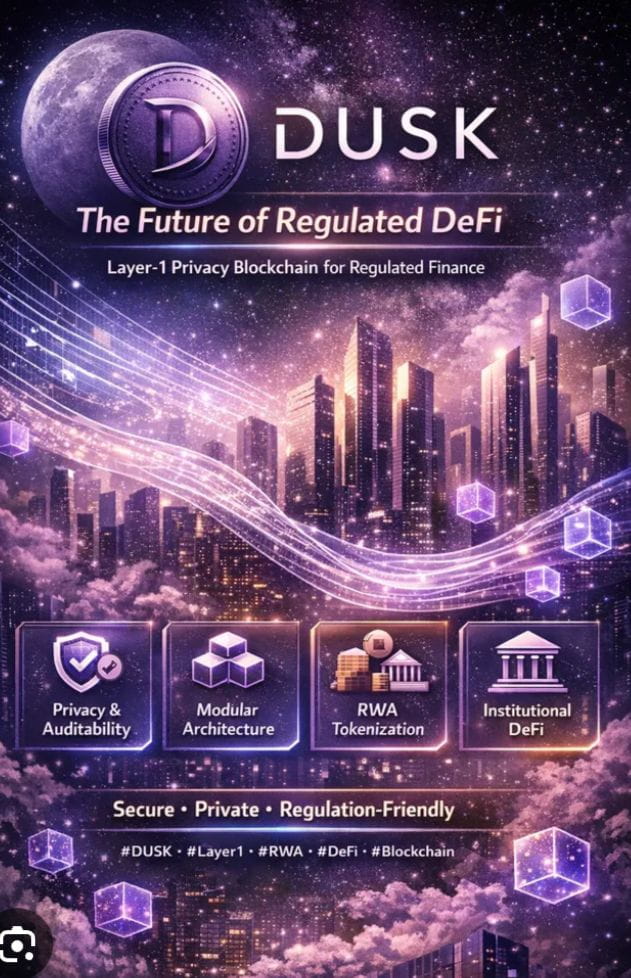
Governance within Dusk is deliberately conservative. Instead of routing every decision through broad token-holder voting, the network draws a clear boundary between core protocol stability and ecosystem-level innovation. Fundamental elements such as consensus mechanics, privacy assurances, and settlement logic are managed as critical infrastructure rather than subject to popularity contests. This approach reduces governance noise and minimizes impulsive changes driven by market emotion. For institutional observers, such restraint reflects operational maturity, not centralization.
Validator incentives are designed to reinforce this philosophy. Reward mechanisms prioritize consistent participation and honest operation over aggressive competition. The result is a validator set that remains smaller, more accountable, and technically capable, which is essential for a network managing sensitive financial transactions. A controlled validator environment also strengthens finality guarantees, a non-negotiable requirement for asset settlement and post-trade workflows.
Another key element is governance transparency without excessive exposure. While transaction-level data remains private, validator conduct and governance actions remain visible and auditable. This balance is intentional. Financial systems depend on confidentiality at the transaction layer, but require clarity at the control layer. By making governance verifiable without revealing sensitive activity, Dusk mirrors the supervisory standards of traditional financial markets.
This governance structure also enables a sustainable upgrade path. Rather than relying on disruptive hard forks or frequent parameter changes, Dusk favors gradual, rigorously tested protocol evolution. Updates are approached as infrastructure maintenance instead of innovation spectacle. For institutions, this provides confidence that integrations made today will continue to operate reliably years into the future.
Strategically, Dusk’s governance model aligns seamlessly with its broader mission. Privacy-focused finance cannot thrive on unstable foundations. Features like selective disclosure, compliant asset issuance, and institutional settlement depend on a network that remains composed under stress. By emphasizing governance discipline and validator accountability, Dusk addresses one of the most underestimated risks in blockchain adoption: governance breakdown.
As on-chain finance moves closer to regulated capital markets, governance will become a defining factor separating serious infrastructure from speculative platforms. Dusk’s model reflects an understanding that trust is built not through unrestricted participation, but through predictable rules, responsible operators, and minimal surprises. In this sense, governance is not a promotional feature, it is a core component of the product itself.
If Dusk succeeds in positioning itself as a settlement layer for regulated assets, its governance and validator framework may prove just as vital as its privacy technology. In financial systems, the capacity to evolve carefully and securely often outweighs the ability to move quickly, and Dusk appears to be building with that principle firmly at its core.
